
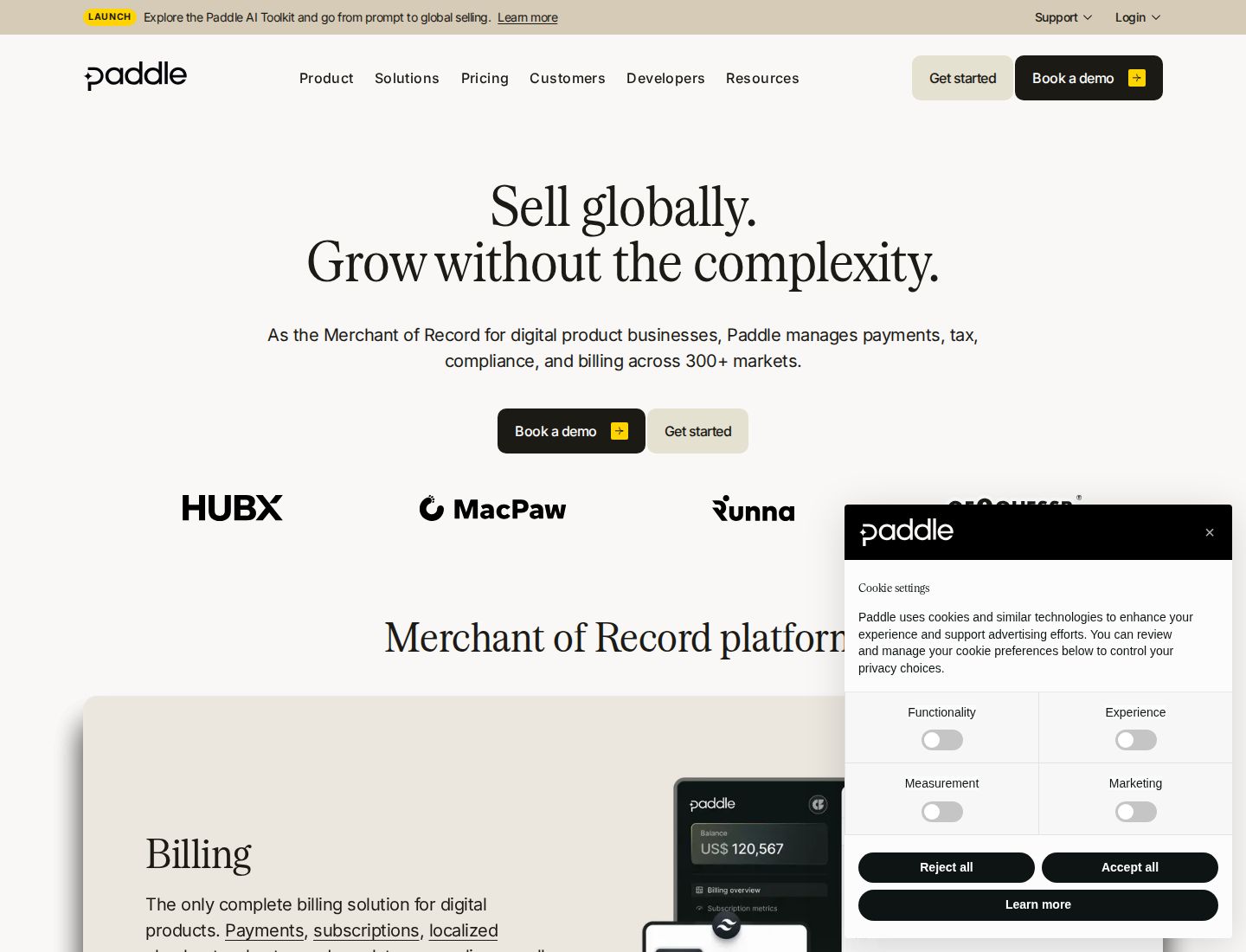
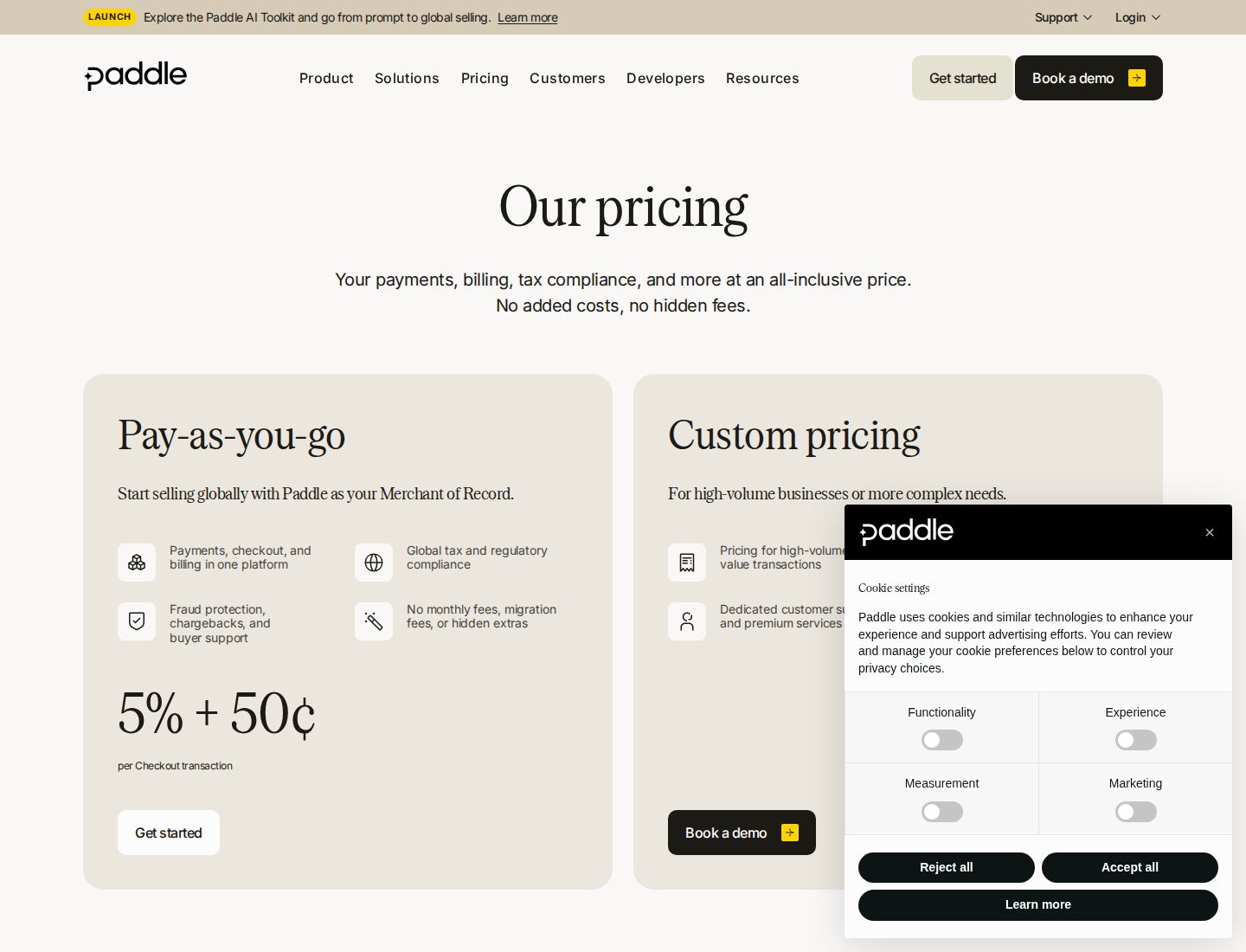
This Paddle review is about the difference between a payment processor and a merchant of record, because that difference is the entire product: Paddle takes 5% plus 50 cents per checkout and, in exchange, becomes the legal seller of your software so that VAT, sales tax and refunds are their problem rather than yours.
Prices are from Paddle's own pricing page, read 22 November 2026. No account was opened, so this is a research-based review with no score - the rule is in how we test.
What a merchant of record actually does
When you sell through Stripe or PayPal, you are the seller. You register for VAT in the EU, for sales tax in US states where you cross the economic nexus thresholds, you file, you remit, and you handle chargebacks. When you sell through Paddle, Paddle is the seller and you are a supplier to Paddle: one contract, one monthly payout, and a tax registration burden that belongs to someone with a tax department.
That is worth more than it sounds for a small software business. A European SaaS selling to consumers in twenty countries has twenty sets of VAT rules, and US economic nexus adds a moving threshold per state. Doing it yourself is possible - tools exist - but the cost is either an accountant or a weekend per quarter, and mistakes are expensive retroactively.
Pricing, in full
| Item | Paddle |
|---|---|
| Per checkout transaction | 5% + 50 cents |
| Monthly fee | none |
| Setup or migration fee | none, per the pricing page |
| Currencies and local payment methods | handled by Paddle as seller |
| Tax, invoicing, refunds | Paddle's responsibility |
Five percent plus fifty cents is roughly double a card processor's headline rate, and that comparison is misleading in both directions: it is more than Stripe charges for moving money, and less than Stripe plus a VAT filing service plus the hours you spend reconciling. For a 29 USD subscription the fee is about 1.95 USD; the equivalent DIY stack is 1.14 USD plus your admin.
Where the fee hurts is low-ticket products. On a 5 USD item, 5% plus 50 cents is 15% - the percentage is small and the fixed part is not. Paddle is built for software priced like software, not for a three-dollar template.
What you get beyond tax
The checkout is the visible part: a branded, locally priced page that shows the buyer their currency with tax included, which is what European consumers expect and what reduces abandoned carts. Behind it sit subscription billing with proration, dunning for failed cards, trial handling, licence keys, and a vendor dashboard with revenue by country.
Two details matter more than the feature list. Local payment methods - iDEAL, Bancontact, SEPA, Alipay and the rest - are the difference between a German buyer completing a purchase and leaving, and Paddle handles them because it is the seller. And chargeback handling: disputes arrive at Paddle, not at you, and Paddle's published claim is a measurable reduction in refunds because the buyer sees a familiar name on the statement.
Where it stops being the right choice
Physical goods. Paddle is for digital products and software. If you ship boxes, look elsewhere.
Very low prices. The 50 cent fixed component turns into double-digit percentages below about ten dollars.
Control over the customer relationship. Paddle is the seller of record, which means the merchant of record appears on the invoice and, in some flows, owns the payment relationship. You keep the customer data and the product, but if your business depends on being the named counterparty - enterprise procurement, for example - that is a real constraint, and procurement teams do ask.
Anyone who wants to be a payments company. If you are building a marketplace, splitting payments between sellers, or handling payouts to third parties, this is the wrong layer.
Speed of integration for a weekend project. The onboarding is a compliance process: company documents, a product review, sometimes a wait. Gumroad gets you selling in an afternoon; Paddle gets you selling compliantly in a week or two.
How it compares
| Fee | Who is the seller | Best for | |
|---|---|---|---|
| Paddle | 5% + 50c | Paddle | SaaS and software selling into many tax jurisdictions |
| Stripe | about 2.9% + 30c | you | developers who want control and will handle tax |
| Gumroad | 10% + 50c, 30% via marketplace | Gumroad | creators selling small digital products fast |
| PayPal | about 3.5% + fixed | you | buyer protection and familiarity |
The comparison that decides it is not Paddle against Stripe on rate. It is Paddle against Stripe plus a tax service plus your time, and whether the difference lands above or below five percent for your volume.
Who should buy it
A SaaS or software product selling B2C or SMB across borders. This is the case Paddle was built for, and the fee is the cost of never thinking about VAT again.
A small team without finance staff. One payout, one invoice from Paddle, one set of books.
A product with a free trial and subscription billing. Trials, proration, dunning and licence keys are included rather than assembled.
Who should not
Anyone selling physical goods, anyone whose average order is under ten dollars, and anyone who needs to be the merchant of record for procurement reasons. Also anyone who has already built a clean Stripe plus tax-tool stack and is happy with it - switching costs money in migration time before it saves any.
Questions people ask
Is 5% + 50 cents the whole cost? It is the published checkout fee, with no monthly fee. Currency conversion and payout fees depend on your payout method and country, which is the line to check in the dashboard before signing.
Do I still need to register for VAT? As a supplier to Paddle you invoice Paddle, not the end customer. The registrations for selling to consumers sit with Paddle; your own local obligations as a company do not disappear.
Can I migrate from Stripe? Yes, and Paddle supports migration, but subscriptions with stored cards are the messy part - plan for a transition period where both run.
Does Paddle handle refunds? Yes, as the seller. That is part of what the fee buys, and the reason the refund statistics in their marketing are plausible.
Which countries? Broad coverage of major markets with local payment methods; check your top three markets specifically, because local methods decide conversion more than the fee does.
What we have not tested - and will
The integration was not built for this page, so the open questions are the ones that only appear in production:
- Real effective rate over a month of mixed subscriptions, refunds and chargebacks, compared with the 5% + 50c quote
- Payout timing and currency conversion cost from Paddle to a European bank account
- Checkout conversion with local payment methods against a plain card-only checkout, measured on the same traffic
- How dunning behaves on a failed subscription renewal
- The onboarding timeline, document by document, for an EU company
- Whether licence keys survive plan changes and refunds cleanly
- What the dashboards actually show a one-person company versus the sales demo
Bottom line
Paddle sells one thing: it takes the tax and compliance burden of selling digital products internationally and charges about two percentage points over a card processor for it. For a SaaS with cross-border consumer sales, that trade is usually correct and the fee is an operating cost, not a margin problem.
For cheap products, physical goods, or anyone who wants to own the payment relationship, it is the wrong layer - and the honest summary is that Paddle is not expensive, it is priced for a job most small sellers underestimate until their first VAT letter.
Every vendor link on this site is disclosed in the affiliate disclosure; a commission never changes a score. Our rules are in the editorial policy, and the rest of the reviews are in the review index.
Sources
All pages read on 22 November 2026:
- Paddle homepage: paddle.com - merchant of record positioning, tax, compliance and billing scope, refund claims
- Paddle pricing: paddle.com - 5% + 50 cents per checkout transaction, no monthly or migration fees, local payment methods







Reader reviews
Loading reader ratings...