
This CookieYes review is about the cheapest honest way to put a consent banner on a site and keep the evidence: free for small traffic, 10 USD a month for 100,000 pageviews, 25 for 300,000, with the banner, the cookie scanner and a consent log behind one subscription.
Prices are from cookieyes.com/pricing, read 24 November 2026, USD per month per domain. No account was created, so this is a research-based review with no score - the rule is in how we test.
What CookieYes is
A consent management platform for websites: a cookie banner that blocks scripts until permission is given, a scanner that finds what cookies your site actually sets, a policy generator, and a record of who consented to what. It exists because GDPR and its equivalents require informed consent before non-essential cookies are placed, and because most sites discovered their plugin load order matters only after a complaint.
The practical detail that separates a real CMP from a decorative banner is script blocking: a banner that says "we use cookies" while Google Analytics loads anyway is compliance theatre, and the regulator's view of it is not generous.
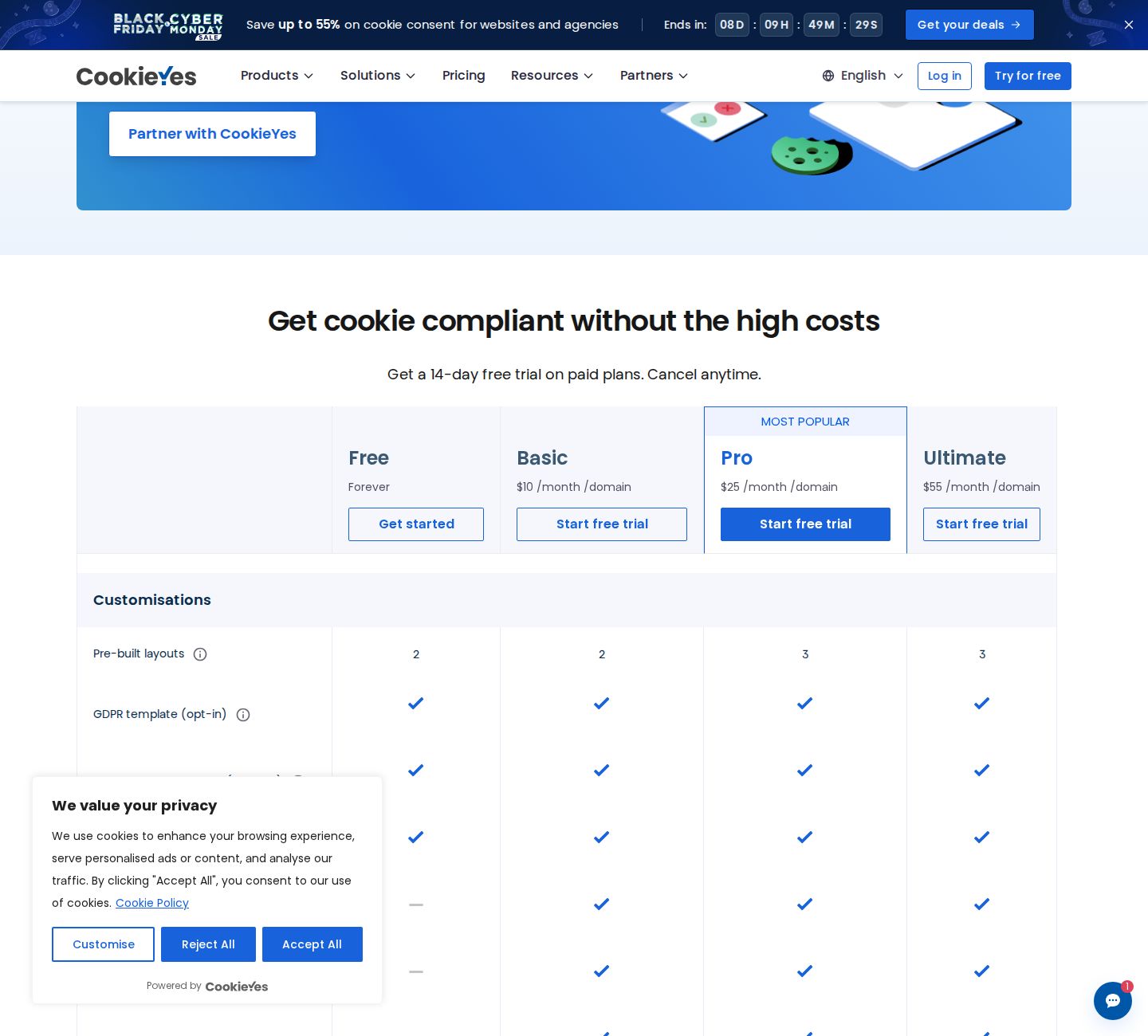
Pricing, precisely
| Plan | Price | Limits |
|---|---|---|
| Free | 0 | 100 pages scanned, 5,000 pageviews a month, basic customisation |
| Basic | 10 USD/mo per domain | 600 pages scanned, 100,000 pageviews |
| Pro | 25 USD/mo per domain | 4,000 pages scanned, 300,000 pageviews, geo-targeting |
| Higher tier | 55 USD/mo | larger scans and traffic |
Overage is 0.30 USD per additional 1,000 pageviews, which is cheap enough to ignore for a normal site and relevant for one with a viral month. The per-domain unit matters for an agency: five client sites are five subscriptions, not one.
The free tier is genuinely useful for a small site - 5,000 pageviews covers a brochure site or a blog - and the jump to 10 USD is small enough that most businesses do not need to think about it for long. The honest reading is that this is one of the few compliance subscriptions where the entry price is not a trap.
What it does well
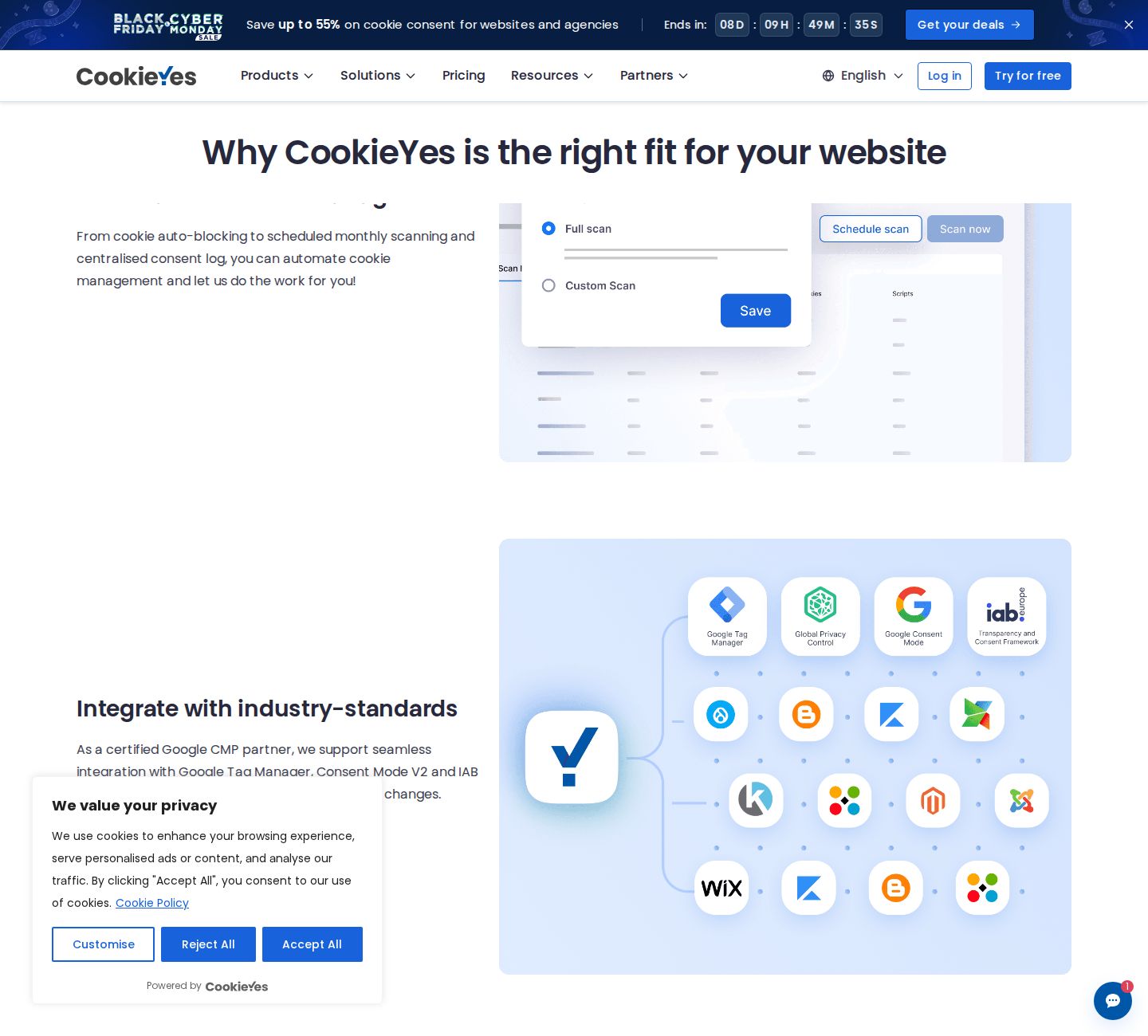
Scanner first, banner second. You run a scan, it lists the cookies your site sets and where they come from, and the banner is configured from that list. That order is what makes consent accurate rather than decorative.
Script blocking that works. Cookies are blocked until consent, including the tags added by other plugins, which is the part most DIY banners get wrong. Google Consent Mode support matters here: it lets Analytics and Ads behave correctly for users who decline without breaking the site.
Geo-targeting on Pro. A business with EU and US traffic can show the banner where consent is required and stay quiet where it is not - which is worth 15 USD a month against a banner that annoys every American visitor.
Consent logs. A record of who consented, when, and to what, with the banner version they saw. When a complaint arrives, this is the document that ends the conversation.
Where it fails
- Per-domain pricing is expensive for an agency with five or ten client sites.
- Pageview metering adds a variable to a compliance cost, which is not how anyone wants to budget compliance.
- The policy generator is a starting point, not legal advice; the text still needs to match how your business actually processes data.
- Banner design is limited on the lower tiers, and a badly designed banner costs conversions.
- Scan frequency is tiered, so a fast-changing site may sit with an out-of-date cookie list.
How it compares
| Free tier | Entry paid | Unit | Best at | |
|---|---|---|---|---|
| CookieYes | 5,000 pageviews | 10 USD/mo | per domain | cheap compliance with real blocking |
| iubenda | limited | about 5 EUR/mo | per site | policies plus consent in one |
| Termly | limited | about 15 USD/mo | per site | policies with a simple banner |
| No banner | 0 | 0 | - | nothing, and exposure |
The comparison with iubenda is the real decision: iubenda sells legal documents and consent together, CookieYes sells consent with a policy generator attached. A business that needs a privacy policy, terms and a cookie banner in one place tends toward iubenda; one that already has policies and needs a working banner tends toward CookieYes.
Who should buy it
A small business selling into the EU where a real consent banner is a legal requirement and a plugin-quality DIY attempt is a risk.
A site running Google Analytics and ads that needs Consent Mode handled properly rather than approximated.
A business with mixed EU and US traffic where geo-targeting on Pro stops showing a banner to people who do not need it.
Who should not
An agency with many client domains - per-domain pricing multiplies fast, and a white-label platform is the better structure. A business that needs a full legal document suite: iubenda sells that. And a site with no tracking cookies at all, where a banner is unnecessary and this is a solution to a problem you do not have.
Questions people ask
Does it actually block scripts before consent? Yes, that is the core feature; check that your tag manager and analytics are inside the blocked list after setup.
Is the free plan enough? For a small site under 5,000 pageviews a month, yes - the banner and the scanner work.
What happens when I exceed pageviews? Overage is 0.30 USD per 1,000 extra views, rather than a hard stop.
Can I use it on multiple sites? One subscription per domain, which is the cost to plan for if you run several.
Does it make my site compliant? It makes consent collectable and provable. Compliance also depends on your policies and what you actually do with data.
What we have not tested - and will
The checks that would produce a score, all needing an installation:
- Whether blocked scripts truly do not fire before consent, tested with a network log
- Google Consent Mode behaviour with analytics and ads after a decline
- Banner impact on conversion rate, measured against a cookie-less period
- Geo-targeting accuracy for an EU visitor behind a VPN
- Consent log completeness after a policy change mid-month
- Pageview counting against our own analytics, to see what the meter really measures
- Scan completeness for a site with a tag manager and three third-party scripts
Bottom line
CookieYes is the cheapest credible consent platform: free under 5,000 pageviews, 10 USD a month for a real site, 25 for one with geo-targeting, all per domain. It does the thing that matters - blocking scripts until consent - and keeps the evidence.
Buy it if you sell into the EU and your banner is currently decorative. If you also need policies and terms, iubenda bundles those; if you are an agency, budget per domain before committing to the model.
Every vendor link on this site is disclosed in the affiliate disclosure; a commission never changes a score. Our rules are in the editorial policy, and the rest of the reviews are in the review index.
One practical note before installing: list every third-party script on the site first - analytics, pixels, chat, fonts - and check after setup that each one is inside the blocked list and appears in the consent categories. A banner that covers analytics but misses the marketing pixel is the most common failure, and it is invisible until someone audits you.
A last note on policy text: the generator produces a document that describes the cookies it found, and it cannot know what your business does with data elsewhere - CRM, invoicing, email marketing. The banner is a technical control; the policy is a description of processing, and only you can write that accurately.
Sources
All pages read on 24 November 2026:
- CookieYes homepage: cookieyes.com - cookie banner, scanner, consent logs, Google Consent Mode support
- CookieYes pricing: cookieyes.com - Free with 100 pages scanned and 5,000 pageviews, Basic 10 USD per month per domain with 100,000 pageviews, Pro 25 USD with 300,000 and geo-targeting, higher tier 55 USD, overage 0.30 USD per 1,000 pageviews







Reader reviews
Loading reader ratings...