This LiveChat review is about the opposite end of the support market from a shared inbox: a chat product built to sell while the customer is on the page, priced per agent at 19 USD a month on the entry tier and 79 on the tier that includes the growth tooling. It is a revenue tool wearing a support tool's clothes, and that is not a criticism.
Prices are from livechat.com/pricing, read 23 November 2026, in USD with annual billing. No account was created, so this is a research-based review with no score - the rule is in how we test.
What LiveChat is
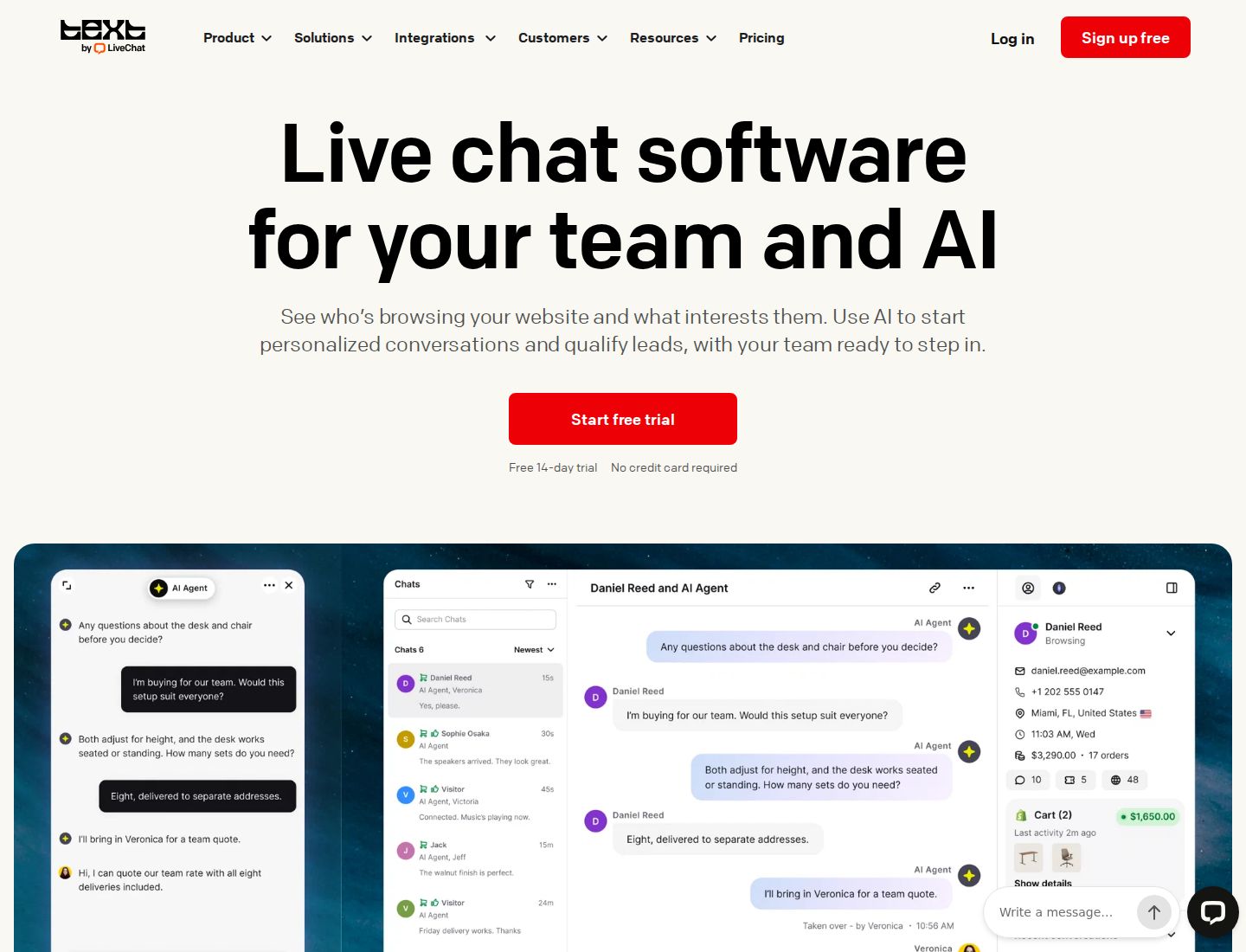
Live chat software with a strong secondary act: an e-commerce play. The widget sits on the site, an agent sees who is browsing, and the conversation can turn into a sale - product cards, discount codes and checkout links inside the chat window. The pitch on the homepage is explicit about this: chat that drives revenue, not only chat that answers questions.
The product comes from a family of tools - HelpDesk for ticketing, ChatBot for automation - which explains both the polish of the chat experience and the fact that you will be sold the other two eventually.
Pricing, precisely
| Plan | Price | Notable inclusions |
|---|---|---|
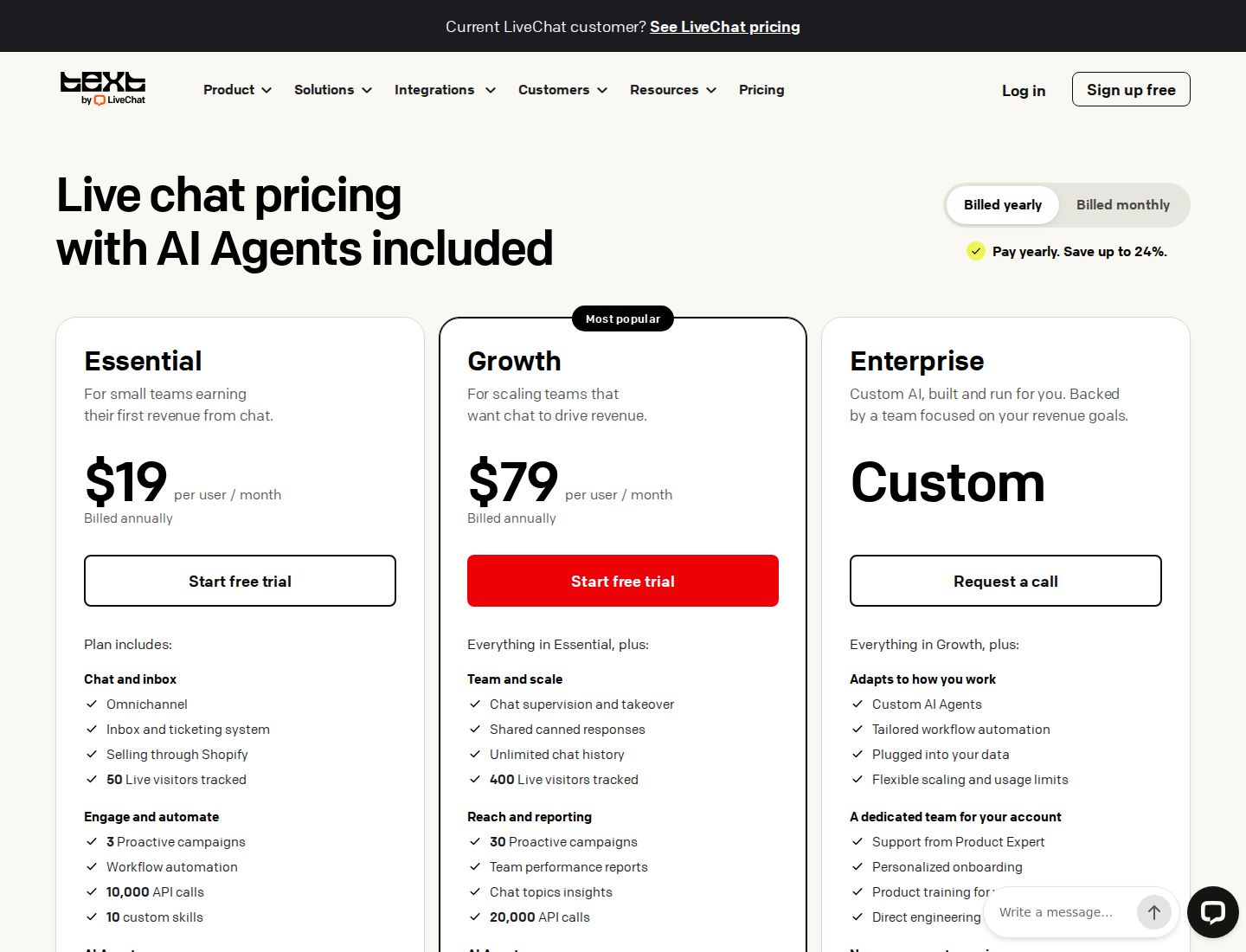
| Essential | 19 USD/user/mo | chat and inbox, omnichannel, Shopify selling, 50 tracked visitors, 3 proactive campaigns, 10,000 API calls |
| Growth | 79 USD/user/mo | the scaling tier: more visitors tracked, more campaigns, team performance reports |
| Enterprise | custom | dedicated team, custom AI, training |
Annual billing saves up to 24%, which is the difference between the 19 USD shown and a higher monthly rate - the number on the page assumes a yearly commitment, exactly as with most SaaS in this category.
The Essential tier is genuinely usable for a small shop: one agent answering pre-sale questions and a handful of automated greetings. The jump to Growth is steep - four times the price - and it buys reach rather than features you can evaluate in a trial, because the differences are visitor limits and campaign volume. That is the tier to defer until traffic justifies it.
The 50 tracked visitors on Essential deserves a note: "tracked" means the agent can see who is on the site, and on any real shop 50 is nothing. It is not a limit on conversations, it is a limit on the visibility that makes the product interesting, which is a subtle way to price the feature that sells it.
What it does well
The agent experience. The chat window is fast, the canned responses and shortcuts work the way they should, and the transfer between agents keeps the customer's context. Anyone who has used chat software that lags knows how much this matters: the tool cannot slow the reply.
Selling inside the chat. Product cards, checkout links and discount codes let an agent close a sale without sending the customer to an email thread. For a shop with considered purchases - furniture, equipment, anything where a question precedes the card details - this is the feature that pays for the subscription.
Proactive campaigns. A greeting after thirty seconds on the pricing page, a nudge on the cart page, an invitation after two visits. On Essential you get three campaigns, which is enough to test whether proactive chat helps at all.
Reporting that a manager can use. Conversations, response times, satisfaction and - on Growth - agent performance. It is not analytics, but it answers "is chat earning its keep".
Where it fails
- Per-agent pricing compounds. Three agents on Growth is 237 USD a month before the exchange rate; the same team on a workspace-priced tool is a fraction of that.
- The 50 tracked visitors on Essential limits the "see who is browsing" experience that the product sells hardest.
- Ticket management lives in a sister product. The moment support needs to become a queue with SLAs, you are buying HelpDesk too.
- Annual-billing display. The headline price assumes a year; monthly costs more, and the discount is the kind that hides a commitment.
- AI is bundled, not priced by usage - good for predictability, less good if you wanted to swap in your own assistant.
How it compares
| Entry price | Unit | Selling features | Free plan | |
|---|---|---|---|---|
| LiveChat | 19 USD/user/mo | seat | product cards, checkout, campaigns | trial only |
| Crisp | 45 EUR/workspace | workspace | order lookup, no checkout | yes, 2 seats |
| Help Scout | 25 USD/user/mo | seat | none | yes, 5 users |
| Tawk.to | free | agents | basic | free with paid add-ons |
The question is not which is cheaper per agent; it is whether chat is a cost centre or a sales channel. If an agent can close a 400 USD order in the chat window once a week, the per-seat price stops being the deciding number.
Who should buy it
A small e-commerce shop with one or two agents answering pre-sale questions and rescuing carts. Essential at 19 USD per agent is a fair price for that job, and the selling tools are the reason to pick it over a generic chat widget.
A service business that already gets chat traffic. In-home services, clinics, agencies: the proactive campaign after thirty seconds on a pricing page converts more than any email sequence.
A team that values the agent interface over the admin features. LiveChat is a pleasure to answer from; the inbox side is the weaker half.
Who should not
A written-support operation with long threads and SLAs - Help Scout is the better shape. A business with several brands and tight margins, where per-workspace pricing on Crisp is materially cheaper. And anyone whose main channel is WhatsApp or Instagram, where the family's ChatBot product is doing the real work and LiveChat is only the window.
Questions people ask
Is there a free plan? No - a free trial and a free sign-up, then per-agent pricing. The family's free option is elsewhere.
What does "50 tracked visitors" mean? The number of people on your site that agents can see and initiate with on Essential; conversations themselves are not capped by it.
Do I need HelpDesk as well? Only if support must become a ticket queue with SLAs. For chat plus light follow-up, LiveChat alone is enough.
Is the AI included? Yes, AI agents are bundled into the plans rather than sold as credits, which makes the monthly cost predictable.
How much is the annual discount? Up to 24%, depending on tier; the advertised 19 USD already assumes annual billing.
What we have not tested - and will
No widget was installed for this page. The measurements that would produce a score:
- Conversions from proactive campaigns against a control with no chat, on the same traffic
- Whether agents can genuinely handle three concurrent chats without quality loss
- Widget load time on a mobile connection, and its effect on LCP
- How the 50-visitor limit behaves on a busy day - queue, silence, or a prompt to upgrade
- Revenue attributed to chat on a shop with tracked checkout links
- Behaviour of the AI agent on refunds and delivery complaints, where a wrong answer is expensive
- Whether the annual discount survives a mid-term downgrade
Bottom line
LiveChat is the best chat product in this comparison and the most expensive way to staff a support inbox. At 19 USD per agent on Essential it is fair value for a shop that sells through conversation; the Growth tier at four times the price is where the arithmetic needs traffic to justify it.
Buy it if chat is a revenue channel. If chat is a convenience for existing customers, a workspace-priced tool or a free plan will cost a quarter as much for the same conversations.
Every vendor link on this site is disclosed in the affiliate disclosure; a commission never changes a score. Our rules are in the editorial policy, and the rest of the reviews are in the review index.
Sources
All pages read on 23 November 2026:
- LiveChat homepage: livechat.com - chat as a revenue channel, product cards, proactive campaigns, AI agents included
- LiveChat pricing: livechat.com - Essential 19 USD per user per month billed annually, Growth 79 USD, Enterprise custom, annual saving up to 24%, 50 tracked visitors on Essential







Reader reviews
Loading reader ratings...