
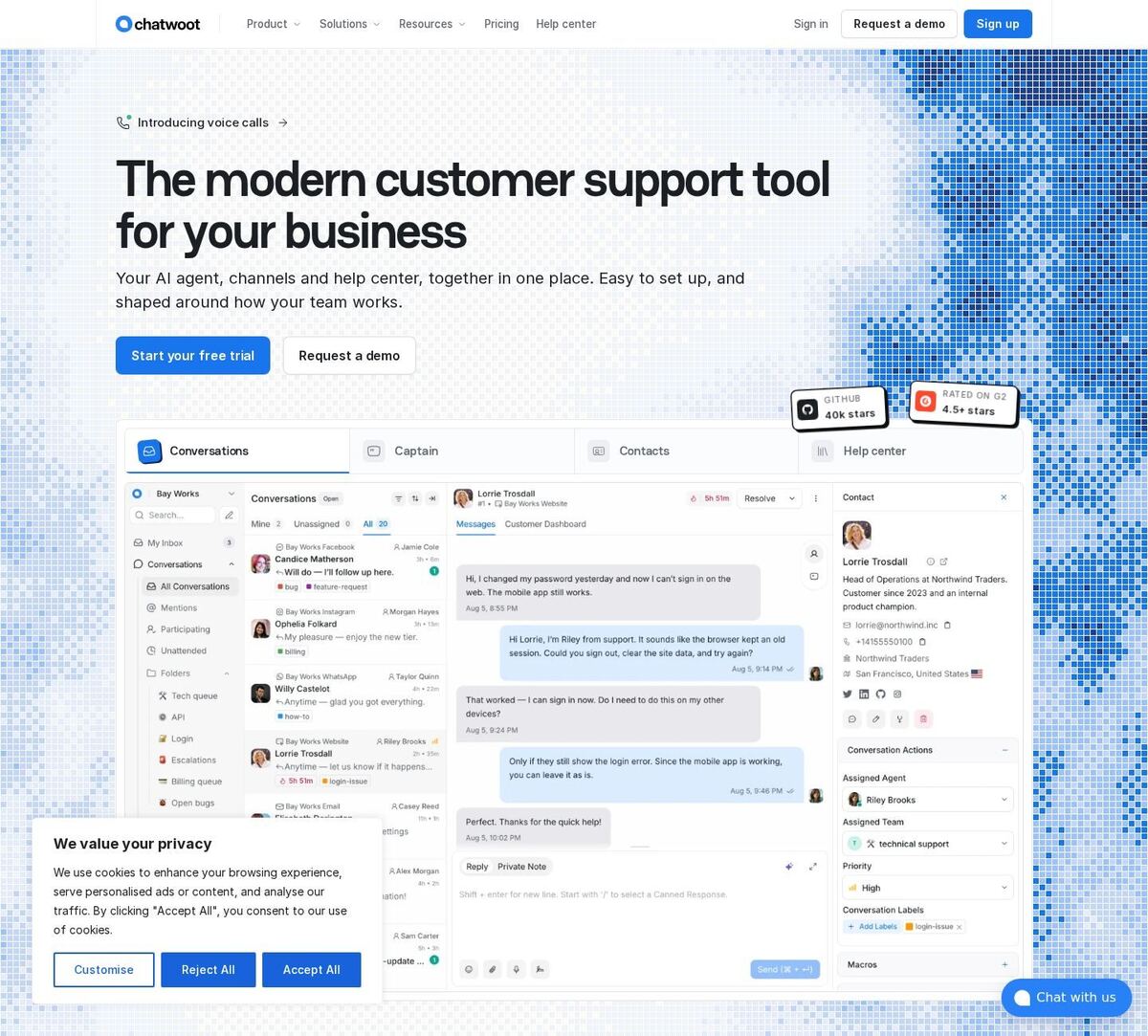
This Chatwoot review is about the open-source alternative in a category full of per-agent pricing: free to self-host, 19 USD per agent on the cloud entry plan, and a product that a developer can keep running for the price of a small server.
Prices are from chatwoot.com/pricing, read 24 November 2026, USD per agent per month. No account was created, so this is a research-based review with no score - the rule is in how we test.
What Chatwoot is
A customer engagement platform - shared inbox, live chat, and messaging across email, website, WhatsApp, Facebook and others - with an open-source codebase that can be self-hosted. The vendor runs a cloud service for people who do not want to, and publishes a self-hosted option for those who do.
The product covers what a small support team needs: conversations with assignment and status, canned responses, labels, a help centre, automation and reporting. It does not have the depth of Zendesk or the polish of Crisp, and it does have something neither offers: the ability to stop paying and keep the software.
Pricing, precisely
| Plan | Price | Limits |
|---|---|---|
| Hacker | 0 USD/agent | up to 2 agents, cloud |
| Startups | 19 USD/agent/mo | the small team tier |
| Business | 39 USD/agent/mo | more automation and reporting |
| Enterprise | 99 USD/agent/mo | advanced controls |
| Self-hosted | 0 in licence fees | your server, your data |
The free cloud tier for two agents is a real, permanent offer, and the self-hosted edition is free software - which makes Chatwoot the only product in this comparison where a three-person business can run support without a subscription, provided someone can maintain a server.
The honest arithmetic for a cloud buyer is 19 USD per agent against Crisp's 45 EUR per workspace: three agents cost 57 USD on Chatwoot and 45 EUR on Crisp, so the workspace model still wins at small sizes. Chatwoot's advantage appears at five or more agents, or when self-hosting removes the bill entirely.
What it does well
One inbox across channels. Website chat, email and messaging arrive in the same list with a unified customer profile, which is what a small team actually needs and what a chat widget alone cannot do.
Self-hosting that is real. Docker deployment, documented upgrades, and the same features as the cloud for most of the product. A business with a developer and a compliance requirement can keep every conversation on its own infrastructure.
Automation without a consultant. Assignment rules, canned responses, labels and simple automation are configurable in an afternoon, and the help centre covers the repetitive questions.
The price floor. Two agents free on cloud, and nothing at all if you self-host - a structure no per-agent competitor matches.
Where it fails
- Rough edges. The interface is functional rather than refined, and some screens lag behind the commercial products.
- Mobile apps are weaker than the browser experience, which matters for a small team answering on the move.
- Reporting is basic compared with a helpdesk, and analytics are the first place the open-source model shows.
- Self-hosting is a commitment - upgrades, backups, monitoring and a mail server for inbound email, all your responsibility.
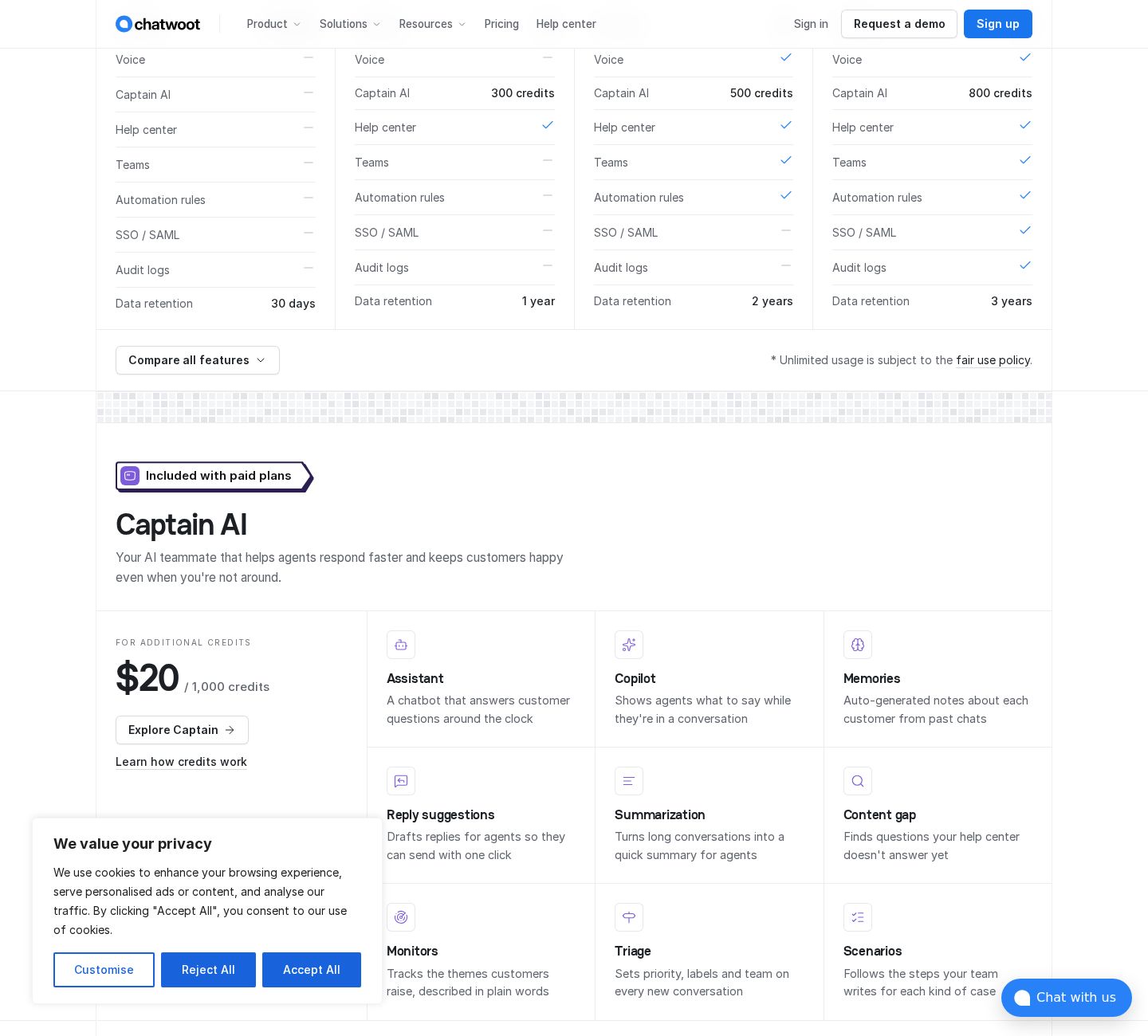
- Advanced features sit on higher tiers (39 and 99 USD), so the cloud price is not always 19.
How it compares
| Free tier | Entry paid | Self-host | Best at | |
|---|---|---|---|---|
| Chatwoot | 2 agents on cloud, free self-host | 19 USD/agent | yes | open-source ownership |
| Crisp | 2 seats | 45 EUR/workspace | no | polish for small teams |
| Zendesk | none | 19 EUR/agent (email only) | no | depth and routing |
| Tawk.to | unlimited agents | 29 USD/mo to remove branding | no | free chat with monitoring |
The comparison that matters is Chatwoot against Crisp at three to five agents: Crisp is a fixed 45 EUR for four seats and a cleaner product, Chatwoot is 76 USD for four on cloud but free if you host it. The decision is who maintains the server.
Who should buy it
A developer-led business that wants support data on its own server. Self-hosted Chatwoot is the only credible open-source option in this category.
A team of five or more agents. At that size per-agent cloud pricing still wins over a workspace plan, and Chatwoot's 19 USD is the cheapest per-agent rate here.
A startup that wants to start free. Two agents on cloud at zero cost, with a migration path to self-hosting instead of a price rise.
Who should not
A business with no technical help - self-hosting is a dependency, and the cloud plan is not the cheapest at small sizes. A team that needs polished mobile apps and reporting depth. And anyone whose support depends on AI responses, where the commercial tools are ahead.
Questions people ask
Is the free cloud plan permanent? Yes, for up to two agents - it is a tier, not a trial.
What does self-hosting cost? The licence is free; expect a 5 to 20 USD VPS, plus backups and someone who can upgrade it.
Do I need a separate mail server? For inbound email, yes - the documentation covers SMTP and IMAP configuration, and it is the fiddliest part of a self-hosted install.
Does it handle WhatsApp? Yes, through the official API with a business account, on cloud and self-hosted.
Can I migrate from another tool? There are importers for common formats and an API; conversations with attachments are the part to check.
What we have not tested - and will
The checks that would produce a score, all needing a deployment:
- Self-hosted install on a 5 USD VPS: time to first conversation, and memory under a week of traffic
- Upgrade path across two major versions, where self-hosted projects usually hurt
- Whether the help centre deflects questions as well as a dedicated knowledge base
- Report accuracy on response and resolution times with three agents
- WhatsApp integration reliability over a month
- Mobile app experience for answering between meetings
- Migration of a Crisp or Help Scout history, including attachments
Bottom line
Chatwoot is the open-source answer to per-agent support pricing: two agents free on cloud, 19 USD per agent after that, and free software if you run it yourself. The product is capable and unpolished, and self-hosting is a genuine commitment.
For a technical team it is the best value in support. For everyone else, Crisp at 45 EUR per workspace is cheaper at small sizes and much easier to live with - and the honest advice is to choose based on who maintains the server, not on the licence.
Every vendor link on this site is disclosed in the affiliate disclosure; a commission never changes a score. Our rules are in the editorial policy, and the rest of the reviews are in the review index.
One note on the self-hosting decision
The pattern is the same as with Umami in analytics and n8n in automation: free software is cheaper in money and more expensive in attention, and the trade only works if somebody owns it. Ask the question before installing - who upgrades it, who is paged when it stops, and where the backups live. If the answer is nobody, buy the cloud plan and let the vendor worry.
How to evaluate it in a week
Start on the free cloud tier with two agents and real conversations, then deploy the self-hosted edition in parallel for a weekend to see whether the maintenance is something you would accept. The comparison between those two weeks is the decision, and it costs nothing but attention.
One more practical point: the cloud and self-hosted editions share the same codebase, so a business can start on the cloud at 19 USD per agent and move to its own server later without a migration project - rare in this category and the single most useful thing about choosing Chatwoot early.
Sources
All pages read on 24 November 2026:
- Chatwoot homepage: chatwoot.com - shared inbox, live chat, omnichannel messaging, open-source edition
- Chatwoot pricing: chatwoot.com - Hacker free for up to 2 agents, Startups 19 USD per agent, Business 39 USD, Enterprise 99 USD, self-hosted at no licence cost







Reader reviews
Loading reader ratings...