
n8n is the automation platform that developers recommend to each other, and the reason is a licence rather than a feature. This n8n review is about what self-hosting really costs, when the cloud is worth 20 EUR, and where the tool stops being the right answer.
What n8n is
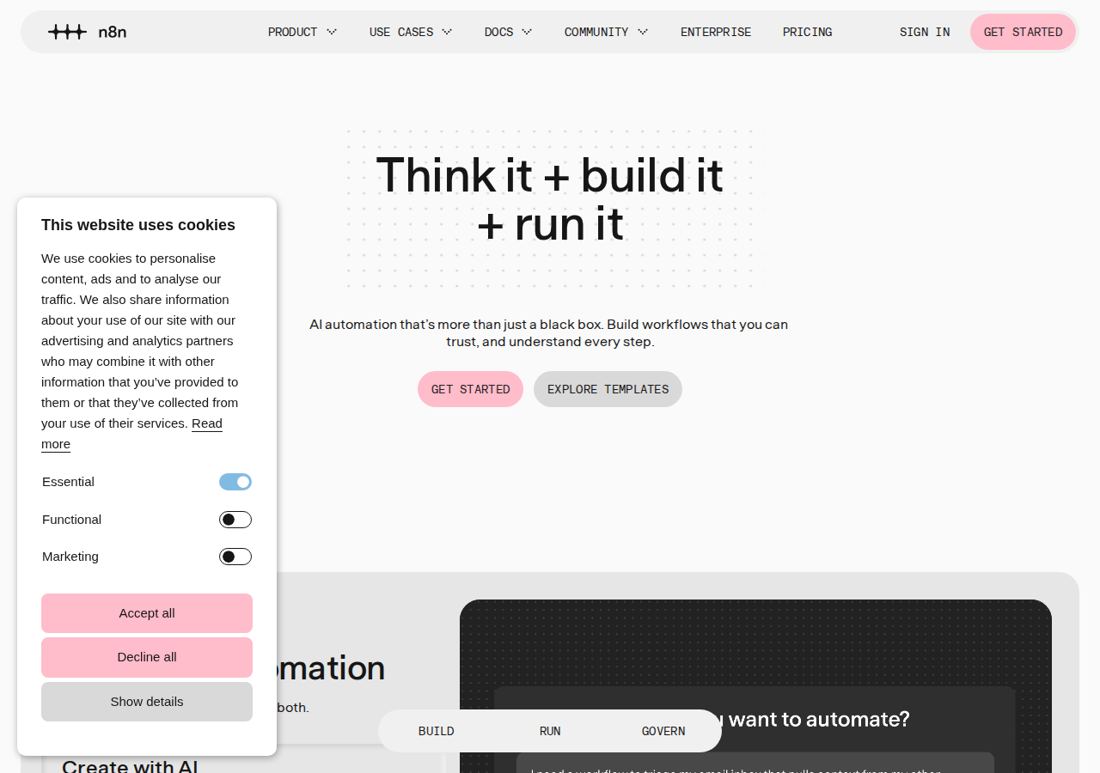
A workflow automation platform with a visual editor and code escape hatches. You build on a canvas: trigger, nodes, branches, and a Code node that runs JavaScript or Python when an integration does not do what you need. It ships with more than a thousand nodes, AI agent and MCP nodes, sub-workflows and error workflows, and it can be self-hosted on Docker in about fifteen minutes.
The licence is fair-code: source available, free for internal use, restricted for resale. That distinction matters if you plan to build a product on top of it.
What you see before you sign up
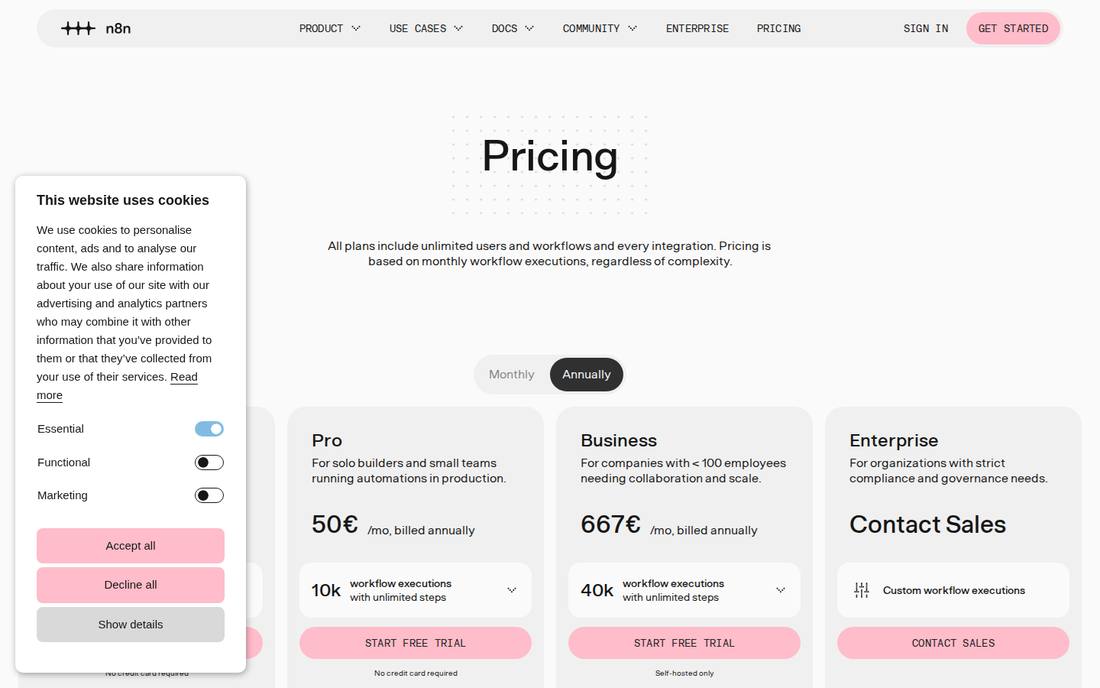
The pricing page is unusually honest about the split: self-hosted free, cloud from 20 EUR, enterprise on request. It states executions rather than tasks, and steps inside an execution are unlimited, which is the structural advantage over Zapier - a twenty-step workflow costs the same as a two-step one.
We are not enrolled in n8n's affiliate programme, although the programme exists publicly; the affiliate disclosure explains how that is marked when it changes.
Self-hosting, costed honestly
A small VPS runs n8n for 5 to 20 EUR a month. Add backups, monitoring and someone who knows what to do when a container restarts badly, and the real cost is an afternoon a month plus the risk of forgetting it. For a developer that is nothing; for a business owner it is a dependency they did not plan for.
The cloud at 20 EUR removes the server work and caps executions at 2,500 a month, which is either plenty or nowhere near, depending on whether you process forms or orders.
Where it fails
- You inherit the operations. Self-hosting means upgrades break, disks fill and backups are your job.
- The editor has a learning curve. Loops and merges are concepts, not buttons; a non-technical user will build something that runs and produces wrong data.
- The fair-code licence is not open source. Fine for internal automation, awkward if you intended to resell.
- Cloud execution counting is strict. An execution is one trigger firing, whether it moves one record or a hundred.
- Community templates vary in quality. Many are outdated and need the credentials and field names repaired before they run.
Who it is for, and who should skip it
It fits developers and technical founders, agencies that host automation for clients, and anyone with a server and a workflow that Zapier would price out. It fits data work where a Code node is the difference between possible and not.
Skip it if you will not maintain a server, or if nobody on the team is comfortable debugging a container. Skip it if the automation is three simple Zaps - Zapier's setup time is lower and the difference in price is small at that volume. And skip the cloud if your volume is high; self-hosting is the point.
How it compares with the other three
Against Zapier, the trade is price and control against maintenance: n8n self-hosted is unlimited and free, Zapier is maintained for you at 19.99 a month for 750 tasks. Against Activepieces, both self-host, and the difference is maturity of the node library and the AI agent features. Against Pipedream, n8n is the visual product and Pipedream the code-first one, priced per usage.
The category is compared on /category/ai-automation, and the test procedure behind a future score is in how we test.
The 14,000-workflow library
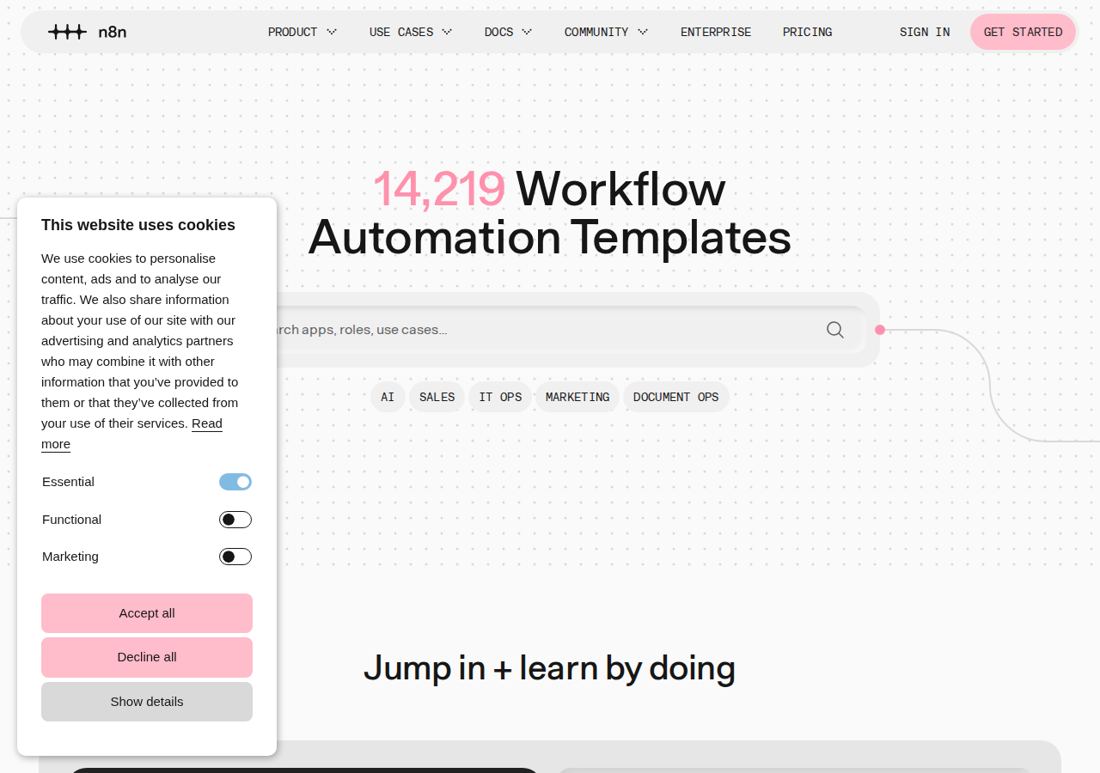
The community library is the most underrated feature. Searching for your app plus "workflow" usually returns five to fifty candidate automations, and importing one gives you a working skeleton - credentials, field mapping and error paths still need fixing, but the structure is free. That library is why n8n feels faster than its editor suggests.
A realistic self-hosted setup
A 4 GB VPS, Docker Compose with PostgreSQL, a reverse proxy for HTTPS, and a nightly database dump to object storage. That is an evening of work and covers the failure modes that matter. The two mistakes are running SQLite in production and forgetting to pin the image version - both produce a broken upgrade at the worst moment.
Add uptime monitoring that hits the webhook endpoint, not the editor URL. A workflow can be broken while the interface answers fine, and the interface is what everyone checks first.
What the AI nodes change
The agent nodes let a workflow call a model, use tools and return structured output, which turns n8n from an integration tool into something closer to an application platform. The honest caveat is cost: every agent run spends tokens, and an automation that loops over a thousand rows with a model inside can cost more than the automation saves.
Who ends up staying
Developers stay because the licence and the Code node give them an exit from every limitation. Agencies stay because they can host ten client automations on one server. Business owners stay only if they have someone technical, and the ones who do not usually return to Zapier within a year - which is the correct outcome, not a failure.
What we have not tested - and will
Research-based review: public pages plus our own captures, no deployment. Open questions:
- Time from a bare VPS to a working workflow with credentials
- Executions consumed by a daily order-sync over a month
- Whether the AI agent nodes produce usable structured output without tuning
- Upgrade behaviour across two minor releases
- How many of the top-listed templates actually run without repairs
Bottom line
n8n is the best value in this category for anyone who can run a server, and the wrong product for anyone who cannot. The licence is generous, the execution model is honest, and the library shortens the first build.
Start self-hosted on a cheap VPS. If you find yourself dreading the maintenance, pay the 20 EUR for cloud - that is exactly the trade the product is designed around, and it is a fair one.
Sources
- n8n.io/pricing/ - cloud tiers, executions and annual pricing, read 13 November 2026
- n8n.io/features/ - editor, code nodes, AI nodes and sub-workflows, read 13 November 2026
- n8n.io/workflows/ - community template library, 14,219 workflows, read 13 November 2026
The licence, in plain language
Fair-code means the source is visible and you can run it internally for free, modify it, and host it for your own organisation. You cannot take it, rebrand it and sell automation as a service without a commercial agreement. For a business automating its own work, none of that matters; for an agency planning to resell, read the terms before building a product on it.
Execution counting compared
An execution is one trigger firing. A workflow that processes 500 rows from a single webhook call is one execution; the same work in Zapier would be 500 tasks. That difference is why people migrate at volume, and why the cloud's 2,500 executions is more generous than the headline suggests for batch work.
A note on the AI assistant credits
Cloud plans include assistant credits, which generate or repair workflows from a prompt. They are useful for a first draft and unreliable for anything with credentials or unusual data shapes. Treat the output as a sketch: it saves the boilerplate and never saves the testing.
Who should choose cloud over self-hosting
Three cases. You have no server and no desire to learn Docker. You need someone else to answer when a workflow stops at 3 a.m. You are building a client-facing automation where uptime is part of the promise. In those cases 20 EUR is cheap, and the execution cap is the only constraint worth pricing.
Everyone else should self-host, keep a database backup, and spend the 20 EUR on a better VPS.
One closing note: export your workflows as JSON once a month. They are portable, they restore in minutes, and they turn a server failure from a crisis into an afternoon.
And keep a second person with access to the server, even if they never log in. Bus factor applies to automation as much as to code.





Reader reviews
Loading reader ratings...