
Activepieces is the automation tool that answers the question "can I just host this myself" with a yes rather than a licence footnote. This activepieces review is about what MIT licensing actually buys, whether 280 integrations is enough, and where flat pricing stops being the advantage.
What Activepieces is
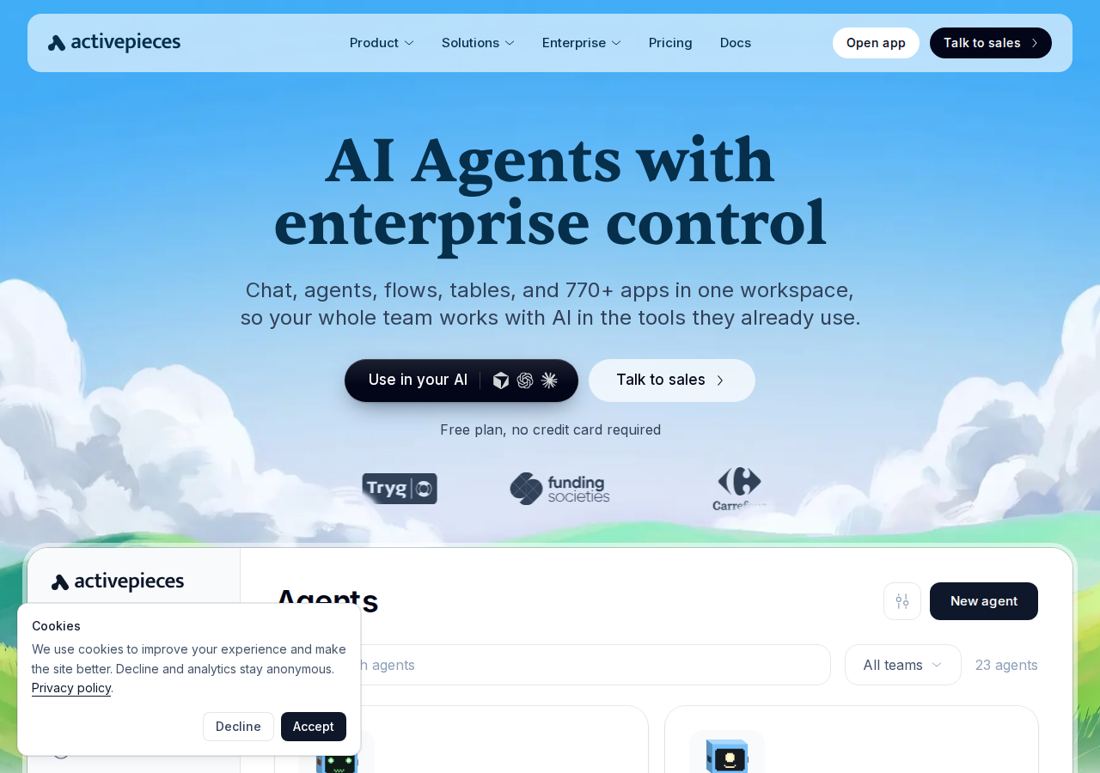
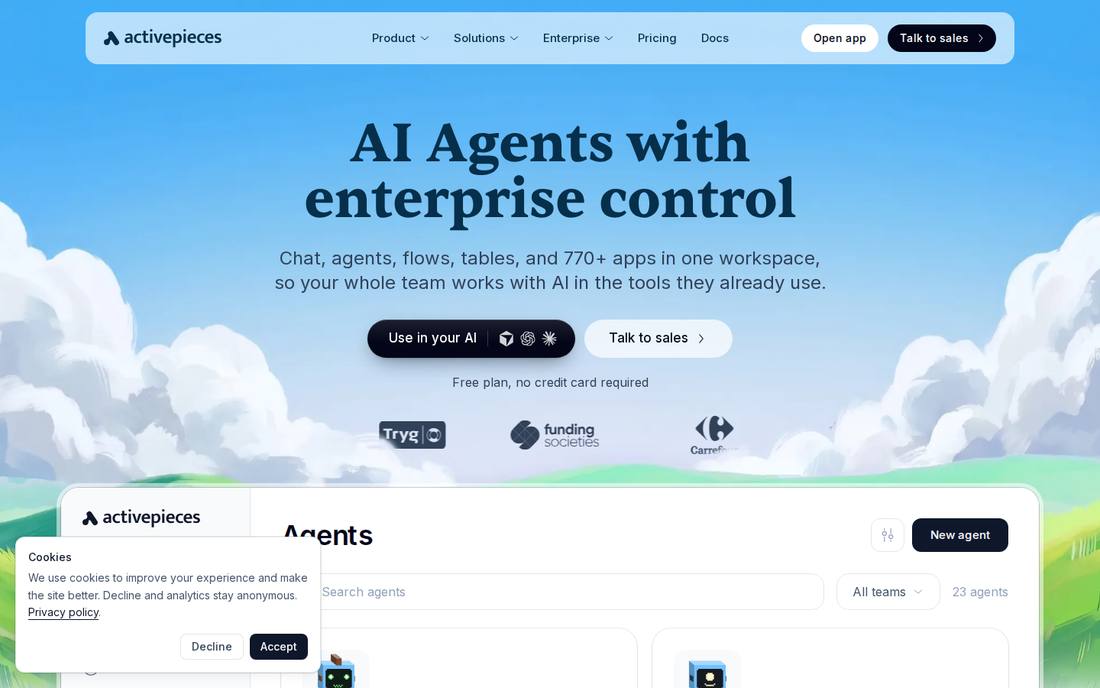
An open-source workflow automation platform. Flows are built on a visual canvas with triggers, actions, branches and loops, and the integrations - called pieces - are npm packages written in TypeScript. Around the flows sit an AI agent builder with tools and knowledge bases, team workspaces, and a Docker image you can run anywhere.
The MIT licence is the structural difference from n8n's fair-code: you can modify Activepieces, resell services built on it, and embed it in a product without a commercial agreement.
What you see before you sign up
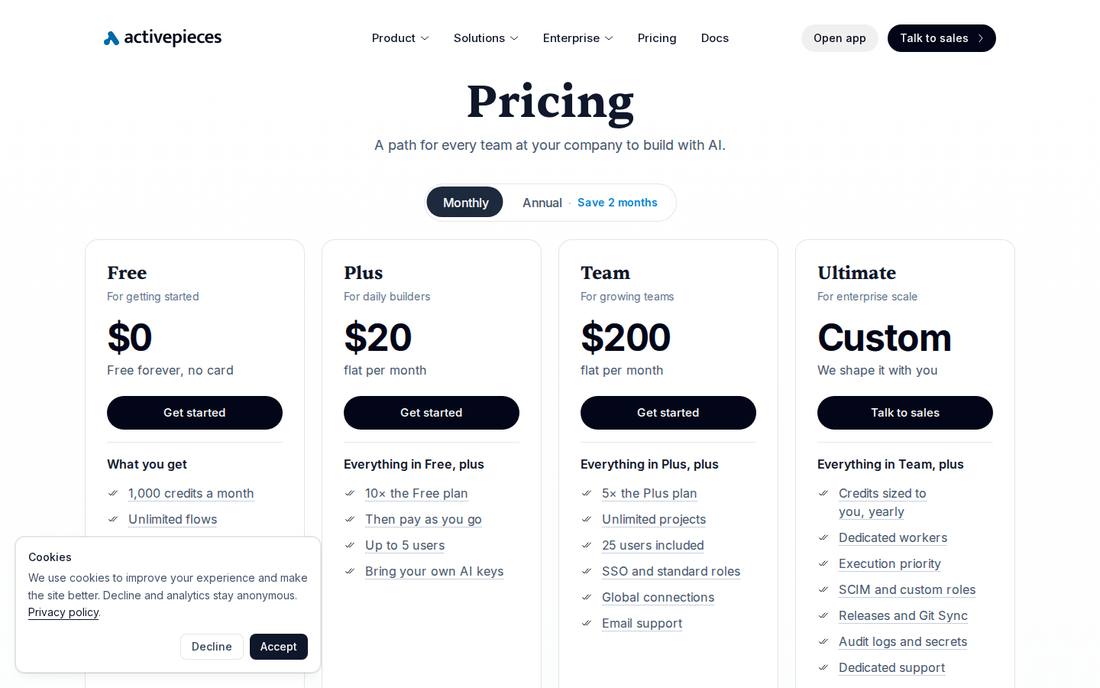
The pricing page is the simplest in this comparison: free forever without a card, 20 USD a month flat, 200 USD a month flat, enterprise on request. No per-task counters on the top level, no calculator, no "contact sales" for the middle tiers.
We are not enrolled in any affiliate programme for this product, so nothing here earns a commission; the affiliate disclosure explains how that is marked if it changes.
What flat pricing changes
With Zapier you optimise the workflow to reduce tasks; with Activepieces you optimise it to be correct. That sounds like a small difference and it is the reason people switch: a five-step flow nested in a loop is not a financial decision any more.
The allowance still exists, and a runaway loop can exhaust it, but the mental overhead of counting disappears - which is worth more than the price difference for anyone maintaining automations monthly.
Where it fails
- Integration breadth. 280 pieces covers the common apps and misses the long tail; a niche CRM means an HTTP step or a custom piece.
- Fewer community templates than n8n or Zapier, so more building from scratch.
- Self-hosting is still operations. Docker makes it easy and does not make it free of maintenance.
- The AI agent builder is young. It works and the guardrails are thinner than in dedicated agent platforms.
- Enterprise pricing jumps hard from 200 USD a month to tens of thousands a year.
Who it is for, and who should skip it
It fits small teams that want automation without counting tasks, agencies that resell automation under their own brand, and anyone who needs to embed a workflow engine in a product - the MIT licence is the deciding factor there. It fits developers who want n8n's flexibility with a cleaner licence.
Skip it if your workflow depends on an app that is not in the 280, because you will be writing an HTTP integration by hand. Skip it if you want a catalogue to browse rather than a builder to learn. And skip it if you will never self-host and your volume is small - the free cloud tier may be enough, and Zapier's setup is faster.
How it compares with the other three
Against n8n, the split is licence and integrations: Activepieces is MIT with 280 pieces, n8n is fair-code with 1,000+ nodes and 14,000 community workflows. Against Zapier, Activepieces is a tenth of the catalogue at a fraction of the per-task cost. Against Pipedream, both are developer-friendly, and the difference is visual versus code-first.
The category is compared on /category/ai-automation, and the test procedure behind a future score is in how we test.
Writing your own piece
A custom piece is a TypeScript package with a definition, actions and authentication: roughly a hundred lines for a simple API. That is faster than waiting for a vendor to add an integration, and it is the feature that makes the small catalogue survivable. The catch is maintenance - pieces need updates when the API changes, and nobody else will do it.
A realistic self-hosted setup
Docker Compose with the application container and PostgreSQL, a reverse proxy with TLS, and a nightly database dump. An evening of work, and the same two failure modes as any self-hosted tool: unpinned versions and unprotected backups.
The difference from n8n is legal rather than technical. If you build a product or a client service on the flows, MIT means you do not need to read a licence twice - and for an agency, that is worth more than integration count.
The AI agent builder
Agents get a system prompt, a set of tools (which are pieces), and optionally a knowledge base. They can run inside a flow or be exposed as a chat endpoint. For a small business the useful pattern is narrow: a support agent with three tools and a knowledge base of your own docs, replacing a form nobody wanted to fill in.
What it does not give you is evaluation tooling, guardrails or trace analysis at the level of a dedicated agent platform. Treat the agents as a convenient feature and test them the way you would test a workflow.
Who ends up staying
Two groups. Teams that hate per-task billing and have standard apps - they stay for years because nothing breaks the flat price. And developers building automation into a product - they stay because the licence does not ask questions.
The ones who leave hit an integration gap and go back to Zapier for one workflow, keeping Activepieces for the rest. That hybrid is common and sensible; the tools are not exclusive.
What we have not tested - and will
Research-based review: public pages plus our own captures, no deployment. Open questions:
- Time from Docker run to a working flow with credentials
- Tasks consumed by a daily sync over a month on the 20 USD tier
- How many of the 280 pieces support the fields a real workflow needs
- Whether a custom piece takes an afternoon or a week
- Agent quality with a small knowledge base and three tools
Bottom line
Activepieces is the right choice when the licence matters and the integrations cover your stack. The flat 20 USD is honest, the free tier is real, and self-hosting is a first-class option rather than a footnote.
If you live on niche apps, buy Zapier. If you want the biggest open-source ecosystem, buy n8n. If you want MIT and flat pricing, this is the one.
Sources
- activepieces.com/pricing - plans, flat prices and allowances, read 13 November 2026
- activepieces.com - flows, pieces and AI agents, read 13 November 2026
- activepieces.com/pricing - plan limits and task pricing, read 23 November 2026
The editor, in practice
Flows are linear with branches, which is easier to learn than n8n's merge logic and less flexible. Debugging shows the input and output of every step, and the step-level retry is a checkbox rather than a configuration exercise. For a small team that is the right trade: fewer concepts, faster first flow.
The pieces are typed, so the editor knows which fields an app returns and offers them in a dropdown. That sounds minor and removes the most common source of errors in no-code automation - typing a field name wrong.
Pricing at the top end
The jump from 200 USD a month to an enterprise contract in the tens of thousands is steep, and it exists because the enterprise tier sells self-hosting support, SSO and audit logs rather than more tasks. If you need those and not the tasks, the open-source edition plus your own SSO is a legitimate alternative.
The short version
MIT licence, flat 20 USD, free self-hosting, 280 integrations. If your apps are on the list, this is the cheapest honest automation you can run. If they are not, add Zapier for that one workflow and stop worrying.
A note on migration
Flows export as JSON and import cleanly between instances, which makes self-hosted to cloud and back a practical move rather than a theory. The credentials do not travel; they are re-entered per connection, and that is the twenty minutes you should budget for any move.
And keep one thing in mind before choosing: the cheapest automation is the one you finish. A platform with 7,000 integrations you never learn costs more than 280 you understand.
Practically: start on the free tier, build one flow end to end, and only then compare tiers. The first flow tells you more than any table.





Reader reviews
Loading reader ratings...