
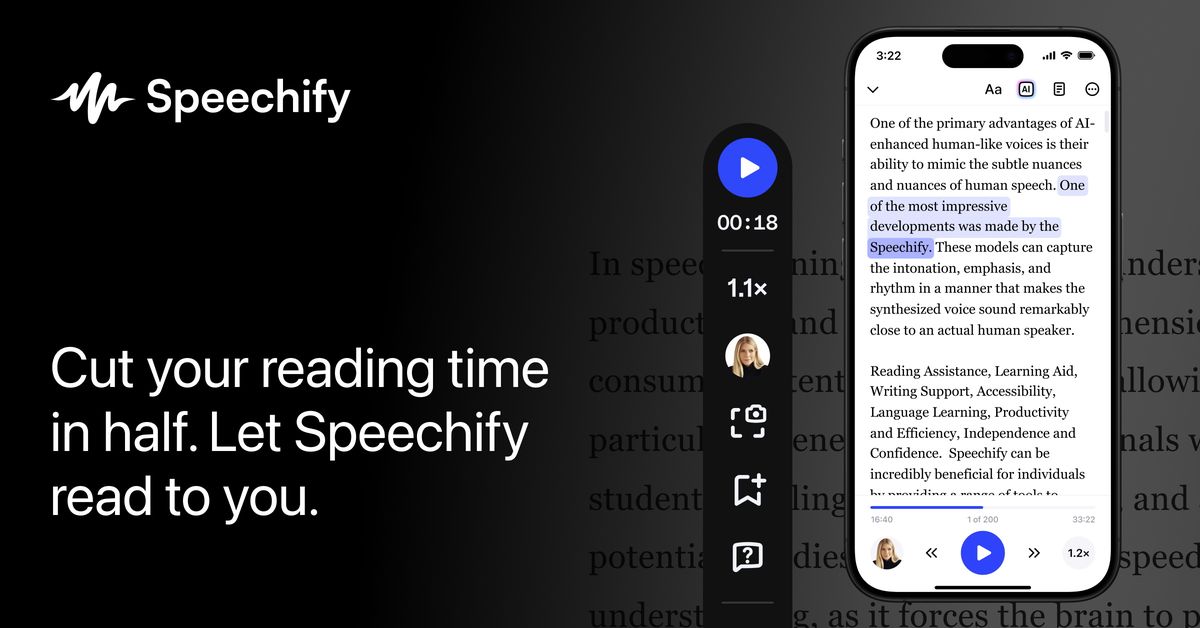
Speechify is the tool people install when they want their reading to happen in their ears instead of their eyes. This Speechify review is about the gap between that job and the job the other four products do - generating, editing and transcribing audio - because confusing the two is the most expensive mistake in this category.
What Speechify is
A reading assistant across three surfaces: a mobile app that reads documents and photos of text, a browser extension that reads web articles aloud, and a desktop app that does the same for anything on screen. Premium replaces the basic voices with better ones and adds offline listening, faster playback without pitch distortion, and higher import limits.
A separate product, Speechify Studio, targets creators who want to produce voice-over from text. That is closer to ElevenLabs territory, and it is worth knowing the two exist under one brand before you judge the pricing page.
What you see before you sign up
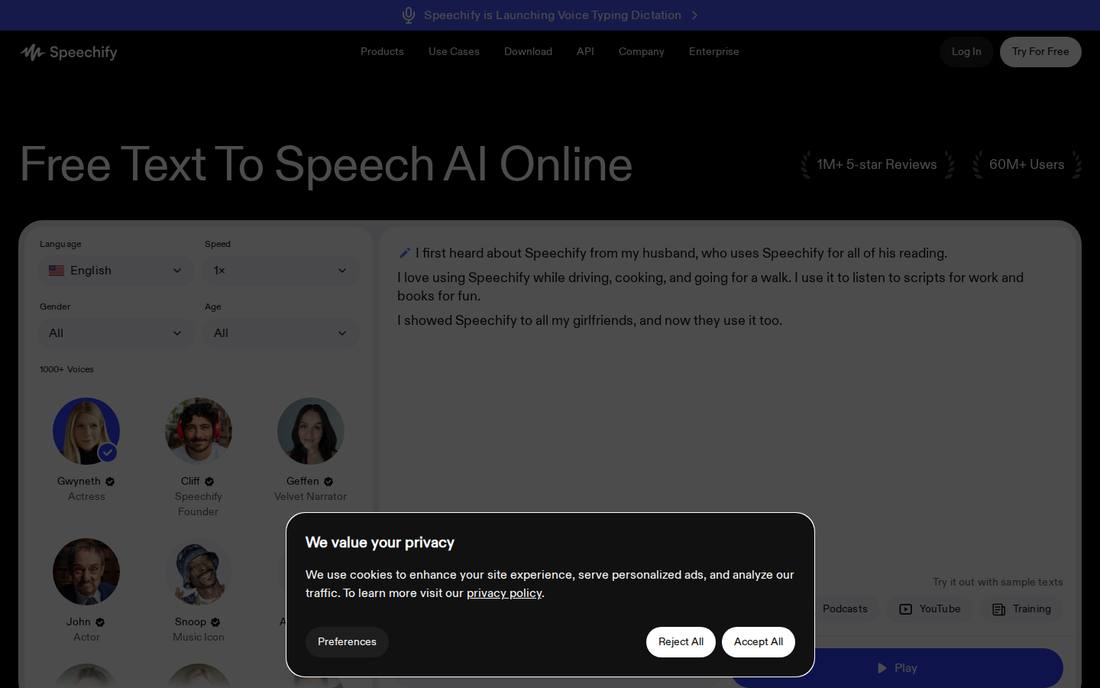
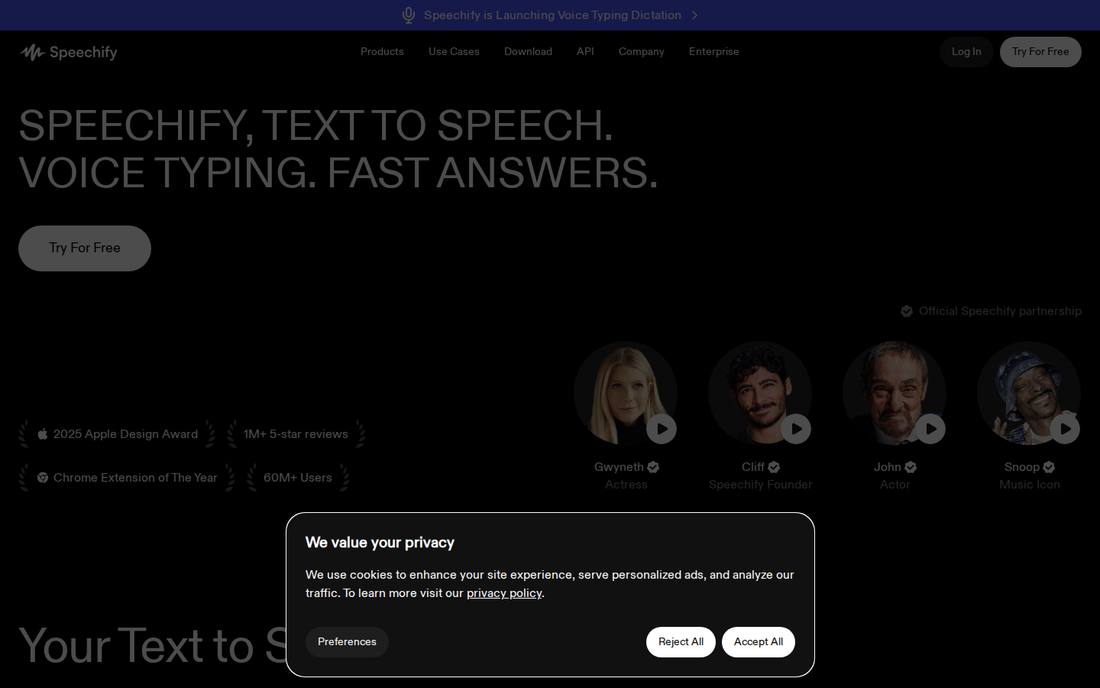
The homepage leads with students and accessibility rather than marketing teams, which is honest positioning. You can paste text into the free reader without an account, hear a voice immediately, and decide in two minutes whether the voices are good enough for you. That is a better trial than most competitors offer, and it is why the paywall feels less aggressive here.
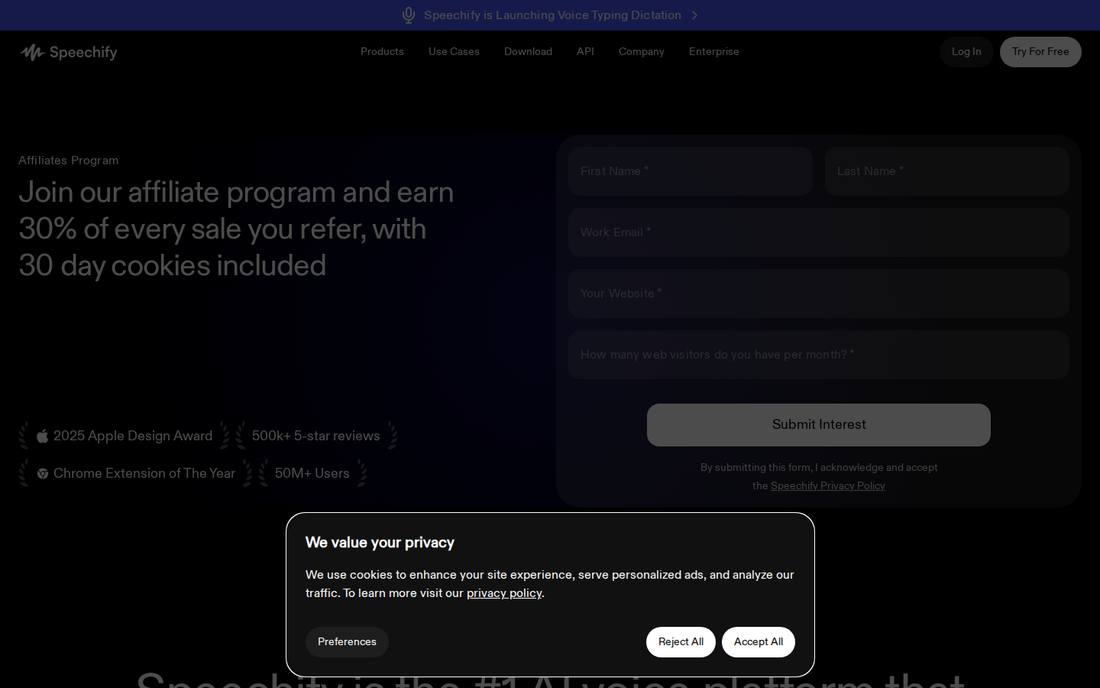
The affiliate programme is public, and this review currently carries no affiliate link - we have not been enrolled, and the affiliate disclosure says how we mark it when that changes.
What daily use actually looks like
The workflow is small enough to describe in one line: send text to Speechify, choose a voice and speed, listen. In practice three habits develop. Articles go through the browser extension while you work; PDFs go through the mobile app on a commute; long documents get a speed of 1.5x to 2x, because synthetic speech survives speed better than human narration does.
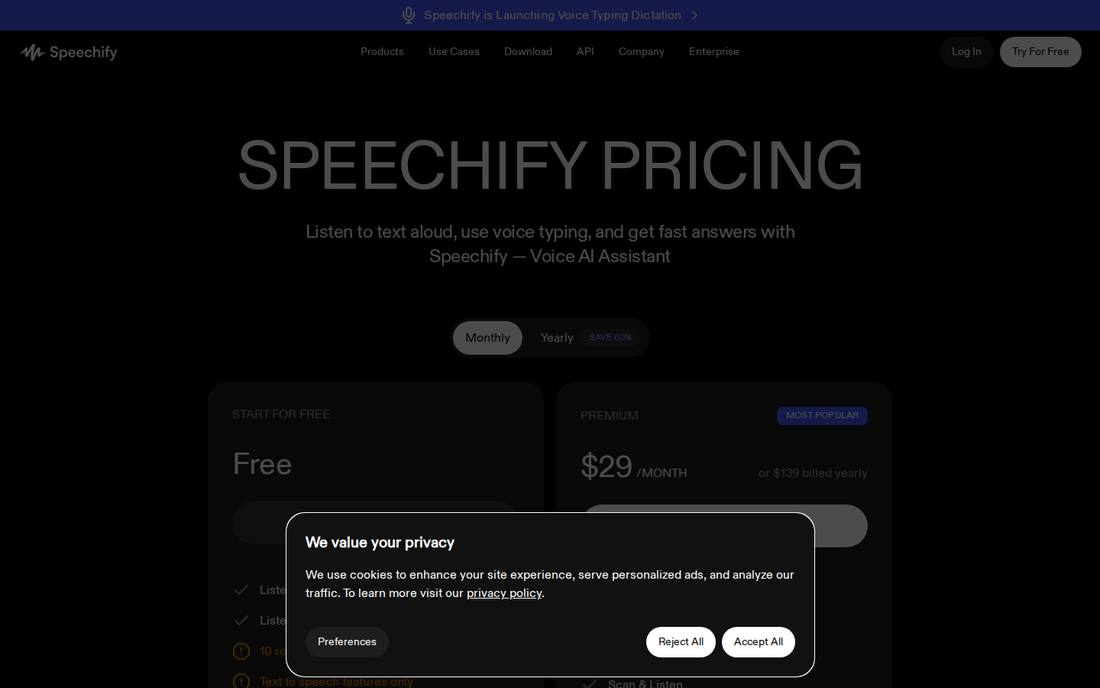
The quality difference that matters is not raw naturalness - it is whether you can listen for twenty minutes without noticing the voice. Basic voices fail that test around minute three; the premium ones usually pass it, which is exactly what 139 USD a year is buying.
Where it fails
- Complex layouts break. Tables, footnotes, two-column PDFs and code blocks come out as a stream of disconnected numbers.
- Pronunciation of names and jargon is the same problem as every other tool: no glossary, no fix, just re-hearing it wrong.
- No production output. You cannot export a polished file for publishing; that is Studio's job and a different purchase.
- One price, no middle tier. If you need only offline listening, you buy the whole bundle.
- Library management is thin. Hundreds of imported documents become a list you scroll rather than a system you search.
Who it is for, and who should skip it
It fits students with reading-heavy coursework, commuters who convert articles and PDFs into listening time, and readers with dyslexia or low vision for whom reading is a task rather than a pleasure. It fits anyone who already listens to podcasts and wants documents to fit the same habit.
Skip it if you are producing audio rather than consuming it - ElevenLabs generates, Descript edits. Skip it if you read on screen most of the time and only occasionally want audio; the free tier covers that. And skip it if you need a team plan with administration, because the public page does not sell one.
How it compares with the other four
It does not compete with ElevenLabs, Descript, Otter or Notta on output: it consumes text, they produce or process audio. The honest comparison is cost per hour listened. At 139 USD a year, Speechify costs less than most people spend on one audiobook subscription and covers far more material - provided they actually listen.
The whole category sits on /category/ai-audio, and the test procedure behind a future score is documented in how we test.
Who actually pays, and why the annual price is the real number
Three groups convert, and each for a different reason. Students convert because the alternative is not reading four hundred pages a week, it is skimming them badly and losing marks. Commuters convert because the marginal cost of listening is zero and the alternative is scrolling. Readers with dyslexia or low vision convert because the tool is not a convenience, it is the difference between access and exclusion.
For the first two groups, 29 USD a month is a number they can start with and cancel; 139 USD a year is the number they should evaluate, because that is what the tool costs once the novelty fades and the habit either exists or does not. Divide it by twelve and compare it with what you spend on coffee, podcasts or one streaming service. If you listen weekly, the annual price is cheap; if you cannot name the last document you listened to, it is not.
The monthly option exists for a specific case: a semester, a project, a two-month stretch of heavy reading. Buying monthly for those and annual for steady use is not a hedge, it is the correct choice in both situations.
The accessibility case, stated honestly
Speechify's strongest argument is not productivity, it is access. For a reader with dyslexia, decoding text is effortful in a way the tool removes entirely; for a reader with low vision, it is the difference between relying on someone else and reading independently. That makes the free tier more valuable here than on any other product in this comparison, because it turns a paid accessibility tool into a free one for the people who need it most.
What the tool does not do is teach reading or replace specialist software with structural navigation and Braille support. It reads what you give it, in the order the document presents it. For a student with an assessment arrangement, that distinction matters and is worth checking with the institution before substituting one for the other.
What it replaces
It replaces the built-in screen reader for people who do not need a screen reader, and it replaces the read-aloud feature of an e-reader for material that is not in that e-reader's store. It does not replace a dedicated audiobook service, because the narration is synthetic and the catalogue is whatever you import. Most users end up with both: audiobooks for books, Speechify for everything that will never be recorded.
That combination is the honest version of the pitch, and it is cheaper than it sounds: one audiobook credit a month costs roughly what the annual plan costs for a whole year of documents.
A practical test before you buy
Pick the document you most want to listen to, the one you have been putting off. Paste three pages into the free online reader and play them at 1.5x while doing something else. If you finish the three pages without reaching for the screen, the paid tier will pay for itself. If you stop after a minute, no upgrade fixes that - the problem is the material, not the voice.
That test costs nothing and answers the only question the pricing page cannot: whether listening is a habit you have or a habit you would like to have.
What we have not tested - and will
Research-based review: public pages plus our own captures, no account. Open questions:
- How the premium voices handle a 30-page PDF with tables and footnotes
- Real battery and storage cost of offline listening on mobile
- Whether the browser extension handles paywalled and dynamic pages
- Pronunciation accuracy on the same 40-term list we will use for ElevenLabs
- How Studio compares with ElevenLabs on the same script, if we test it later
Bottom line
Speechify is the best value in this category for consumption and the wrong purchase for production. If you want documents read to you, start free and upgrade after a month of real use; if you want audio for publishing, buy ElevenLabs or Descript instead.
The subscription is easy to justify and easy to forget - which is why the free tier and the 139 USD annual price are the honest pair to compare, not the 29 USD monthly figure that makes it feel smaller than it is.
Sources
- speechify.com/pricing - Free and Premium plans and prices, read 13 November 2026
- speechify.com/text-to-speech-online/ - free reader, read 13 November 2026
- speechify.com/affiliates - affiliate programme, read 13 November 2026



Reader reviews
Loading reader ratings...