This NitroPack review is about speed as a subscription rather than a skill: 5 USD a month for a small site, 13.20 for 40,000 pageviews, and a service that does the caching, minification and CDN work you would otherwise assemble from five plugins. It is the fastest way to a better Core Web Vitals score, and the one that removes the most control.
Prices are from nitropack.io/pricing, read 24 November 2026, USD with annual billing. No site was connected, so this is a research-based review with no score - the rule is in how we test.
What NitroPack is
A cloud service that sits in front of WordPress and serves optimised pages from its own network. You install a plugin, it talks to the service, and the service does the work: full-page caching, HTML and CSS minification, image optimisation and conversion to WebP, font loading, critical CSS, script deferral, and CDN delivery from edge locations.
The model is different from a plugin stack such as WP Rocket, and that difference is the whole decision. WP Rocket runs on your server and you control every option; NitroPack runs in its cloud and optimises the page on its way out, which means less server load and less tuning - and less visibility into why a specific page behaves a certain way.
Pricing, precisely
| Plan | Annual price | Pageviews | Sites |
|---|---|---|---|
| Starter | 5 USD/mo (from 8) | 8,000 a month | 1 |
| Plus | 13.20 USD/mo (from 22) | 40,000 a month | 1 |
| Business | quoted, higher tiers | 540,000 a month on the top published tier | more |
| Free | 0 | limited | 1 |
The structure that matters is pageviews. Unlike a plugin, which costs the same whether you get ten visitors or ten thousand, NitroPack prices by traffic, and the annual discount (up to 40%) is on that pageview allowance. A site that grows crosses tiers, and the tier jump is not gradual.
The free plan exists and is genuinely usable for a low-traffic site, which is the best way to test whether the service improves your numbers before paying - and the honest advice is to test rather than assume, because the gain depends on what your site currently does wrong.
What it does to a page
The sequence matters: NitroPack serves a cached, already-optimised HTML document, with critical CSS inlined, the rest deferred, images converted and lazy-loaded, and scripts delayed until interaction where the preset allows. Because the optimisation happens at the edge rather than on your server, PHP and MySQL stop being the bottleneck for cached pages - which is why hosts recommend it to sites that cannot tune their stack.
For a WooCommerce store the cart-aware caching is the feature to check: caching a shop is different from caching a blog, and a cart cache that serves a stale cart is worse than no cache. The Plus tier adds cart cache optimisation explicitly, which is the reason shops should not stay on Starter.
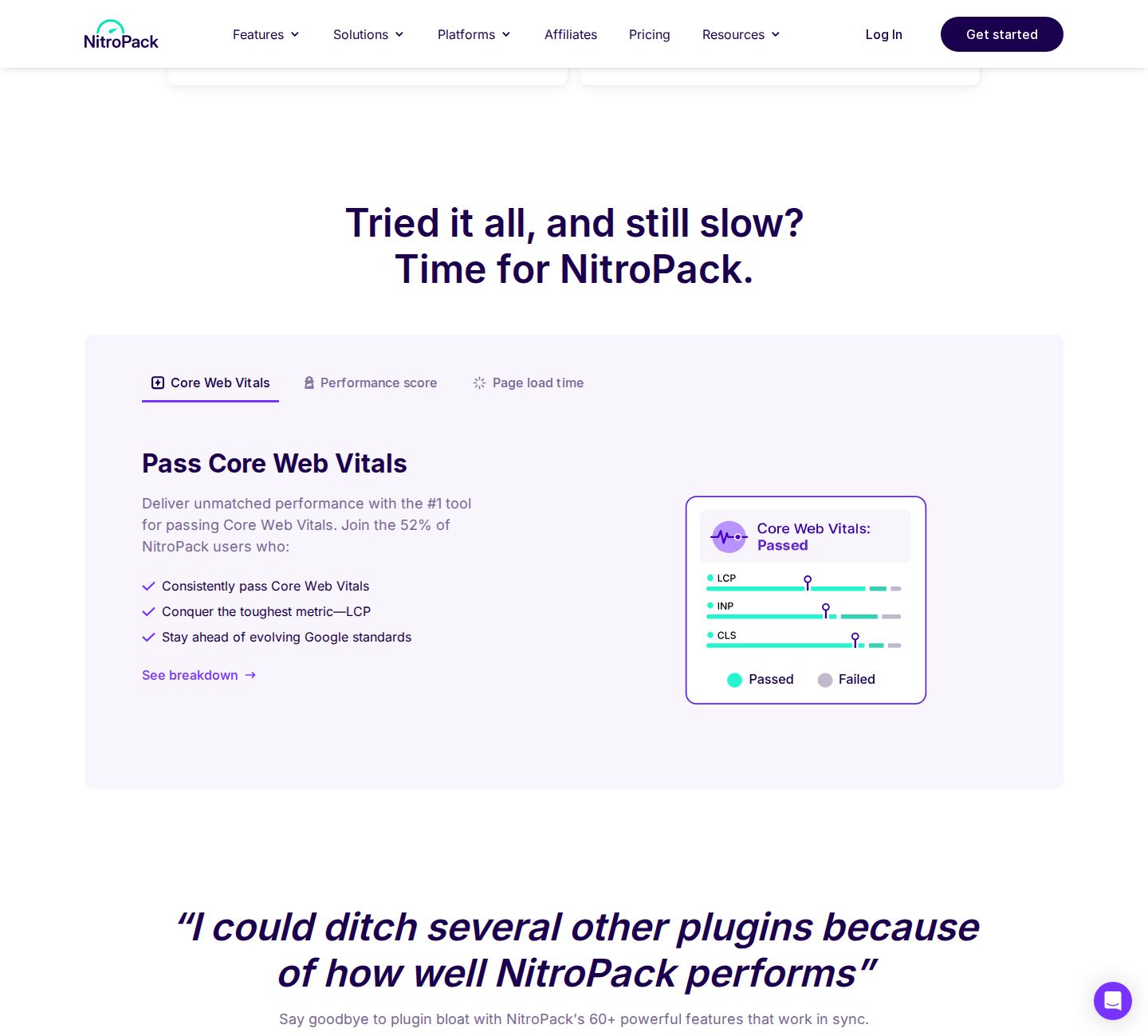
For a content site the biggest visible wins are usually LCP (hero image served from the edge in WebP) and CLS (font loading), and both are handled without touching code.
Where it fails
- Pageview pricing. A traffic spike is a bill, not a badge - the opposite of the unmetered offers elsewhere in hosting.
- Opacity. When a page is broken by an optimisation preset, debugging means excluding pages and guessing; a plugin stack lets you see each step.
- Conflict surface with other optimisation plugins. Two caching layers fighting is the classic way to break a WordPress site, and NitroPack requires removing the others.
- Dependency. Turning it off returns the site to whatever state it was in, which is fine and means you should know what that state is.
- Annual discount requires forecasting traffic you do not yet have.
How it compares
| Entry price | Unit | Where it runs | Best for | |
|---|---|---|---|---|
| NitroPack | 5 USD/mo | pageviews | cloud, edge | sites that want a score without tuning |
| WP Rocket | about 59 USD/yr | per site | your server | control and no traffic billing |
| Bunny | usage-based | bandwidth | edge CDN | CDN layer under your own caching |
| Host with built-in cache | included | in plan | host | simplest, least flexible |
Against WP Rocket the decision is traffic versus control: NitroPack is cheaper for a small site and much more expensive for a popular one, and WP Rocket's flat licence means a viral day costs nothing. Against a host that includes caching, the question is whether NitroPack's edge optimisation adds anything on top - sometimes yes, often no.
Who should buy it
A small business whose site is slow and whose time is short. Starter at 5 USD for 8,000 pageviews does the work of four plugins, and the free plan proves it first.
A shop on shared or mid-range hosting. Edge caching removes load from a server that was never sized for it, and Plus adds the cart-aware cache.
Anyone who needs Core Web Vitals fixed for an ad campaign or an SEO deadline. The preset gets most of the way without a developer.
Who should not
A site with unpredictable viral traffic - pageview pricing turns success into an invoice. A developer who wants to tune each optimisation: a plugin stack is transparent and cheaper at volume. And a site already served by a host with a good built-in cache and a CDN, where the marginal gain will be small.
Questions people ask
Is the free plan a trial? It is a limited free plan rather than a timed trial, which makes it a fair way to measure the improvement.
What counts as a pageview? A served page from the NitroPack network, including cached ones - which is why the allowance is the budget.
Do I have to remove other caching plugins? Yes, practically: two optimisation layers conflict, and support will ask you to disable them.
Is the CDN included? Yes, delivery from the edge network is part of the plan, with bandwidth limits per tier.
What happens if I exceed pageviews? The site keeps working; the account is billed or throttled depending on the plan - check the current overage terms before a campaign.
What we have not tested - and will
No site was connected for this page. The measurements that would produce a score:
- LCP, CLS and TTFB before and after on the same theme, measured from three regions
- Whether the WooCommerce cart cache serves a correct cart under concurrent sessions
- Pageview counting against our own analytics, to see what the allowance really meters
- Behaviour when an optimisation preset breaks a page, and how quickly it can be excluded
- Server CPU reduction on a shared host, which is half the value
- Load time for a logged-in user, since cached pages rarely apply to them
- Overage handling in the checkout rather than in the FAQ
Bottom line
NitroPack is the fastest route to better page speed for a small site: 5 USD a month for 8,000 pageviews, everything handled in the cloud, and a free plan to prove it. The trade is traffic-based billing and less control over what happens to each page.
For a business that wants the score without the tuning, it is a fair buy - especially on hosting that was never fast. For a popular site or a developer, a flat-licence plugin like WP Rocket plus a CDN is cheaper and clearer. Test with the free plan first: the improvement depends on what your site gets wrong today, and that is measurable in an afternoon.
Every vendor link on this site is disclosed in the affiliate disclosure; a commission never changes a score. Our rules are in the editorial policy, and the rest of the reviews are in the review index.
Sources
All pages read on 24 November 2026:
- NitroPack homepage: nitropack.io - cloud optimisation, edge delivery, caching and image conversion
- NitroPack pricing: nitropack.io - Starter 5 USD per month billed annually (from 8) with 8,000 pageviews, Plus 13.20 USD (from 22) with 40,000 pageviews, higher tiers up to 540,000 pageviews, free plan










Reader reviews
Loading reader ratings...