
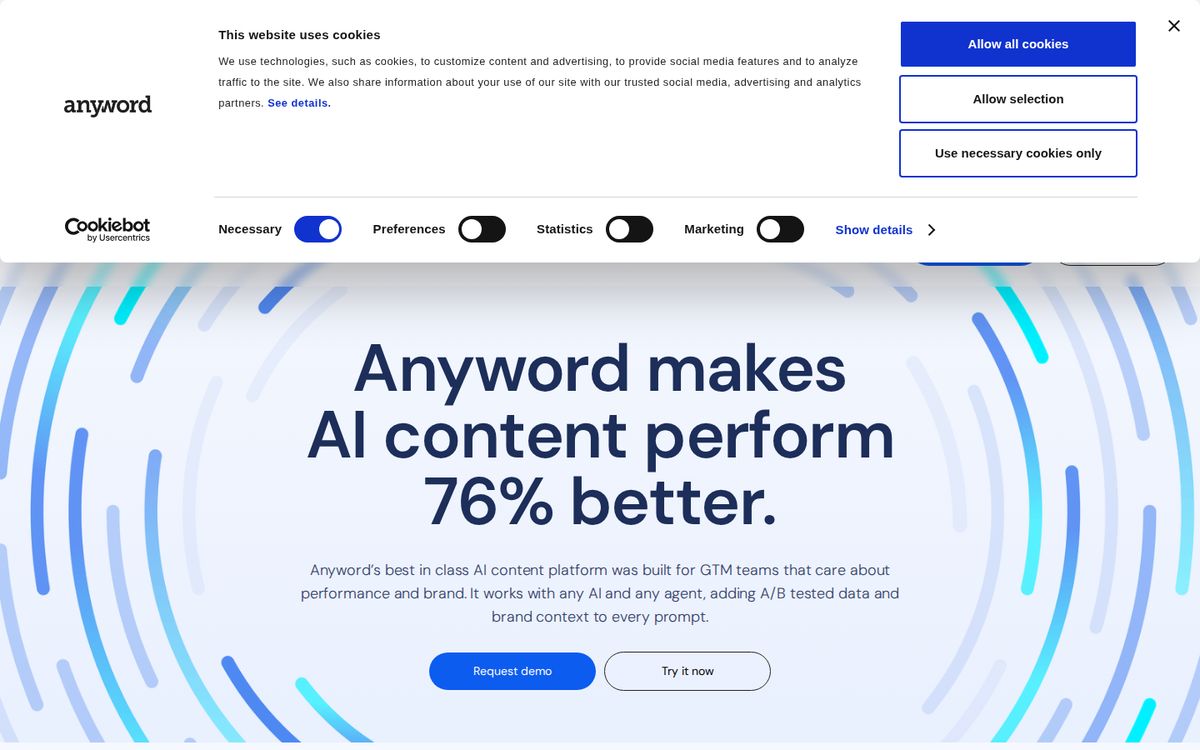
Anyword is the only tool in this group that tries to answer a different question: not "can it write?" but "will this copy perform?" This Anyword review is about that promise, its price, and the kind of site it fits.
What Anyword is
A copywriting platform with a predictive layer. You give it a product, an audience and a channel, it generates variants, and it attaches a performance score to each one based on the vendor's model of what converts. The Data-Driven tier adds the analytics behind those scores.
For paid channels that is a useful idea: choosing between five ad headlines is normally a guess until the budget is spent. A score is a second opinion before the spend.
What you see before you sign up
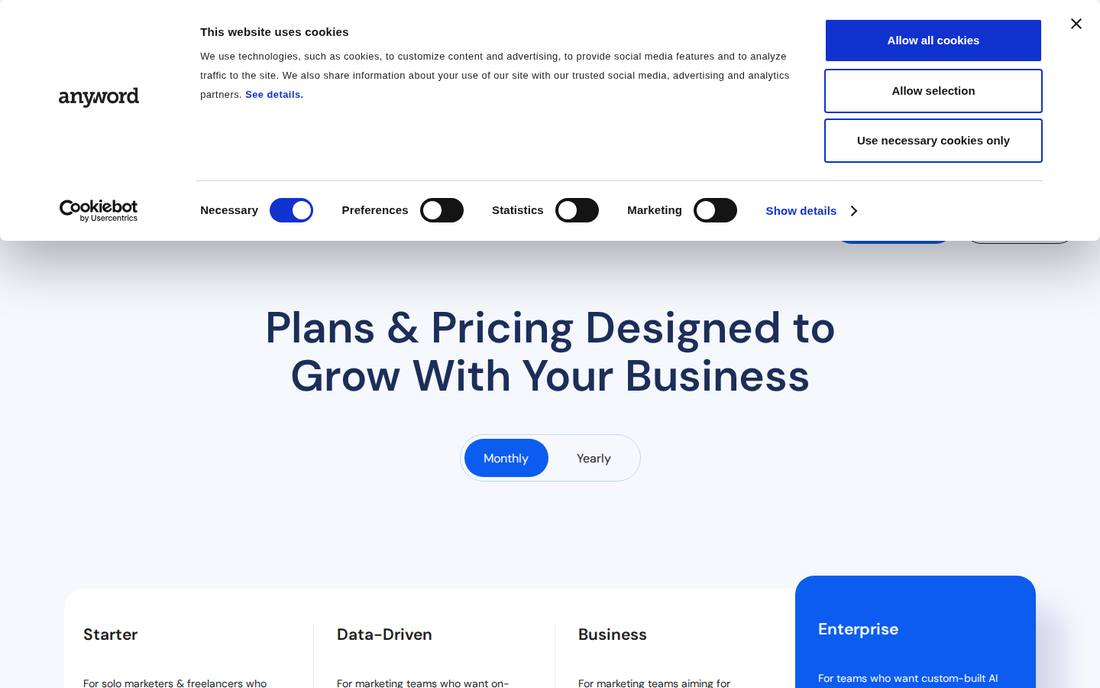
The homepage makes one claim - AI content that performs better because it is scored - and the pricing page is short: Starter and Data-Driven, each with monthly and annual prices side by side. There is no free plan on the page we read, so the decision starts at 39 USD a month billed yearly. The affiliate programme has its own public page, which we note because a review site should be transparent about which vendors can pay it.
How the main workflows work
Most jobs are short-form: headlines, ads, subject lines, product descriptions. You provide context once, generate a set, compare scores, pick and edit. The editing step is still yours, but the selection step is where Anyword differs - instead of choosing the variant you like, you choose the variant the model expects to perform.
Whether that helps depends entirely on feedback. In ad accounts you can test the prediction against reality within days. In blog posts you cannot, which is why the product is not built for long-form.
Pricing, read carefully
| Plan | Monthly | Billed yearly |
|---|---|---|
| Starter | 49 USD/mo | 39 USD/mo |
| Data-Driven | 99 USD/mo | 79 USD/mo |
The annual discount is about 20%, and the meaningful line is Starter versus Data-Driven: the second tier costs roughly double for the predictive analytics. If you will not run measurable campaigns, that upgrade has nothing to measure.
Who it is for, and who should skip it
It fits performance marketers - paid social, paid search, email - who already test copy and want a faster first pass. It fits teams producing many short variants for the same product.
Skip it if you publish articles, if you need SEO scoring, or if you cannot test the predictions against real results. Without feedback the score is just a number with a confident font.
How it compares with the other four
Jasper is broader and more expensive; Copy.ai automates workflows instead of scoring copy; Writesonic is built around long articles and AI search visibility; Grammarly edits what you already wrote. Anyword is the narrowest product here, and the only one that sells a prediction rather than a document. Our reviews index lists the whole category, and how we test explains the procedure behind a future score.
What each plan actually includes
The pricing page lists the limits that matter: the entry plan includes 50 performance predictions, 50 performance data rows, unlimited copy generation, 100+ marketing templates, a Blog Wizard with a plagiarism checker and the Chrome extension. The Data-Driven tier doubles the prediction allowance to roughly 100 and unlocks the analytics behind the scoring.
Read that list again and notice the oddity: unlimited copy generation on the cheap tier, but only 50 predictions. The vendor is not selling words - it is selling evaluation, and the evaluation is the metered part. If you write a hundred headlines a month and only want fifty scored, the entry plan fits; if you want every variant scored, you need the tier above, which is where the real price is.
A real workflow, step by step
- Describe the offer: product, audience, channel, and the action you want.
- Generate a batch of variants - ten is a useful number, not three.
- Look at the predicted scores, then read the top three anyway; the score ranks, it does not write.
- Publish the best two as an A/B test rather than the best one.
- After the test, note which score band actually won - that is your calibration, and it is worth more than the tool's own confidence.
- Repeat monthly; the model's predictions and your audience drift.
Steps 4 and 5 are what separate a user who benefits from steps 1 to 3 from one who just paid for a number.
Where it falls short
- The score is a prediction, not a measurement. Nobody can tell you how it was trained on your market.
- No long-form pipeline. The Blog Wizard exists, but the product is optimised for short, testable copy.
- Prediction limits are low relative to how many variants a real test cycle needs.
- No SEO data, so it cannot tell you whether the page will rank, only whether the copy might convert.
Alternatives, and what they cost
Cheaper: Copy.ai at 24 USD for workflow automation, or a general assistant for draft variants you score by hand. Same price: Grammarly at 12 EUR if the problem is polish, not performance. More expensive: Jasper at 59 USD for brand voice across a team. The honest alternative for anyone without an ad budget is to skip the prediction entirely and write three variants per week - the scoring exists to save testing cycles, and without testing cycles there is nothing to save.
Questions we get
Do the scores hold up? That is the only question that matters and it is on our test list; until we run it, treat the number as a ranked guess. Is it useful for SEO copy? Not really - search intent and keyword coverage are outside what it models. Can I use it for email subject lines? That is the strongest use case: short, testable, high volume. Why is there no free plan? The vendor does not advertise one; the entry cost is 39 USD billed yearly.
What a month of real use would look like
Week one is setup: brand voice, audience definitions, and a first batch of variants for one campaign. Week two is the first honest test - two headlines, equal budget, seven days, then compare the winner with the score the tool gave it. Week three is where the tool either earns trust or loses it: if the winning variant was ranked fourth, you stop trusting the ranking and start using the product as a generator with a decorative number attached. Week four is the decision: keep the subscription, drop to the cheaper tier, or cancel.
That sequence is not specific to Anyword, but it matters more here because the product's entire pitch rests on a prediction you can verify within two weeks. That is unusual in this category - most claims take months to test - and it is the strongest argument for trying it if you already run paid campaigns.
Who it replaces, and who it does not
It replaces the copywriter's first pass on ad variants and the media buyer's gut call about which headline to run. It does not replace the media buyer, and it does not replace the strategist who decides what the campaign is about. On a team of two - one person running ads, one writing - it compresses the loop between them, which is the honest version of "AI copywriting" in a performance context.
For an SEO content team, none of that applies. There is no keyword input, no brief, no outline, and no way to check whether the copy answers the search intent. Buying Anyword for a blog is buying a prediction about a channel you are not measuring.
What we have not tested - and will
Research-based review: public pages, no account. Open questions:
- Whether the predicted scores correlate with real campaign results
- How many variants a Starter plan produces per month
- Whether the scoring works outside English
- How the integrations behave with ad platforms in practice
- What the affiliate programme pays and whether we would join it
Bottom line
Anyword is worth 39 USD a month to someone who tests copy for a living and wants a faster first draft of the variants. For organic content it is the wrong tool at the right price - the score has nothing to predict.
Sources
- anyword.com/pricing - Starter and Data-Driven prices, read 13 November 2026
- anyword.com/affiliates - affiliate programme page, read 13 November 2026
- anyword.com - product positioning, read 13 November 2026







Reader reviews
Loading reader ratings...