Skip to content
VerdictMill
Copy.ai logoCopy.aiResearch-basedAI writing & contentUpdated 2026-11-27

Copy.ai review: from copy generator to go-to-market workflow tool

By Milan Pasic•Published 2026-11-13•Updated 2026-11-27
Verdict

Copy.ai has stopped selling sentences and started selling workflows: 24 USD a month billed yearly buys a system that runs multi-step content jobs, which is more than most writers need and less than an agency retainer.

No score: this page is research-based and has not been hands-on tested yet.

Research-based · not hands-on tested
Visit Copy.aiLinks to the official site
20,000
The number that matters

workflow credits a month on the top tier, against a product that now sells pipelines rather than drafts

Best for

It fits a small marketing or sales team that repeats the same content jobs and wants them automated, and it fits anyone comfortable building a workflow once to save time later.

Not for

You write one-off articles, if you want an editor that scores SEO as you type, or if you object to spending an afternoon building a workflow before you get any output.

Pricing

24 USD/mo billed yearly, 29 USD/mo monthly; Enterprise from 1,000 USD/mo

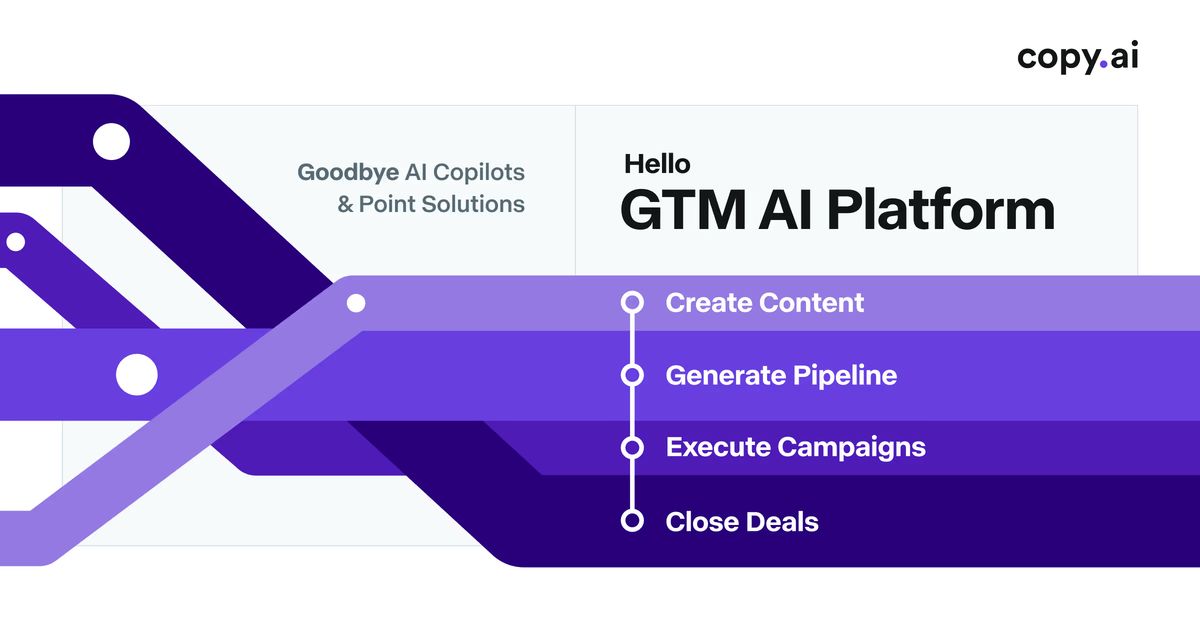
Vendor artwork from copy.ai. The screenshots below are pages we captured on 13 November 2026.

Current offers

No current offer for Copy.ai. We checked the vendor's pricing page on 2026-11-16 and found no public discount, coupon or promotion. When one appears, we add it here with the date we verified it.

What we tested

Product
Copy.ai
Type
Research-based · not hands-on tested

How it compares

Copy.aiJasperWritesonicAnyword
Entry paid price24 USD/mo yearly59 USD/mo yearly79 USD/mo billed annual39 USD/mo yearly
Free tiernot advertised7-day trial7-day trialno free plan advertised
Built aroundworkflowsbrand voiceAI search visibilitypredictive scoring
Enterprise tier1,000 USD/moby quote399 USD/mo Growthby quote
Affiliate programyesyesyesyes

Figures read from each vendor's pricing page on 13 November 2026. Annual discounts and promotions change; the renewal price is the number to check before buying.

Copy.ai used to be the cheap alternative to Jasper for short-form copy. It is not that anymore: the product is now built around workflows - chains of steps that take an input, run several AI actions and produce a finished asset. This Copy.ai review is about whether that shift changes who should buy it.

What Copy.ai is

A web application for content and go-to-market work, with three layers: a chat interface for one-off writing, a library of prompts and templates, and a workflow builder that chains prompts, data and integrations together. Brand voice is stored once and applied across generations.

The workflow layer is the difference. A workflow can, for example, take a product feed, write descriptions for each item in a fixed style, translate them, and push the result into a spreadsheet - work that would otherwise need a person clicking generate fifty times.

What you see before you sign up

The public site is aimed at go-to-market teams: the homepage sells outcomes, the features page sells the workflow builder, and the blog talks to sales and marketing operations. Pricing is a simple toggle between monthly and annual with a 20% saving, plus an enterprise tier priced by quote. There is no free plan on the page, which makes the decision cleaner and the entry cost higher.

How the main workflows work

In practice you build a workflow once and run it many times. The build step is where the effort goes: choosing inputs, writing prompts that survive different data, and testing against a small sample before running it on the full list. The run step is cheap and fast.

That inverts the usual trade-off. A tool that writes one paragraph at a time rewards a good prompt; a workflow rewards an hour of setup. If you produce the same asset shape every week, the setup pays for itself; if every job is different, you are paying for a builder you will not use.

Pricing, read carefully

PlanPriceNotes
Starter29 USD/mo monthly, 24 USD/mo billed yearly (288 USD/yr)Self-serve, workflow credits
Enterprisefrom 1,000 USD/mo (12,000 USD/yr)Seats, controls, support

The annual saving is 20%, which is real but modest; the bigger question is credit consumption, because workflow runs burn credits faster than single prompts. The enterprise tier is not a feature upgrade you can evaluate from a pricing table - it is a sales conversation, and the published 1,000 USD starting point tells you the size of customer they want.

Who it is for, and who should skip it

It fits a small marketing or sales team that repeats the same content jobs and wants them automated, and it fits anyone comfortable building a workflow once to save time later.

Skip it if you write one-off articles, if you want an editor that scores SEO as you type, or if you object to spending an afternoon building a workflow before you get any output. For single pieces, a general assistant is cheaper and faster.

How it compares with the other four

Against Jasper, Copy.ai is cheaper per seat and less focused on brand assets; against Writesonic, it is not trying to be an SEO platform; against Anyword, it does not score copy before you publish; against Grammarly, it is not a writing assistant at all. The full set of comparisons lives in our reviews index, and how we test explains what a score on this site will mean when these products are tested hands-on.

What each plan actually includes

The pricing page lists the differences concretely: the paid plan includes 20+ integrations and API access, unlimited customizable workflows, and access to OpenAI, Anthropic and Gemini models under one interface. Enterprise adds bulk workflow runs, enterprise-grade security, a designated account team and larger credit pools - 20,000 workflow credits a month appears next to the enterprise tier.

That last number is the one to interrogate before paying. A workflow that writes 200 product descriptions burns credits per run, and the credit allowance rather than the monthly fee is what will stop your work. Copy.ai publishes the pool size; Jasper does not publish anything similar, which is a real difference in how transparent the two are about limits.

A real workflow, step by step

  1. Pick a job you already repeat weekly - product descriptions, a newsletter, a sales sequence.
  2. Write the input schema: what the workflow needs (product name, feature, audience, tone).
  3. Chain the steps: research or summarise, draft, rewrite for the channel, check length.
  4. Test on three rows of real data, not one - the point of a workflow is that it survives variety.
  5. Run it on the full set and export to the destination (sheet, CMS, email tool).
  6. Re-run weekly; adjust the prompts when the output drifts.

The time budget is roughly an afternoon for step 3 and five minutes for steps 5 and 6. That is the trade: Copy.ai is cheap per month and expensive on the day you build the workflow.

Where it falls short

  • The builder is the product. If you do not enjoy designing prompts and testing on sample data, you will pay for a tool you use like a chat window.
  • No long-form editorial workflow. There is drafting, but no outline-first article pipeline like Writesonic's.
  • Credit maths is opaque until you run it. The page shows plan credits, not how many descriptions a credit buys.
  • No SEO scoring or keyword data, so it does not replace an SEO tool.

Cheaper and more expensive alternatives

Cheaper: a general assistant, if your jobs are one-offs. Same price band: Anyword at 39 USD for scored copywriting, or Grammarly at 12 EUR if the problem is polish rather than production. More expensive: Jasper at 59 USD for brand voice and campaigns, or Writesonic at 79 USD if you need articles and AI search tracking. Copy.ai's real competitor is the spreadsheet plus a script, and it wins only when the workflow is reused.

Questions we get

Can I use it without building workflows? Yes, but then you are paying for a chat interface with better branding.

What happens when credits run out? Workflows stop until the pool resets or you upgrade; there is no overage pricing published on the page.

Does it support my language? Generation works, but prompts and brand-voice samples are yours to write, and quality in smaller languages drops.

Is the enterprise tier worth it below 1,000 USD a month? Not for features - it is a support and controls conversation, priced for teams that already have volume.

Who it replaces, and who it does not

Copy.ai replaces a content operations role more than a writer. The person it saves is the one who currently copies a product name into a template, generates a description, pastes it into a sheet and repeats forty times. That person's afternoon becomes a workflow run. It does not replace an editor, and it does not replace the judgement about which product claims are true.

The pattern I would expect in a small business: one workflow for product copy, one for the newsletter, one for cold email variants. Three workflows, each run weekly, is where the plan pays for itself. Below that, the subscription is convenience; above it, the credit pool becomes the constraint and the conversation moves to Enterprise, which is exactly how the pricing is designed.

How it behaves on a bad day

Workflow tools fail differently from chat tools. A chat failure is one bad paragraph you rewrite. A workflow failure is one bad instruction repeated two hundred times before anyone notices, which is why the testing step on three rows matters more than it sounds. The other typical failure is silent truncation: an output that looks finished but stops mid-sentence because a token limit was hit, and nothing in the interface flags it.

Both are manageable, but they change who should own the tool. A workflow belongs to someone who will check a sample before running the batch, not to whoever has the login.

What we have not tested - and will

Research-based review: public pages only, no account. Open questions:

  • How many workflow runs a starter plan's credits actually allow
  • Whether the workflow builder is usable without a technical background
  • Output quality against Jasper and Writesonic on the same brief
  • How brand voice holds up across a fifty-item batch
  • What the affiliate program pays and whether enrolment would change what we publish

Bottom line

Copy.ai is the best value in this group for repeatable content work, and an odd fit for anyone who writes one piece at a time. If you can name three jobs you repeat every week, the workflow builder justifies the price. If you cannot, buy something simpler.

Sources

Our verdict

Updated 2026-11-27
Buy it if
You want repeatable workflows that move data between tools rather than one-off drafts. Twenty-four dollars a month billed yearly buys a system that runs on your data, not a chat box.
Skip it if
You need long-form articles with research behind them. Copy.ai has moved to workflows, and the writing is now the output of a pipeline you have to design yourself.
What we would do
Map one workflow by hand first, then rebuild it inside the tool and compare the time. If the manual version takes ten minutes, the automation has nothing to save you.

— Milan Pasic, editor. This is an editorial judgement, not a summary of the text above; the score follows the published method.

Milan Pasic

Editor. Writes the tests, runs the comparisons and publishes the numbers — including the ones that make a product look worse. Reviews are written and checked by a person, and every score follows the published method.

About · Editorial policy · LinkedIn

Related reviews

How it compares in this category

All AI writing & content reviews →
ProductScorePrice (1 site)TestedVerdict
Anyword logoAnyword—39 USD/mo billed yearlynot testedAnyword sells something the other four do not: a predicted performance score for each variant, priced at 39 USD a month billed yearly - useful for advertisers, unnecessary for bloggers.
Frase logoFrase—39 USD/mo billed annuallynot testedFrase is a content pipeline at a content-tool price: 39 USD a month for ten researched articles, publishing to your CMS and a decay alarm - with AI-visibility monitoring as the newest, least proven layer.
Grammarly logoGrammarly—Pro 12 EUR/mo billed annually in our regionnot testedGrammarly is the cheapest useful paid tool in this category at 12 EUR a month, but it polishes writing you already did instead of producing drafts - a different job from Jasper or Copy.ai.
Jasper logoJasper—59 USD/mo billed yearly, 69 USD/mo monthlynot testedJasper is the most polished brand-voice platform in this group and the most expensive per seat: 59 to 69 USD a month buys consistency across a marketing team, not better sentences than a cheaper tool produces.
QuillBot logoQuillBot—5.00 EUR/mo billed annuallynot testedQuillBot is the cheapest useful writing tool here: 5 EUR a month billed annually for unlimited paraphrasing, grammar and summaries, with a free tier that stops at 125 words per action.
Rytr logoRytr—49 USD per month, about 39.20 USD billed yearlynot testedRytr still sells unlimited writing for 9 USD a month, but the product now leads with relationship memory at 19 USD and up - cheap for a solo operator, expensive for anyone who cannot verify what it remembers.
Writesonic logoWritesonic—79, 199 and 399 USD/mo, billed annuallynot testedWritesonic still writes articles well, but 79 USD a month billed annually is now priced for tracking how AI engines mention your brand, not for generating blog posts.

Same test rig, same article, default settings. Scores are ours; prices are the vendor's list price on the date each page was written.

Screenshots

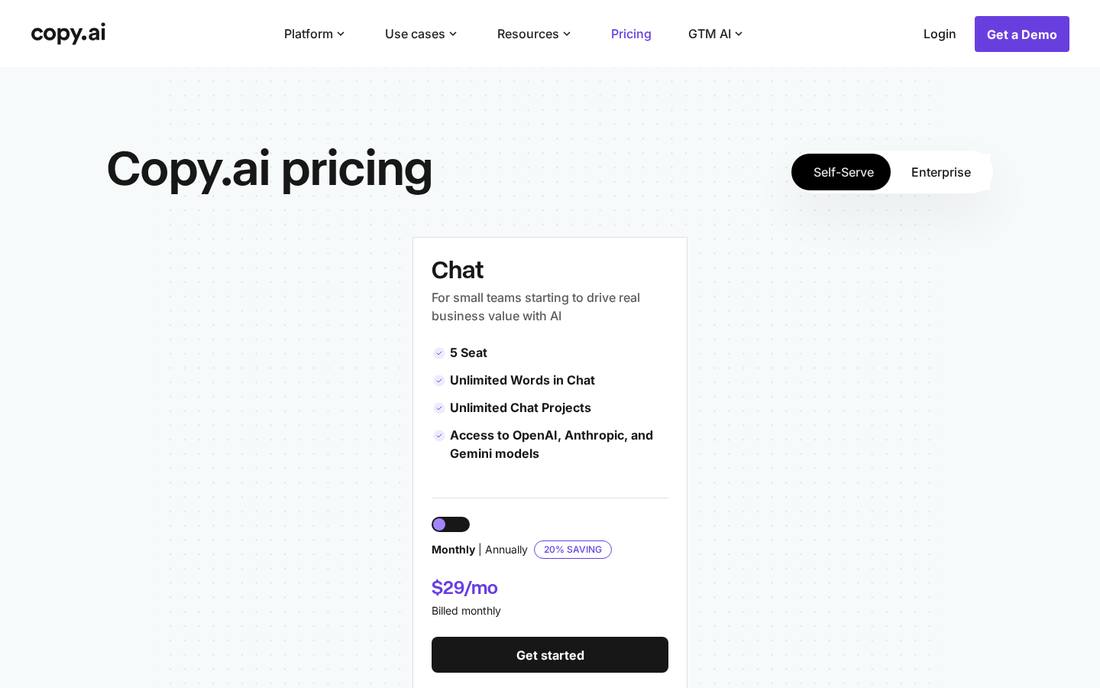
Pricing page as a buyer sees it, 13 Nov 2026: monthly and annual toggle, 20% saving on annual.
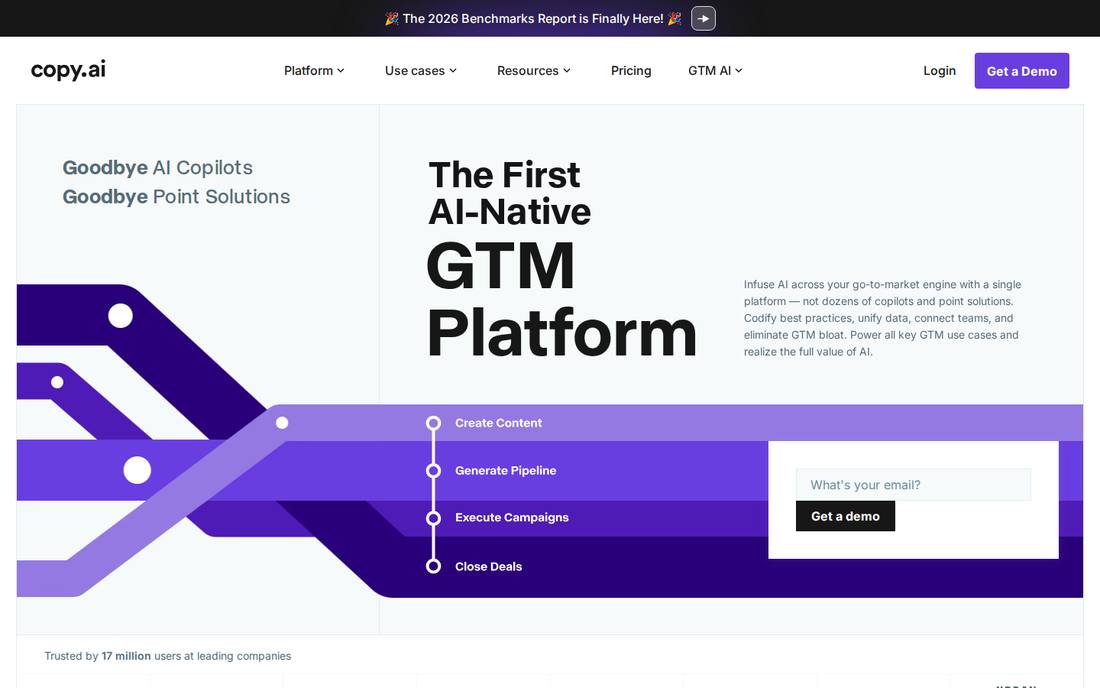
The features page leads with go-to-market workflows rather than templates.
PRO

Copy.ai paid plans

24 USD/mo billed yearly, 29 USD/mo monthly; Enterprise from 1,000 USD/mo

Copy.ai's paid ladder is short: one self-serve plan and an enterprise tier. The self-serve plan at 24 USD a month billed yearly is the cheapest entry in this group, and it unlocks the workflow builder - the feature that separates Copy.ai from a chat window. Whether that is worth paying for depends on whether you have repeatable jobs: a weekly newsletter, product descriptions for a catalogue, or a sales sequence that has to be regenerated for each segment. For a single article a week, the workflow builder is a toy; for a team producing the same asset shapes every week, it removes real steps. The enterprise tier at 1,000 USD a month is not about features you can compare - it is about seats, controls and support, and it only makes sense when the volume is already there.

What the paid tier adds
  • +Workflow builder for multi-step content jobs
  • +Brand voice applied across generations
  • +Integrations so workflows run inside existing tools
  • +Chat and workflow credits pooled at workspace level
  • +Enterprise controls, seats and support
Licence

Priced per workspace and seats; credits apply to workflow runs.

What it does not change
  • –No SEO scoring or rank tracking
  • –No free plan is advertised on the pricing page we read - the entry point is paid
Documented from copy.ai on 13 November 2026. No account was created, so nothing here is a test result.Sources: Copy.ai pricing · Copy.ai features

Screenshot walkthrough

  1. Homepage: the pitch is go-to-market AI, not copywriting - the product has been rebuilt around workflows.
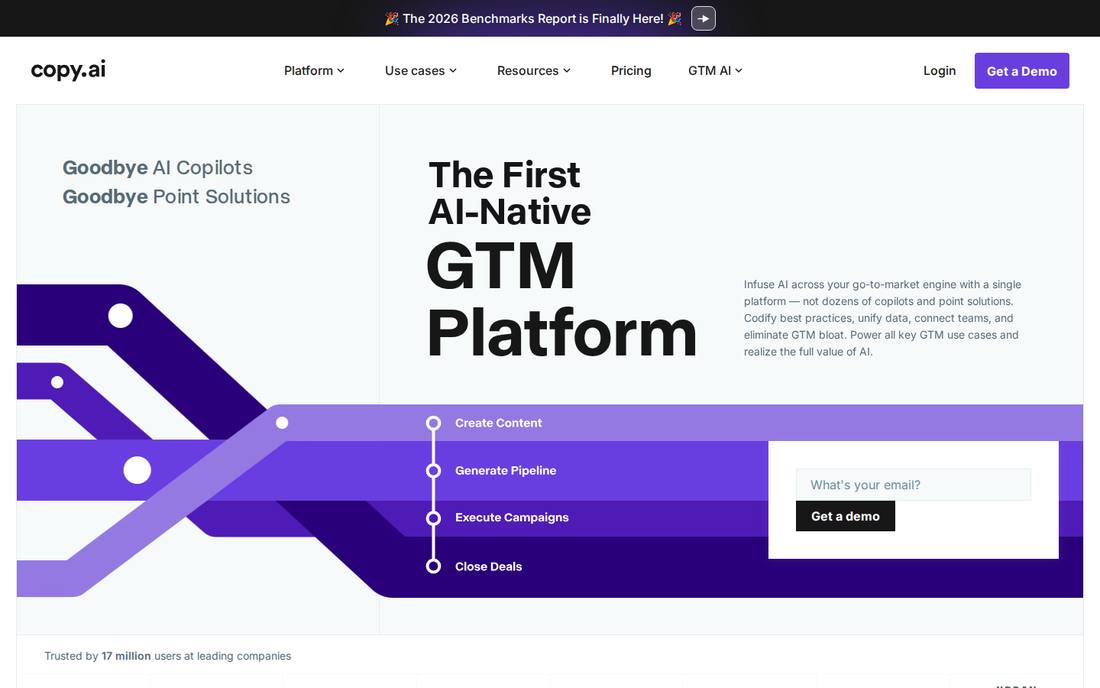
    1. Homepage: the pitch is go-to-market AI, not copywriting - the product has been rebuilt around workflows.
  2. Pricing: 29 USD monthly or 24 USD per month billed yearly (288 USD a year), with enterprise from 1,000 USD a month.
    2. Pricing: 29 USD monthly or 24 USD per month billed yearly (288 USD a year), with enterprise from 1,000 USD a month.
  3. Features: workflow builder, brand voice and integrations are presented as one system for sales and marketing teams.
    3. Features: workflow builder, brand voice and integrations are presented as one system for sales and marketing teams.
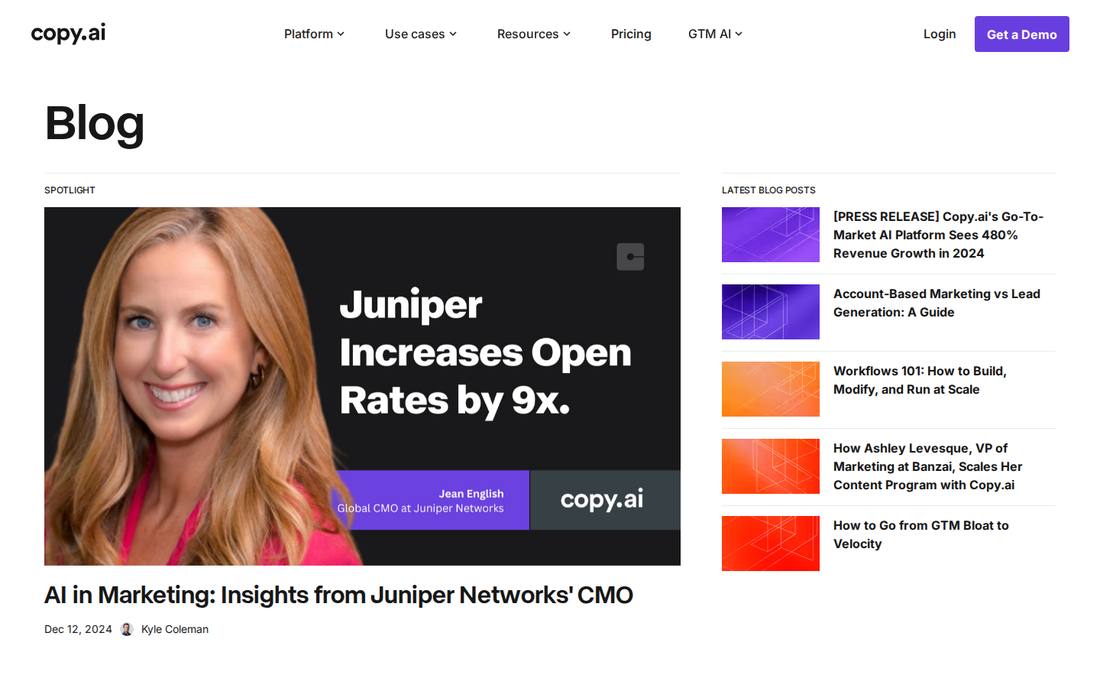
  4. The blog is the clearest signal of who they sell to: go-to-market teams, not individual bloggers.
    4. The blog is the clearest signal of who they sell to: go-to-market teams, not individual bloggers.

Where to get it

No affiliate program: this links to the official site.

Updates to this page

  • 2026-11-27Promotion detected on the vendor page: limited time. Checked 2026-11-27; the review text is not affected.
  • 2026-11-26Promotion detected on the vendor page: limited time. Checked 2026-11-26; the review text is not affected.
  • 2026-11-23Promotion detected on the vendor page: limited time. Checked 2026-11-23; the review text is not affected.
  • 2026-11-16Quoted figures still on the vendor page | promotion signals: limited time
  • 2026-11-16Quoted figures still on the vendor page | promotion signals: limited time
  • 2026-11-16Quoted figures still on the vendor page | promotion signals: limited time
  • 2026-11-16Quoted figures still on the vendor page | promotion signals: limited time
  • 2026-11-16Promotion detected on the vendor page: limited time. Checked 2026-11-16; the review text is not affected.
  • 2026-11-15Promotion detected on the vendor page: limited time. Checked 2026-11-15; the review text is not affected.
  • 2026-11-13Promotion detected on the vendor page: limited time. Queued for verification before we publish an offer.

Reader reviews

Loading reader ratings...

0 comments

Disclosure. This review contains no affiliate links — we are not enrolled in an affiliate programme for this product, although several tools in this category run one. Links point to the official website and cost you nothing extra.

Last updated 2026-11-27. Test conditions and results are documented in the “What we tested” section.

Prices and promotions are re-checked every Monday by an automated check; the last run was 2026-11-27. A change is published only after a person verifies it — see how we test.