
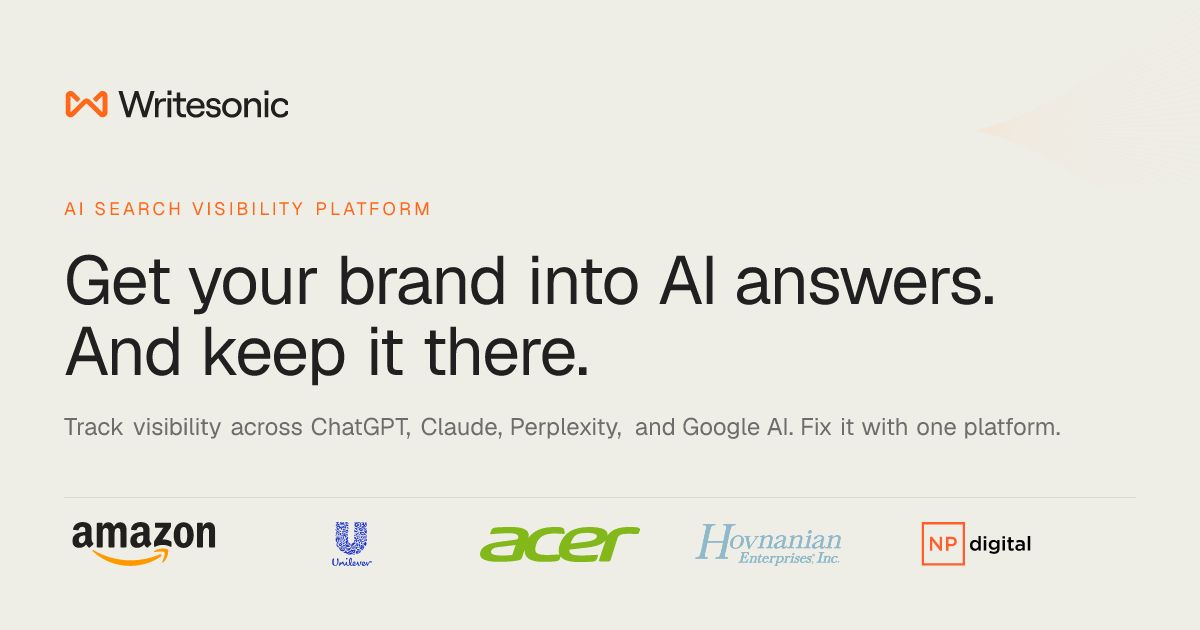
Writesonic began as a cheap article generator and now sells itself as an AI search visibility platform. This Writesonic review separates the two halves: the writing tool people search for, and the monitoring product the pricing is now built around.
What Writesonic is
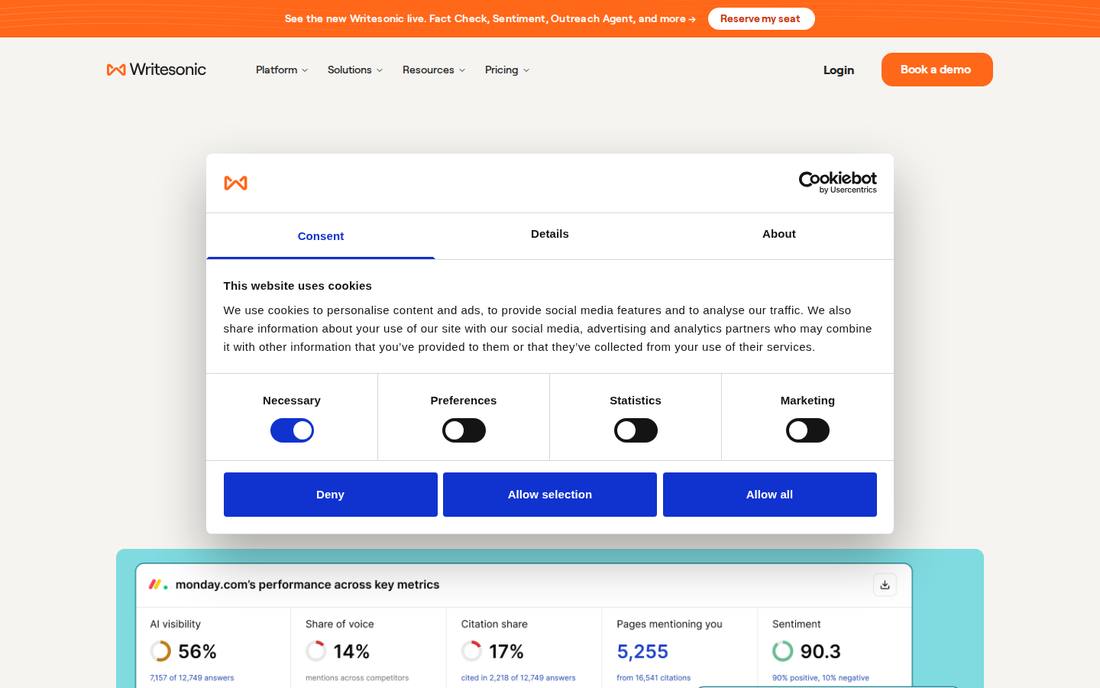
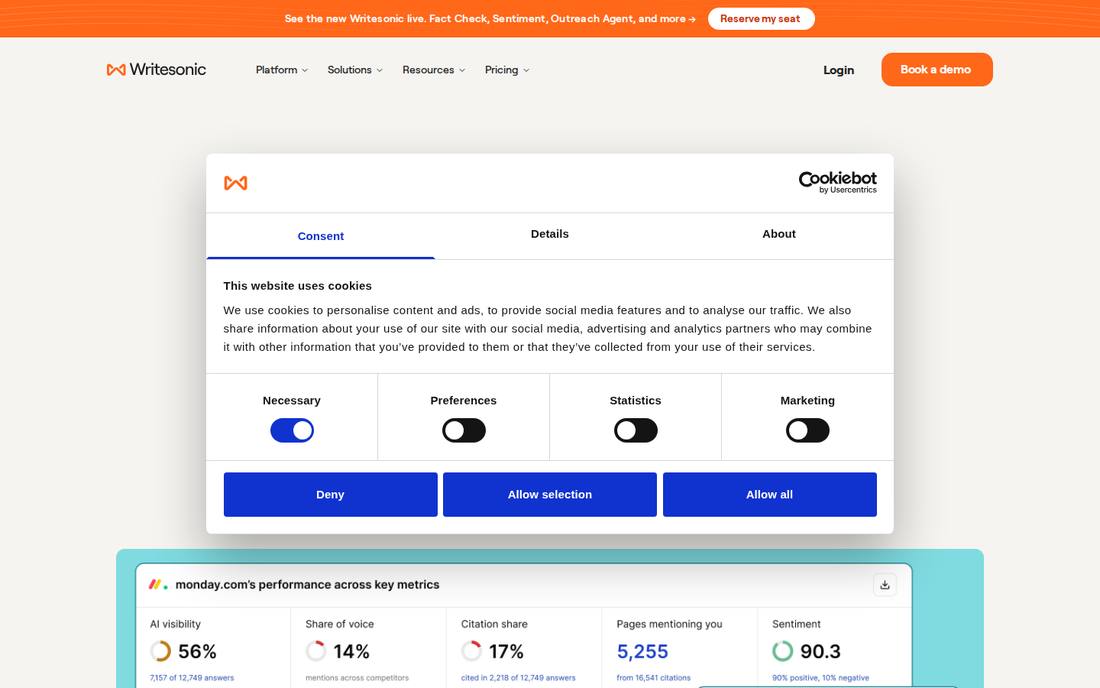
A web application with two overlapping products. The first is the article writer: give it a keyword, a brief and a tone, and it produces an outline, sections and a draft with citations. The second is visibility tracking: it monitors how AI answer engines describe your brand and scores the gap against competitors.
That second half is why the pricing looks the way it does. Article generation is a commodity in 2026; measuring what ChatGPT and AI Overviews say about you is not, and the monthly fees reflect the newer product rather than the older one.
What you see before you sign up
The homepage leads with the visibility pitch, the features page mixes both halves, and the pricing page is a ladder of credits. A 7-day trial is offered on the paid tiers, which is enough to write one or two long articles and judge the outline quality - not enough to evaluate monitoring that takes weeks to produce trends.
How the main workflows work
The article workflow is still the strongest part of the product: keyword to outline to draft to edit, with internal links suggested. The visibility workflow is a dashboard you check periodically rather than a tool you use daily.
Where it differs from Jasper is editorial control: Writesonic is built for people publishing articles, with headings, subheadings and citation slots, while Jasper is built for short marketing assets and brand voice. If your output is long-form, Writesonic's defaults fit better; if it is ads and emails, they do not.
Pricing, read carefully
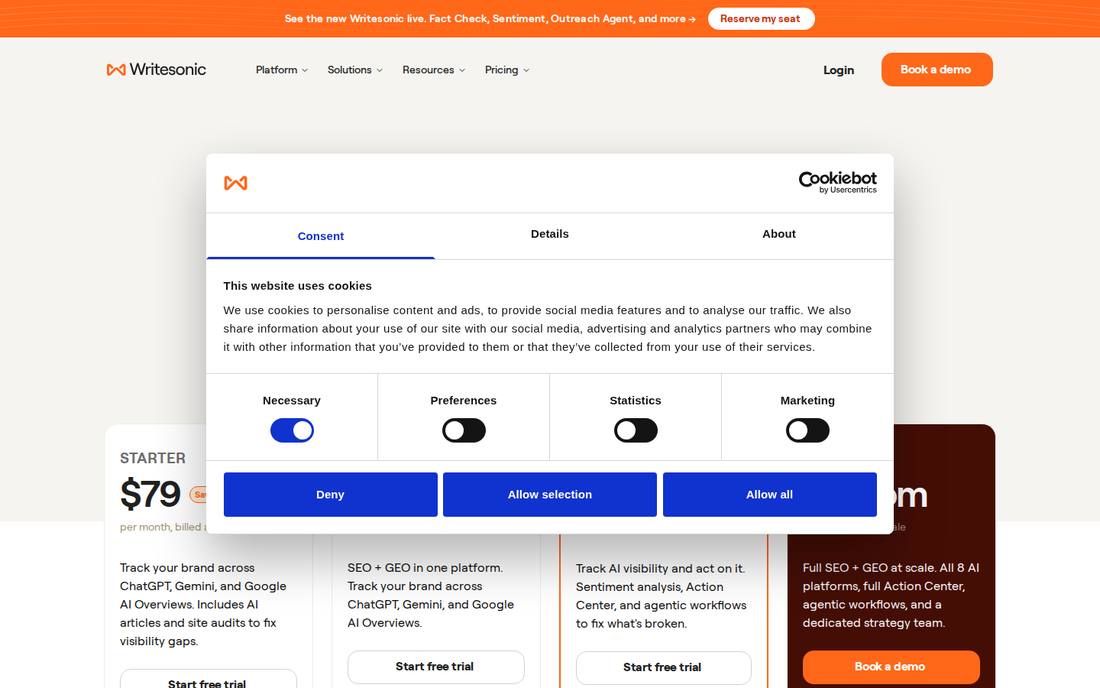
| Plan | Price per month, billed annually |
|---|---|
| Starter | 79 USD |
| Basic | 199 USD |
| Growth | 399 USD |
The ladder is volume and monitoring, not writing quality. A single blog needs Starter if anything; the higher tiers only make sense when you publish dozens of articles a month or you specifically want the AI visibility reporting. Note that the quoted figures are the annual-billing rate - monthly billing is higher, and the 7-day trial does not extend the billing period.
Who it is for, and who should skip it
It fits a content team publishing regularly that also wants to know how AI engines describe the brand. It fits anyone who wants an article-shaped workflow rather than a chat box.
Skip it if you write a few posts a month - 79 USD monthly is more than most writers spend on their whole stack - or if you want a general assistant for emails, ads and analysis. And skip it if the monitoring is the only thing you want: a dedicated brand-monitoring tool may do that part better.
How it compares with the other four
Against Jasper, Writesonic is cheaper at the top and more expensive at the bottom, and it is built for articles rather than campaigns. Against Copy.ai it is almost three times the entry price for a different job: workflows versus long-form. Against Anyword, it does not score copy. Grammarly is not a competitor here at all - different job, different buyer. The category view lives in our reviews index; how we test explains the procedure a hands-on score will follow.
What each plan actually includes
The plan pages are unusually specific, which makes them worth reading line by line. Starter includes 15 AI articles per month, 10 site audits of 100 pages each, and 50 tracked prompts with 150 answers daily. Basic doubles the tracking to roughly 100 prompts and 300 answers. Growth adds sentiment analysis; Enterprise adds an Action Center. The trial is 7 days with 10 trial runs, which is enough for two articles and no more.
Those numbers decide the buying question. Fifteen articles a month is a real content operation for a small site and nothing at all for a publisher. The audit and tracking limits are where the higher tiers earn their price - and where a user who just wants article drafts is paying for monitoring they will never open.
A real workflow, step by step
- Start from a keyword, not a blank page: the writer takes a keyword and produces an outline.
- Check the outline before generating - heading order is the one thing that is cheaper to fix now than after 2,000 words.
- Generate the draft with citations switched on if you intend to verify facts.
- Edit for claims: every number and quote needs a source you can open.
- Run the on-page check, then publish.
- Separately, open the visibility dashboard once a week and look at which prompts you are losing.
Steps 1 to 5 are a writing tool. Step 6 is a different product with a different cadence, and the pricing bundles them whether you need both or not.
Where it falls short
- Citations are a starting point, not a source of truth. Generated references need checking one by one.
- Fifteen articles a month is a hard ceiling on the entry plan; a busy month means upgrading mid-cycle.
- The visibility product is young. Prompt tracking of 50-100 queries is a sample, not a market view.
- No rank tracking against classic search, so it does not replace an SEO suite either.
Cheaper and more expensive alternatives
Cheaper: Copy.ai at 24 USD for workflow automation, or a general assistant plus an outline template. Same intent, different method: Jasper at 59 USD for brand voice rather than articles. More expensive: an SEO suite plus a human writer, which remains the benchmark Writesonic is trying to beat on price. If you only need articles, Starter at 79 USD is the most expensive per-article option in this group and the one with the most structure.
Questions we get
Do I need the visibility tracking? Only if you care how AI assistants describe your brand. For article production alone, it is overhead. Is one article a month realistic on the trial? Two, if you do not waste runs on outlines. Can I use my own sources? The writer accepts briefs and links; how well it uses them is exactly what we have not tested. Does it work for non-English content? Generation works; the citation and audit features are built around English-language search behaviour.
What the output is like, structurally
The drafts that come out of an article generator share a shape: an introduction that restates the keyword, five to seven sections with H2 headings, a conclusion, and a call to action that usually needs deleting. That shape is fine for informational posts and wrong for anything with a point of view. The editing work is therefore predictable - cut the first paragraph, merge two sections, replace the generic example with a real one, and add the sentence only you can write.
Budget an hour of editing for a 1,500-word draft, or roughly 60% of what writing it from scratch would cost. That is the actual saving: not the writing, the blank page. Anyone promising more is selling the trial experience rather than the fifth article.
Who it replaces, and who it does not
It replaces the outline-and-first-draft stage for a content marketer publishing regularly. It does not replace research, and it does not replace an editor who can tell that paragraph three argues against paragraph five. On a team of one, that means the tool saves the least enjoyable hour and leaves the judgement where it belongs.
The visibility half replaces a manual habit: someone typing the brand into ChatGPT every month to see what it says. Whether that habit is worth 79 USD a month depends on how much of your traffic comes from AI answers - and for most small sites, that number is still small enough to measure by hand.
What we have not tested - and will
Research-based review: public pages, no account. Open questions:
- How much editing a Writesonic article needs before it is publishable
- Whether the citations are real sources or plausible-looking text
- How visibility tracking behaves for a site with under a thousand visits
- Credit consumption for one 2,000-word article
- Whether the 7-day trial is long enough to judge the product fairly
Bottom line
Buy Starter if you publish long-form regularly and want a structured workflow; ignore the higher tiers unless you specifically need the AI visibility reporting. If articles are occasional, a cheaper tool plus a general assistant will cost less and produce comparable drafts.
Sources
- writesonic.com/pricing - tiers and prices, read 13 November 2026
- writesonic.com/features - article writer and visibility features, read 13 November 2026
- writesonic.com/affiliate - affiliate program page exists, read 13 November 2026







Reader reviews
Loading reader ratings...