
This Frase review is about a content tool that changed its pitch: it used to sell SEO briefs, and it now sells a pipeline that researches, writes, publishes to your CMS and then watches how the page performs in both Google and AI answers. The entry plan is 39 USD a month for ten articles, and the honest question is whether a small business needs a pipeline at all.
Prices are from frase.io/pricing, read 24 November 2026, USD with annual billing. No account was created, so this is a research-based review with no score - the rule is in how we test.
What Frase is
Three products that used to be one. Research: enter a keyword, get the questions people ask, the topics the top pages cover, and an outline you can edit. Writing: a document editor that scores your draft against that research, with an AI assistant that drafts sections from the outline. Distribution and monitoring: publishing to WordPress, Webflow, Sanity, Wix or Frase's own CMS, and then tracking how the page ranks and whether it is quoted in AI answers.
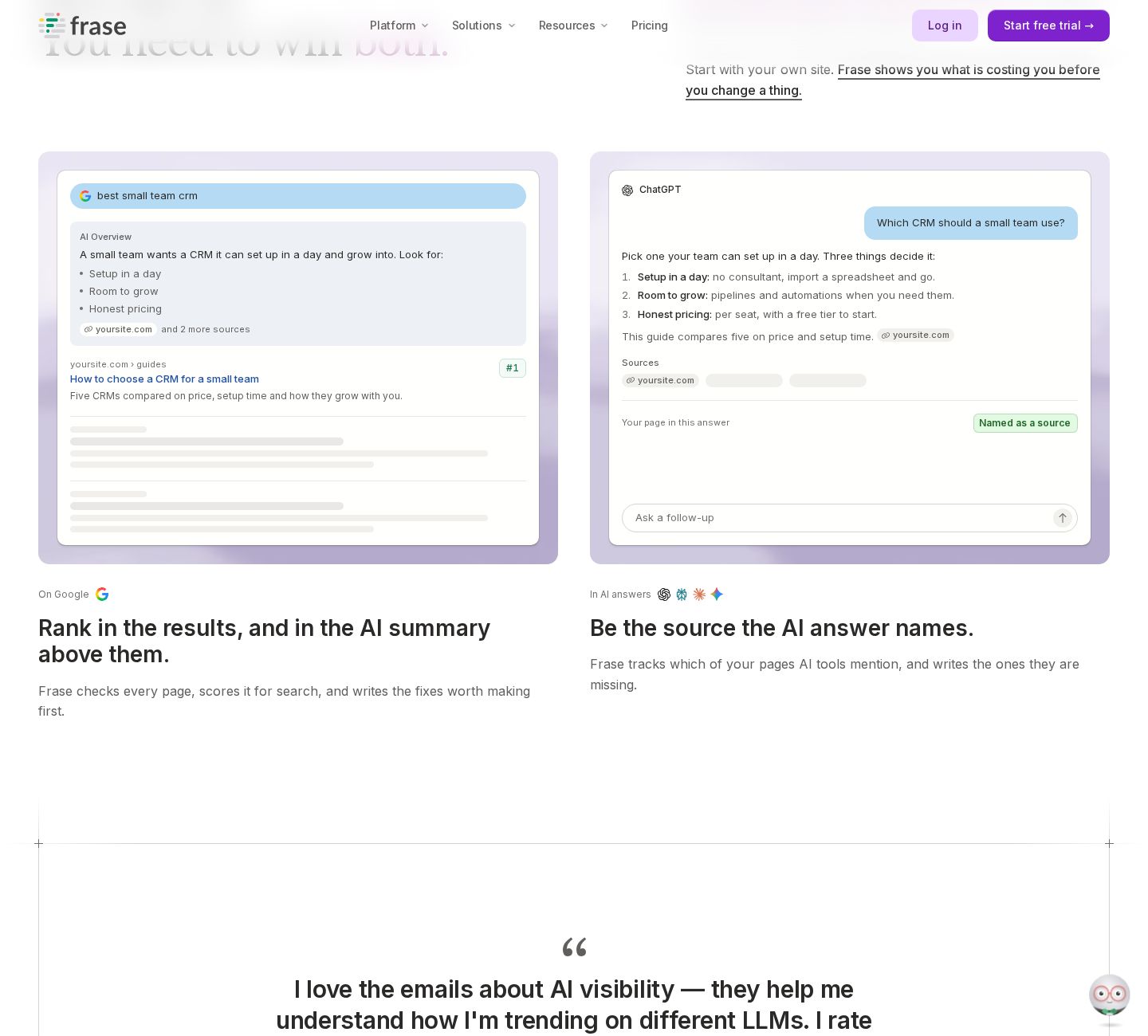
The newer layer is AI visibility - monitoring whether your brand appears in ChatGPT and Google AI answers, plus a GEO score (generative engine optimisation) alongside the classic SEO score. And Content Guard watches a set of pages for Google decay, which is a quietly useful idea: content rots, and nobody notices until traffic is gone.
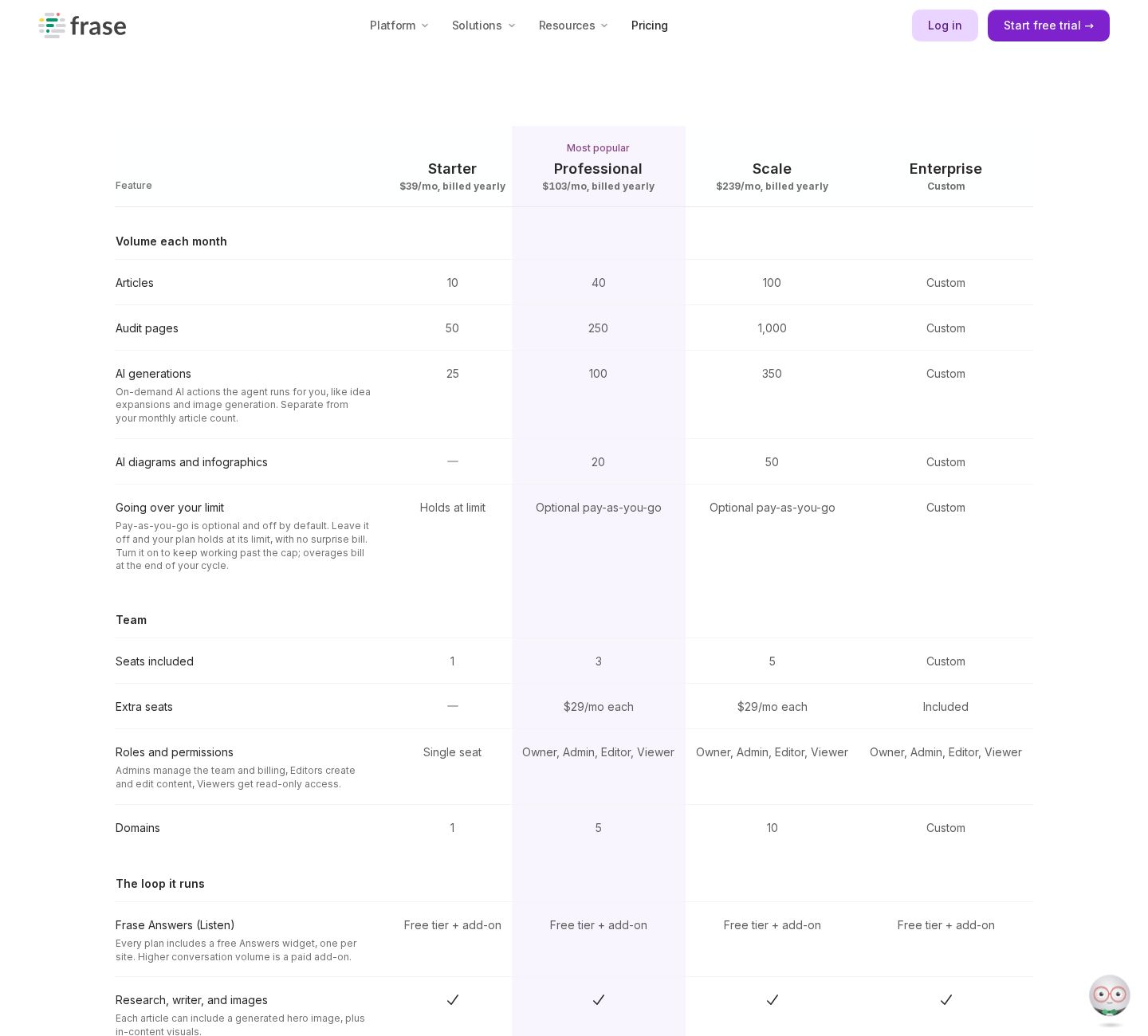
Pricing, precisely
| Plan | Price | Includes |
|---|---|---|
| Starter | 39 USD/mo (was 49), 468 USD billed yearly | 1 seat, 1 site, 10 articles and 50 audit pages a month, Content Guard on 10 pages |
| Team | 103 USD/mo (was 129) | 40 articles and 250 audit pages, content calendar, internal linking, Content Guard on 75 pages, AI crawler monitoring |
| Scale | 239 USD/mo | agencies and multi-site brands |
The unit that matters is articles per month, not seats or words. Ten articles on Starter is a real content calendar for one small site - two to three a week if you publish weekly - and it is nowhere near enough for an agency, which is why the ladder triples at each step.
The trial is seven days without a card, which is short for a content tool: research and drafting take longer than a week to judge, and the honest way to use it is to bring one real article you already planned and run it end to end rather than touring features.
What the research half is worth
The brief is the part that survives every AI shift: a list of the questions real people ask, the subtopics the ranking pages cover, and a structure you can hand to a writer. Frase does this well and, more importantly, shows its sources - you can see which pages informed each suggestion, which is the difference between a research tool and a guess.
Compared with Surfer, the two overlap heavily on the SEO brief and diverge after it. Surfer is a scoring engine for on-page optimisation; Frase is trying to be the whole pipeline, from question to published page to decay alert. If you already write in Google Docs and publish in WordPress, the pipeline matters; if you have a CMS workflow, you may only be buying the research.
What the AI visibility half is worth
Monitoring brand mentions in AI answers is the newest and least proven part of the product, and it is being sold hard. The honest position: it is useful as a directional check - are we mentioned when someone asks about our category - and unreliable as a metric, because AI answers vary by phrasing, region and day.
That does not make it worthless. A monthly check that your brand appears for five category questions is a better use of an hour than most reporting, and Frase automates it. Treat the number as a smoke detector, not a scoreboard.
Where it fails
- The seven-day trial is too short to judge a tool whose value is a workflow.
- Article caps are hard. Ten a month on Starter means the eleventh waits, which is a strange feeling for a subscription you already pay for.
- The AI writer produces drafts that need real editing. Any claim that it writes publishable articles is marketing; the outline plus a human writer is the honest workflow.
- Publishing integrations are the fragile part - CMS APIs change, and a failed publish at 6 p.m. on a Friday is a support ticket.
- Scope creep. Research, writing, publishing, monitoring and a chatbot widget in one subscription means some parts are thinner than the specialist tools they replace.
How it compares
| Entry price | Unit | Research depth | Pipeline | |
|---|---|---|---|---|
| Frase | 39 USD/mo annual | articles per month | strong briefs with sources | research, write, publish, monitor |
| Surfer | about 99 USD/mo annual | users and articles | strong on-page scoring | optimisation only |
| Clearscope | higher, quote-based | seats | best-in-class topical coverage | optimisation only |
| A writer plus search data | variable | none | whatever you do yourself | no |
The last row is not a joke. A freelancer with a keyword tool and a good outline can produce the same article for less money per piece; what Frase sells is the removal of the assembly work between the steps, and that is worth paying for only if you are producing regularly.
Who should buy it
A one-person content operation publishing weekly. Starter at 39 USD for ten articles a month is a fair price for research and a drafting head start.
A small agency producing content for a handful of clients. Team tier with 40 articles and the content calendar, if the publishing integrations hold.
Anyone whose traffic has quietly declined and who wants a decay alarm - Content Guard is the sleeper feature here.
Who should not
A business publishing two articles a month: the subscription costs more than the writing. A team with a strong editorial process and an SEO already using a scoring tool - you would be buying a second opinion. And anyone expecting the AI to write publishable articles without an editor, which is not what the output is.
Questions people ask
Is the AI writing any good? It drafts sections that follow the outline competently and need editing for facts, tone and specificity - treat it as a first draft, not a finished article.
What counts as an article? A document created against a research brief; the cap is monthly and hard.
Does it publish to WordPress? Yes, alongside Webflow, Wix, Sanity and its own CMS - check that your theme's fields map cleanly before relying on it.
What is the GEO score? A score for how well a page is structured to be quoted by AI answers; useful as a checklist, not as a ranking factor you can verify.
Is the 7-day trial enough? Barely - bring one real article to it rather than exploring.
What we have not tested - and will
No account was created for this page. The checks that would produce a score:
- Whether an article built on a Frase brief ranks better than one written without it, over three months and ten pieces
- Editing time per article compared with a manual workflow
- Publish success rate to WordPress across five attempts, including custom fields
- Whether AI visibility monitoring catches a known mention we can verify by hand
- Content Guard's decay detection on a page we deliberately let rot
- Quality of the AI drafts on a technical topic where accuracy is checkable
- Article cap behaviour at the end of a billing month
Bottom line
Frase is a content pipeline sold at a content-tool price: 39 USD a month for ten researched articles, publishing and a decay alarm, with AI-visibility monitoring as the newest and least proven layer. The research is the part worth paying for; the writing is a head start, not a replacement.
If you publish weekly on one site, it removes enough assembly work to justify itself. If you publish occasionally, the same money buys better articles from a writer - and no subscription will fix a content plan that does not exist.
Every vendor link on this site is disclosed in the affiliate disclosure; a commission never changes a score. Our rules are in the editorial policy, and the rest of the reviews are in the review index.
Sources
All pages read on 24 November 2026:
- Frase homepage: frase.io - research briefs, AI drafting, publishing integrations, AI visibility monitoring, Content Guard
- Frase pricing: frase.io - Starter 39 USD per month (was 49) with 468 USD billed yearly, 1 seat and 1 site, 10 articles and 50 audit pages monthly, Team 103 USD (was 129) with 40 articles, Scale 239 USD, 7-day trial







Reader reviews
Loading reader ratings...