
Fliki is what happens when a text-to-speech engine grows a video editor. This fliki review is about the specific case it serves - narrated, faceless video produced at volume - and about the two limits that decide whether it fits: fifteen minutes per video on the entry plan, and 180 credits a month.
What Fliki is
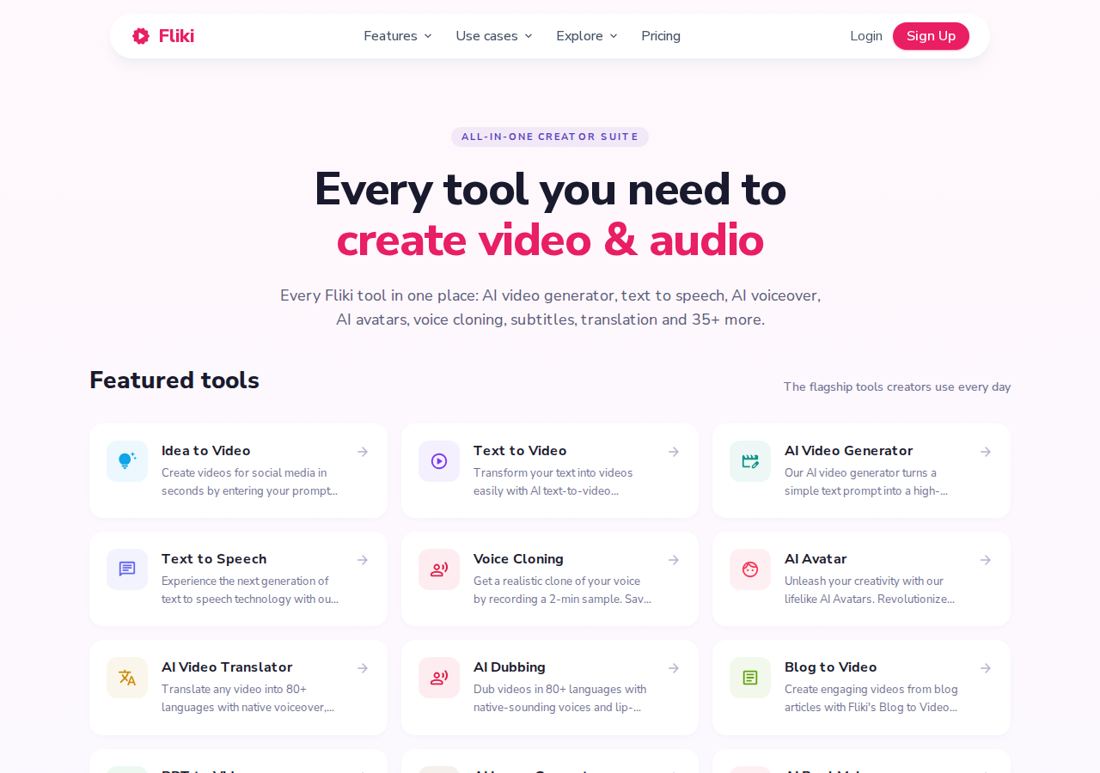
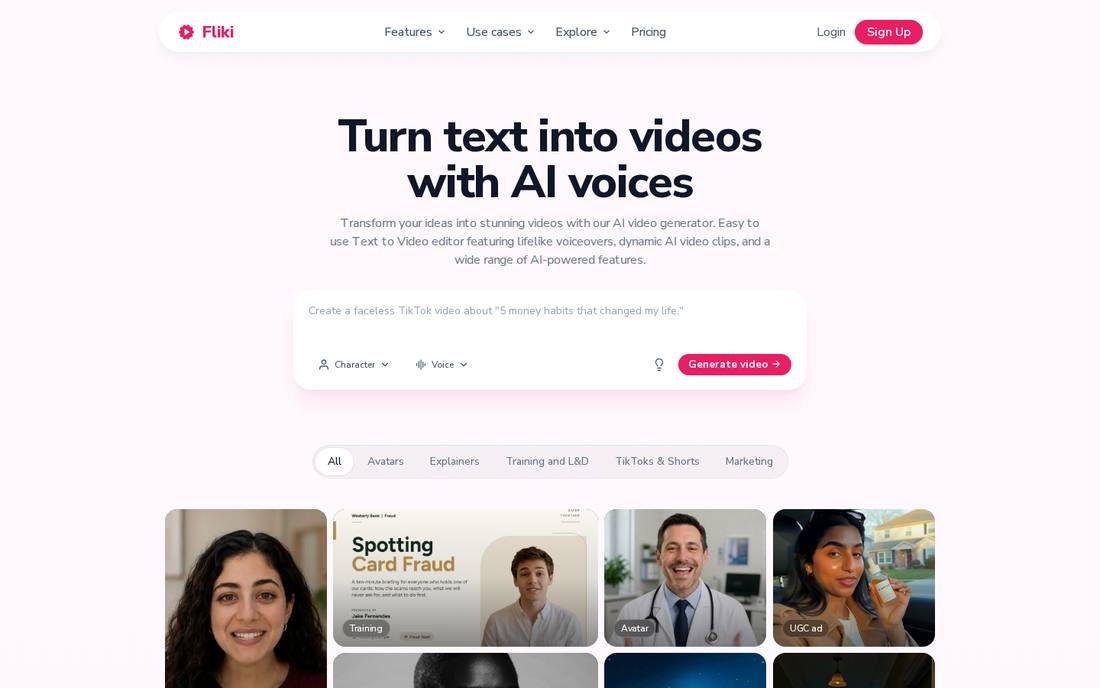
A generator that takes text - a script, a blog post, a list of facts - and returns a video: stock footage matched to the sentences, a synthetic voice reading them, captions, and a soundtrack. It carries a thousand voices, half of them marketed as ultra-realistic, plus voice cloning, a set of stock avatars and the ability to keep a character consistent across a series.
The positioning is honest: this is a tool for channels that never show a face and publish on a schedule.
What you see before you sign up
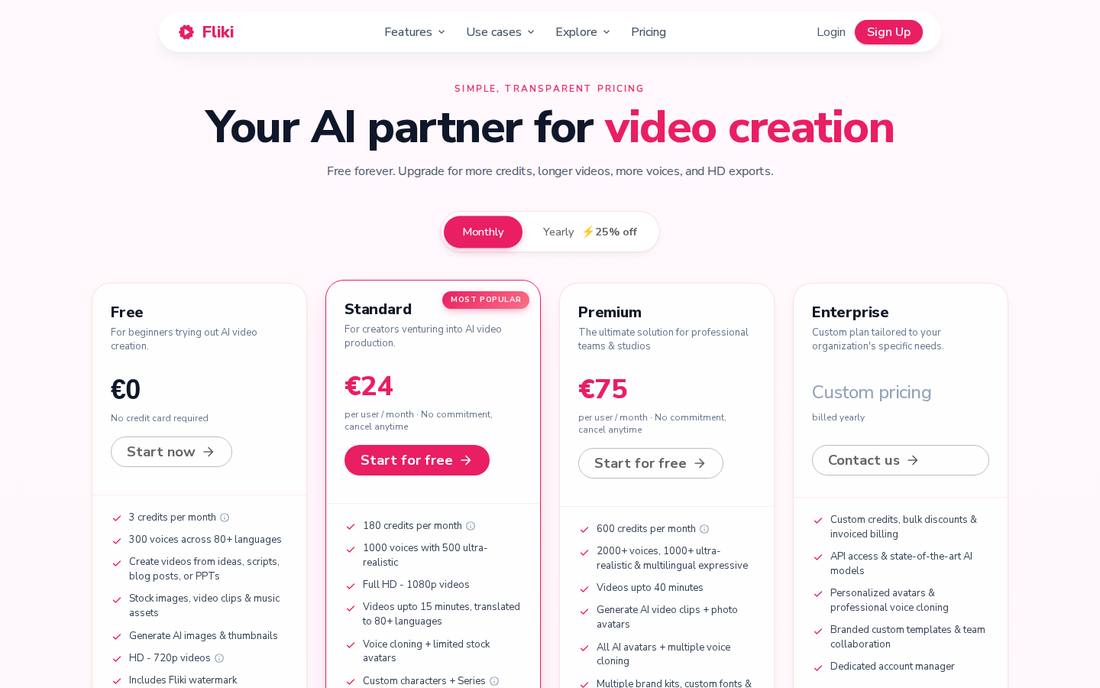
The homepage leads with voice quality and language count, which is where Fliki competes. The pricing page is unusually clean for this category: two tiers, monthly, no annual trap, and the differentiation stated in credits and maximum video length rather than in vague feature lists. Standard is 24 EUR a month with 180 credits and videos up to 15 minutes; Premium is 75 EUR with 600 credits and up to 40 minutes.
We are not enrolled in Fliki's affiliate programme, so nothing here earns a commission; the affiliate disclosure explains how it will be marked when that changes.
How the credits and lengths interact
A credit roughly maps to a minute of generated video, so Standard's 180 credits is three hours of finished video a month - generous for a weekly channel, thin for a daily one. The length cap matters more than the credits for one specific buyer: anyone producing 20-minute explainers cannot use Standard at all, regardless of how many credits are left. Check the cap before the credits.
Revision behaviour is the same as everywhere: a minute of finished video consumes more than a minute of credits once you regenerate scenes, so budget a third more than your published runtime.
What a real workflow looks like
Paste the script, let Fliki split it into scenes, pick a voice and a look, replace the stock clips that do not fit, export. Then fix the three sentences where the voice mispronounced something and re-render those scenes only.
The step that decides quality is clip replacement. Fliki's first assembly is serviceable and generic; what makes a video watchable is replacing a third of the clips with something that matches the sentence rather than the keyword. That is editing, and it is the same hour per video that every stock-footage tool demands.
Where it fails
- Faceless video fatigue. Audiences are now fluent in this look: stock clip, synthetic voice, captions. It works for informational channels and badly for anything that needs trust.
- Matching is literal. A sentence about a hard decision gets footage of a person at a desk looking worried.
- Voice cloning is a feature, not a strategy. A cloned voice reading a badly written script is still a badly written script.
- The 15-minute cap on Standard is a hard wall for course and explainer producers.
- No timeline depth. Multi-track editing, ducking music manually, precise cuts - none of it. If the video needs craft, this is the wrong tool.
Who it is for, and who should skip it
It fits faceless YouTube channels, affiliate content producers working in several languages, small publishers who need a video version of an article, and anyone selling information in a market where filming is impractical. It fits teams that want a monthly bill with no commitment.
Skip it if the video needs a human face or a real location. Skip it if the output is longer than fifteen minutes and you are not prepared to pay 75 EUR. Skip it if craft is the point - a launch film made of stock clips reads as a stock film, and the audience can tell.
How it compares with the other three
Against InVideo, both assemble stock footage and narration, and the split is clear: Fliki wins on voices and translation, InVideo wins on the editor and on price per seat for a small team. Against Pictory, the direction differs entirely - Pictory finds clips inside footage you recorded, Fliki makes footage for a script you wrote. Against HeyGen, the difference is the face: Fliki offers stock avatars with limited motion, HeyGen builds one from your own footage.
The whole category is compared on /category/ai-video, and the procedure behind a future score is in how we test.
The translation angle is the real product
Eighty-plus languages with a voice per language is not a feature-list item, it is the business case. A publisher with an English channel can put the same script into German, Spanish and Portuguese without hiring a narrator, and the marginal cost of each version is a rendering rather than a studio session.
The caveat is the same one that applies to every translated synthetic voice: have a native speaker listen once. A voice that mispronounces the brand name in the first three seconds costs more credibility than the translation buys reach.
Cost per finished minute
At 24 EUR for 180 credits, a channel publishing four ten-minute videos a month spends about 6 EUR per video before editing time. That is cheaper than licensed music for the same four videos, and it is the reason this category exists. The hidden cost is the hour per video spent replacing clips, which no tier reduces.
What we have not tested - and will
Research-based review: public pages plus our own captures, no account. Open questions:
- Credits consumed by one ten-minute video including two rounds of scene fixes
- Voice quality in German and Portuguese against a native listener
- How often the first assembly needs every clip replaced
- Export time and file size at 1080p
- Whether a series character stays consistent across ten videos
Bottom line
Fliki is the honest choice for faceless, narrated video at volume, and the wrong choice for anything that needs a face, a craft or twenty minutes on screen. Standard at 24 EUR is a low-risk first month precisely because there is no annual commitment - use that month to answer one question: after replacing the clips that do not fit, would you publish the result under your own name?
If the answer is yes, Fliki earns its place next to a stock subscription. If it is no, the problem is the format rather than the tool, and a different tier will not fix it.
Sources
- fliki.ai/pricing - tiers, credits, video length caps, read 13 November 2026
- fliki.ai/features - voices, translation, avatars and characters, read 13 November 2026
- fliki.ai/pricing - credit tiers and video minutes, read 23 November 2026
Faceless does not mean anonymous
The channels that succeed with this format share one trait: a consistent editorial voice. The footage is generic, the voice is synthetic, and the only thing carrying identity is what the script says and how it is said. That is a writing job, and it is why the tools in this category look identical in the hands of people who have nothing to say.
Two practical habits make the difference. Keep a series character and a fixed intro so viewers recognise the format within two seconds. And write the script for the ear - short sentences, numbers spoken as words, no subordinate clauses that read fine and die when narrated.
A note on the credit cap
180 credits a month is three hours of finished video, which sounds generous until revisions. Two regenerated scenes per video, four videos a month, and the allowance is gone before the quarter ends - the moment to price Premium is the month you start rationing, not the month you run out.
Who actually pays for this
Three buyers, and only one of them is the obvious one. Affiliate publishers pay because a video version of an article converts on platforms where a link does not. Translators and localisation shops pay because one script becomes eight videos without eight narrators. And small publishers pay because the alternative is no video at all, which is a real constraint rather than an excuse.
What none of them get is a shortcut past writing. The tool removes the camera, the microphone and the studio; it does not remove the need for something worth saying.






Reader reviews
Loading reader ratings...