
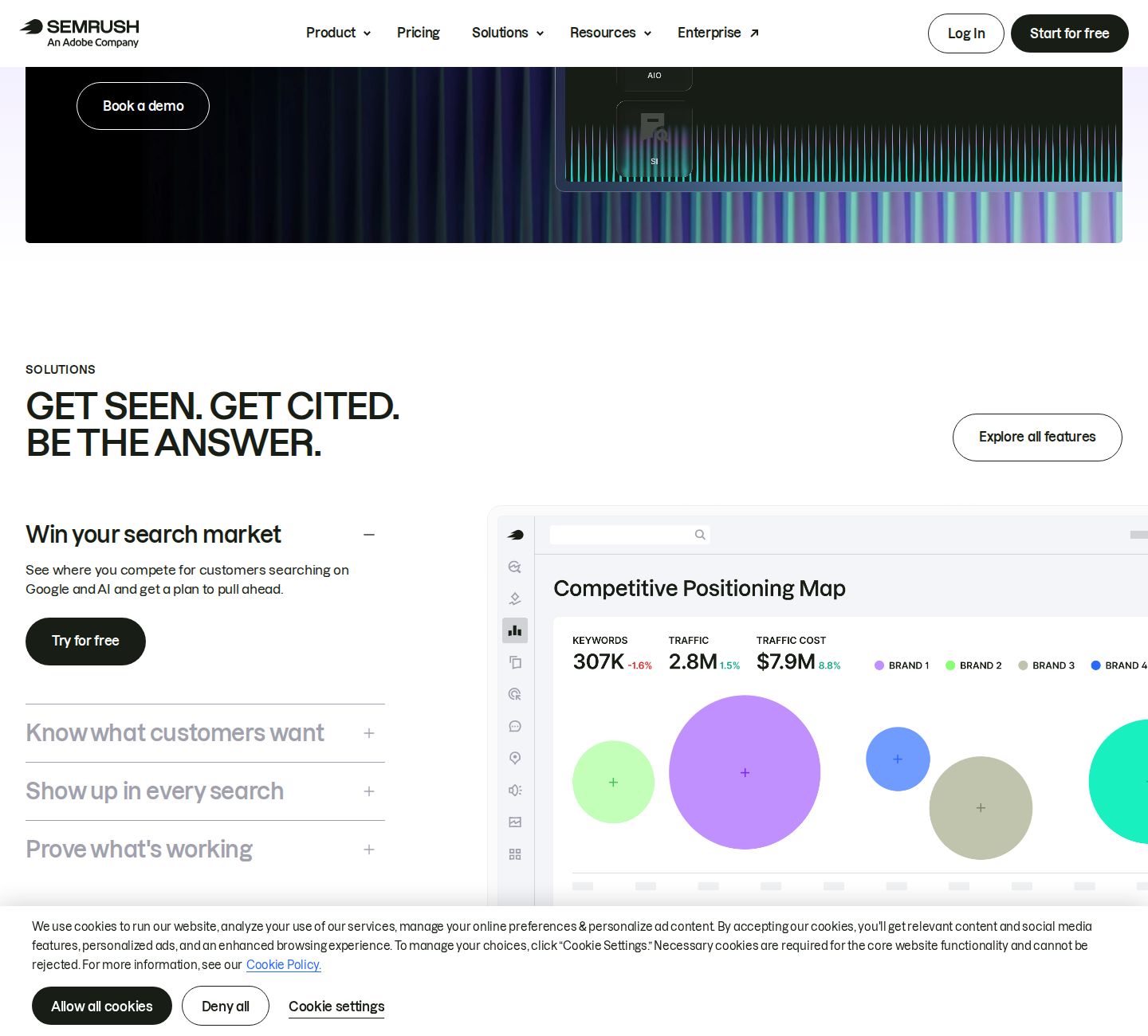
This Semrush review is about the subscription that replaces four tools and charges accordingly: from about 112 EUR a month for the entry tier, each plan a bundle of SEO, competitor research, content and now AI-search visibility, with limits expressed in projects and tracked keywords rather than in features.
Prices are from semrush.com/pricing, read 23 November 2026, in EUR with annual billing. No account was created, so this is a research-based review with no score - the rule is in how we test.
What Semrush is
A suite rather than a specialist. The core is still keyword and competitor research - the domain overview that shows where a competitor's traffic comes from, the keyword magic tool that produces thousands of related terms with volume and difficulty, position tracking, site audit, backlink analytics. Around that sit modules the specialists do not have: PPC research, content templates and the SEO writing assistant, social posting, local listings, and a newer layer of AI-visibility tracking that monitors brand mentions in AI answers.
For a business that needs one subscription rather than five, that breadth is the point. For a business that needs one thing done well, it is a lot of surface area to pay for.
Pricing, precisely
| Plan | Price (annual) | Monthly list | Limits |
|---|---|---|---|
| Starter | 112.52 EUR/mo | 134 EUR | 5 websites, 500 keywords tracked daily |
| Pro | 158.40 EUR/mo | 190 EUR | wider limits, more projects |
| Pro+ | 238 EUR/mo | 286 EUR | 100 prompts tracked daily, more AI features |
| Advanced | custom | - | 40+ websites, 5,000+ keywords, API |
Three observations from the table. The annual discount is real - roughly 16% - and it is the difference between the advertised price and what a monthly subscriber pays, which catches people who sign up before reading the toggle. The limits are projects and keywords, not features: every tier has the same tools, so the upgrade decision is "how many sites and how many keywords", which is easier to plan than a feature matrix but harder to compare across vendors. And Pro+ exists for AI visibility specifically, at 238 EUR, which tells you where the product is being pushed.
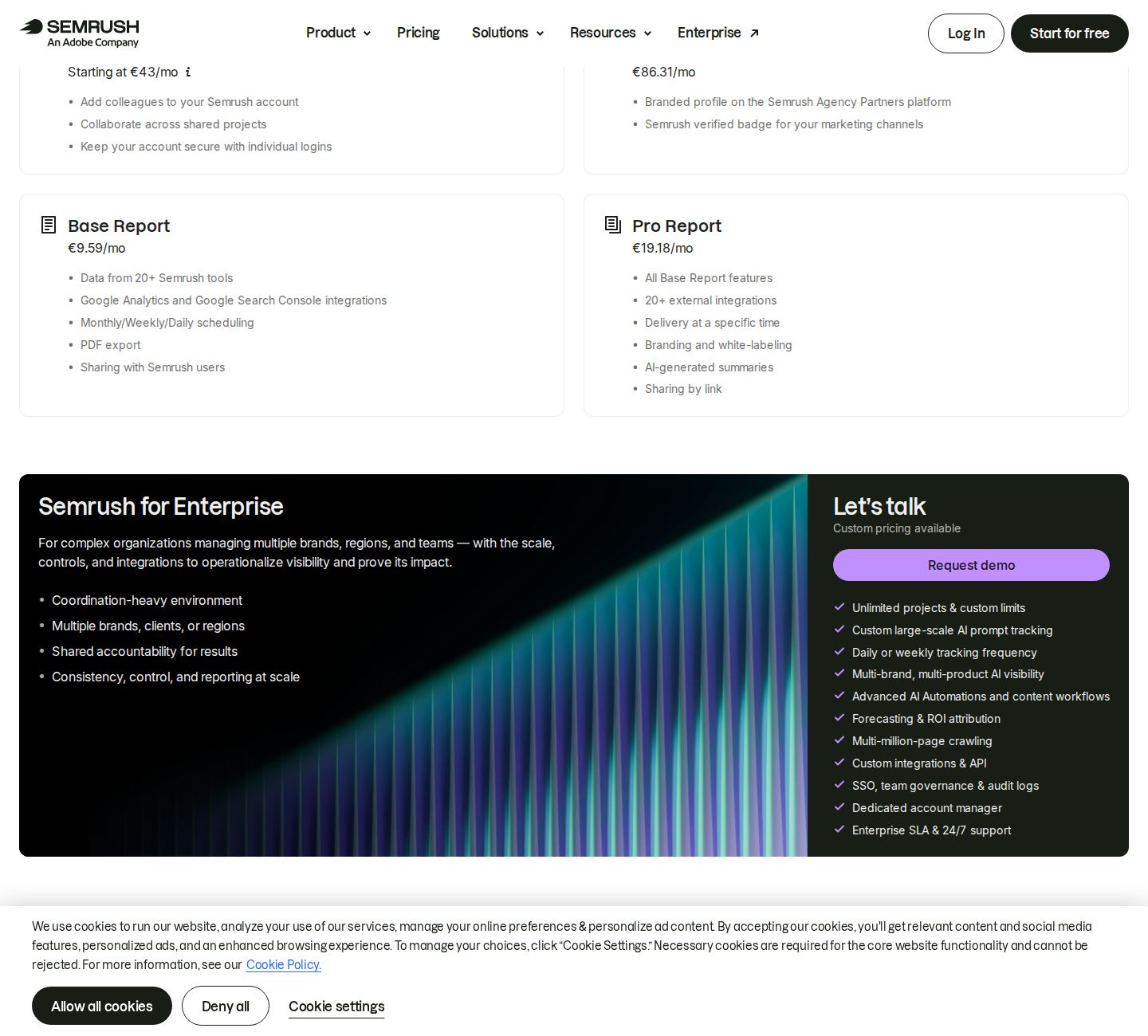
The add-on line is where budgets leak: local, trends and AI add-ons are priced separately starting around 43 EUR a month, and the AI visibility module alone has its own tiers. A "full" Semrush is rarely the number on the pricing page.
What the suite actually replaces
Keyword research and competitor analysis. The domain overview is the feature most people subscribe for: type a competitor, see how much traffic they get, which pages earn it, and which keywords those pages rank for. That single report is usually enough to justify the first month.
Position tracking with daily updates. Not unique, and better implemented here than in most tools: keyword groups, device and location splits, and a share-of-voice view against competitors.
Content tooling. The writing assistant checks a draft against the keywords the page targets and flags coverage gaps - useful as a checklist, not as a writer. Around it sit templates and briefs that shorten the research-to-draft step.
PPC and paid research. Ad copy, budgets and keyword spend for competitors, which a pure SEO tool cannot offer. If you run ads, this replaces a second subscription.
AI visibility. Tracking whether your brand appears in AI answers, with prompt monitoring and sentiment. New, unproven, and clearly where the pricing emphasis now sits.
Where it fails
- Breadth costs money and attention. You pay for modules you may never open, and the interface is dense enough that new users underuse it.
- Limits are counted, not felt. Five websites and 500 tracked keywords on Starter sound generous until the third client and the fourth content cluster.
- Add-ons fragment the price. The headline plan is not the full product; local and AI modules are separate.
- Data depth on backlinks is good but not Ahrefs-good, and the difference shows on large or obscure domains.
- Annual-billing bias: the advertised price assumes a year, and monthly costs about 16% more.
How it compares
| Entry price | Model | Strongest module | Weakest | |
|---|---|---|---|---|
| Semrush | about 112 EUR/mo annual | suite, project limits | competitor and PPC research | backlink depth, price |
| Ahrefs | 119 EUR/mo | specialist | backlink index | no ads or content tools |
| Mangools | about 38 EUR/mo annual | budget specialist | keyword research value | thin suites, small limits |
| Search Console | free | diagnostic | your own site | no competitor data |
The decision between Ahrefs and Semrush is the oldest argument in this industry and it comes down to what you do all day. If link building is the job, Ahrefs. If you do research, content, ads and reporting for clients, the suite saves two subscriptions and the backlink gap rarely matters.
One practical warning before subscribing: the interface is large enough that the first week should be spent on one module only, usually competitor research, rather than touring every tab - teams that tour tend to cancel in month two.
Who should buy it
An agency or freelancer with several clients. The project limits map to a client list, and the reporting is presentable without extra work.
A business running ads and content together. PPC research plus the writing assistant is a real combination, not a bundle of unrelated tools.
Anyone who wants AI-visibility tracking alongside classic SEO - it is the one place where a suite has an advantage no specialist matches yet.
Who should not
A small business with one site and a blog: Mangools at a third of the price does the keyword work, and Search Console does the rest. A link-building specialist, who will be disappointed by the backlink index relative to Ahrefs.
Questions people ask
Is the yearly price really cheaper? Yes, about 16%: Starter is 112.52 EUR a month annually against 134 monthly.
How many websites on Starter? Five, with 500 tracked keywords daily - the limit most people hit first.
Do I need Pro+? Only for heavier AI-prompt tracking (100 prompts daily) and the wider AI features. For classic SEO, Starter or Pro is enough.
Are local and trends included? No - they are separate add-ons starting around 43 EUR a month.
Can I cancel monthly? Yes, but the monthly rate is higher and annual plans are billed upfront.
What we have not tested - and will
No account was created for this page. The checks that would produce a score:
- Keyword volume accuracy against Search Console impressions on twenty terms
- Whether 500 tracked keywords is enough for a real content calendar
- Backlink overlap with Ahrefs on the same domain, to measure the gap concretely
- Time from signup to the first useful report, which is where suites lose new users
- Whether the AI visibility data is stable week to week or noisy
- Add-on pricing in the checkout flow, since the page only shows "from"
- Export limits on Starter, which decide whether reports are usable
Bottom line
Semrush is the best all-in-one subscription in this market and it is priced like one: about 112 EUR a month annually for the entry tier, more once AI visibility and local modules are added. For an agency doing research, content and ads for several clients, the suite replaces two or three tools and pays for itself.
For a single site with a blog, it is overkill - not because the product is weak, but because you would be paying for five modules to use one. Buy the suite when your week spans channels; buy a specialist when it does not.
Every vendor link on this site is disclosed in the affiliate disclosure; a commission never changes a score. Our rules are in the editorial policy, and the rest of the reviews are in the review index.
Sources
All pages read on 23 November 2026:
- Semrush homepage: semrush.com - keyword research, competitor analysis, content and AI visibility modules
- Semrush pricing: semrush.com - Starter 112.52 EUR per month billed annually (134 monthly), Pro 158.40 (190), Pro+ 238 (286), Advanced custom, add-ons from 43 EUR








Reader reviews
Loading reader ratings...