
Disclosure first: VerdictMill and email-validaton.com are run by the same person. That is why this page carries no score and no affiliate link, and why it sticks to what can be checked on the public site. Treat this email validaton review as a product description written by the operator plus an honest account of the pricing, not as an independent test - our editorial policy explains why we label it this way.
Email Validaton is an email verification service: you give it an address and it tells you whether the mailbox exists, whether the domain accepts mail at all, and what kind of address it is. That sounds like a small utility until you send a campaign to a list that was never cleaned - then the bounce rate decides whether the next send lands in the inbox or in the spam folder.
The domain spells validaton, one i short of validation. That is the real name of the product and it is worth saying once, because a buyer who types the correct spelling lands on a different site.
What it checks
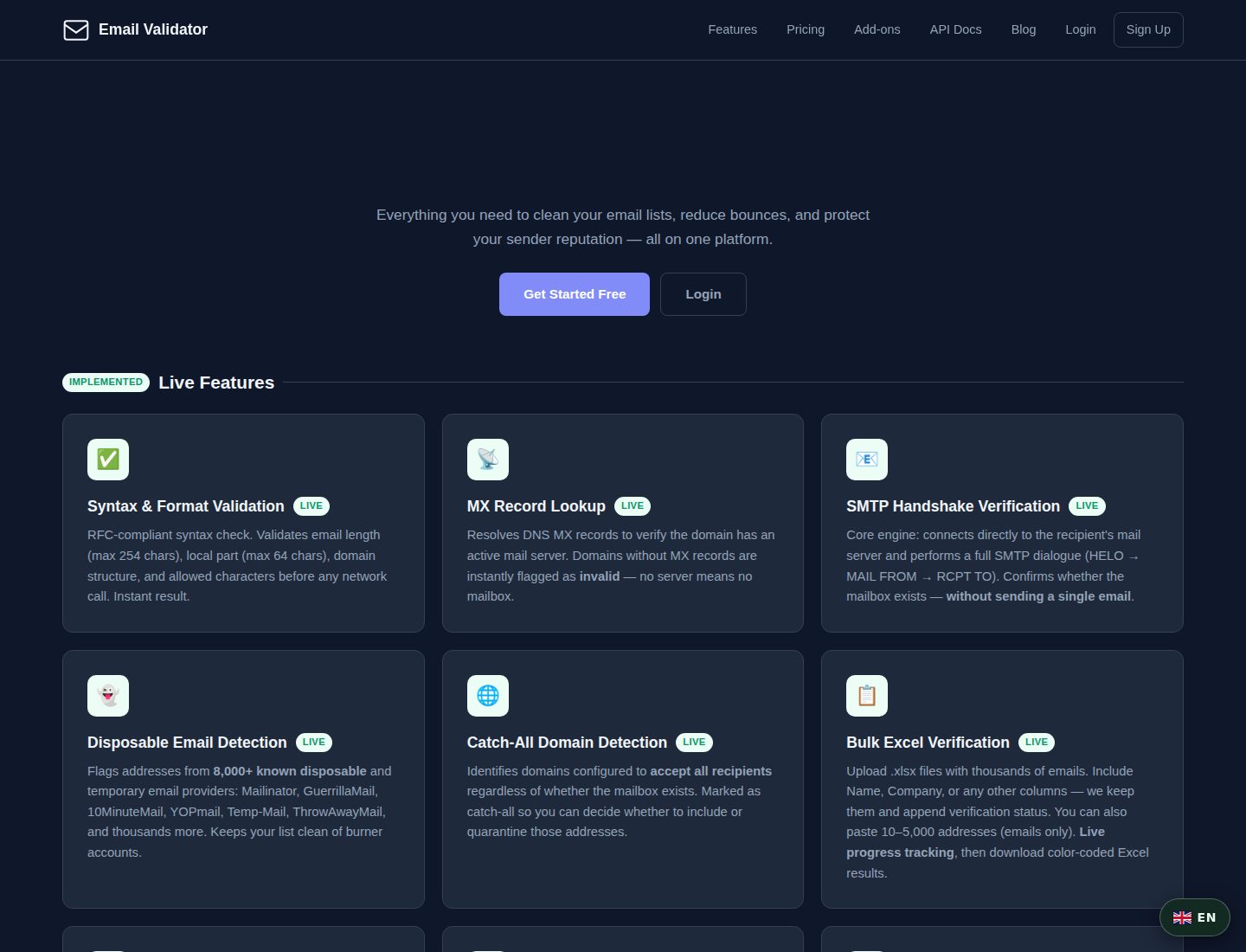
The public feature list is unusually explicit about the order of operations, which is the part that matters in this category:
- Syntax and RFC rules - length limits (254 characters for the address, 64 for the local part), allowed characters, domain structure. This runs before any network call, so malformed addresses cost nothing.
- MX lookup - resolves the domain's mail exchanger. A domain with no MX record cannot receive mail, so it is flagged immediately without probing.
- SMTP handshake - connects to the mail server and asks whether the mailbox exists, which is the only step that can distinguish a real address on a live domain from a plausible one.
- Catch-all and disposable detection - a domain that accepts every address cannot be verified by SMTP at all, so it has to be reported as catch-all rather than guessed as valid. Disposable domains are detected separately.
- DMARC monitoring - domains you add to the account, plus monitored lists, with reports on who is sending as your domain and whether SPF, DKIM and DMARC line up.
- Phone validation - offline checks free, network checks metered.
- API and bulk - the same engine through an endpoint, or through a list upload.
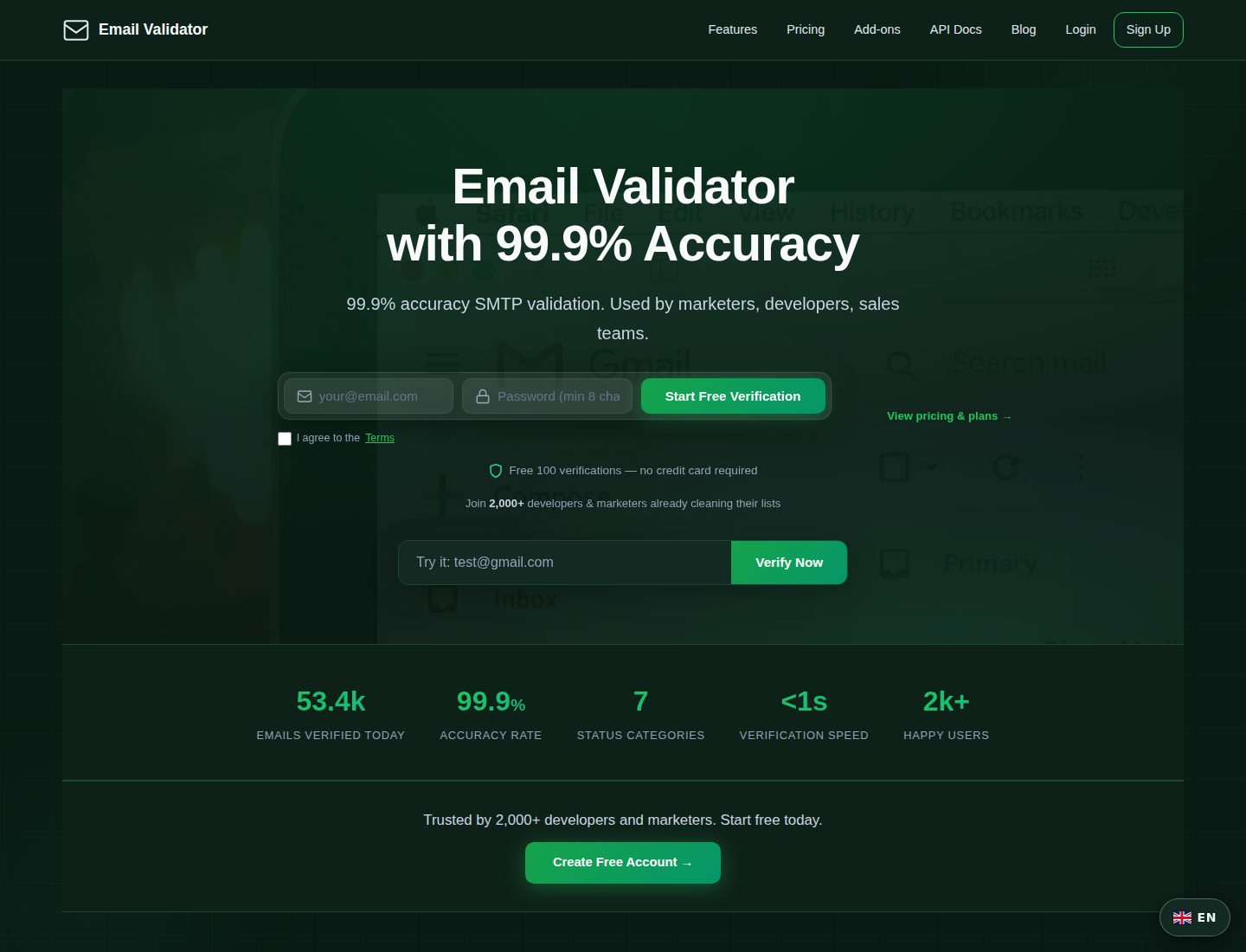
The homepage reports seven status categories, which is the honest way to present this: valid and invalid are the easy answers, and the interesting work is in catch-all, unknown, disposable, role-based and abusive addresses.
What a check costs
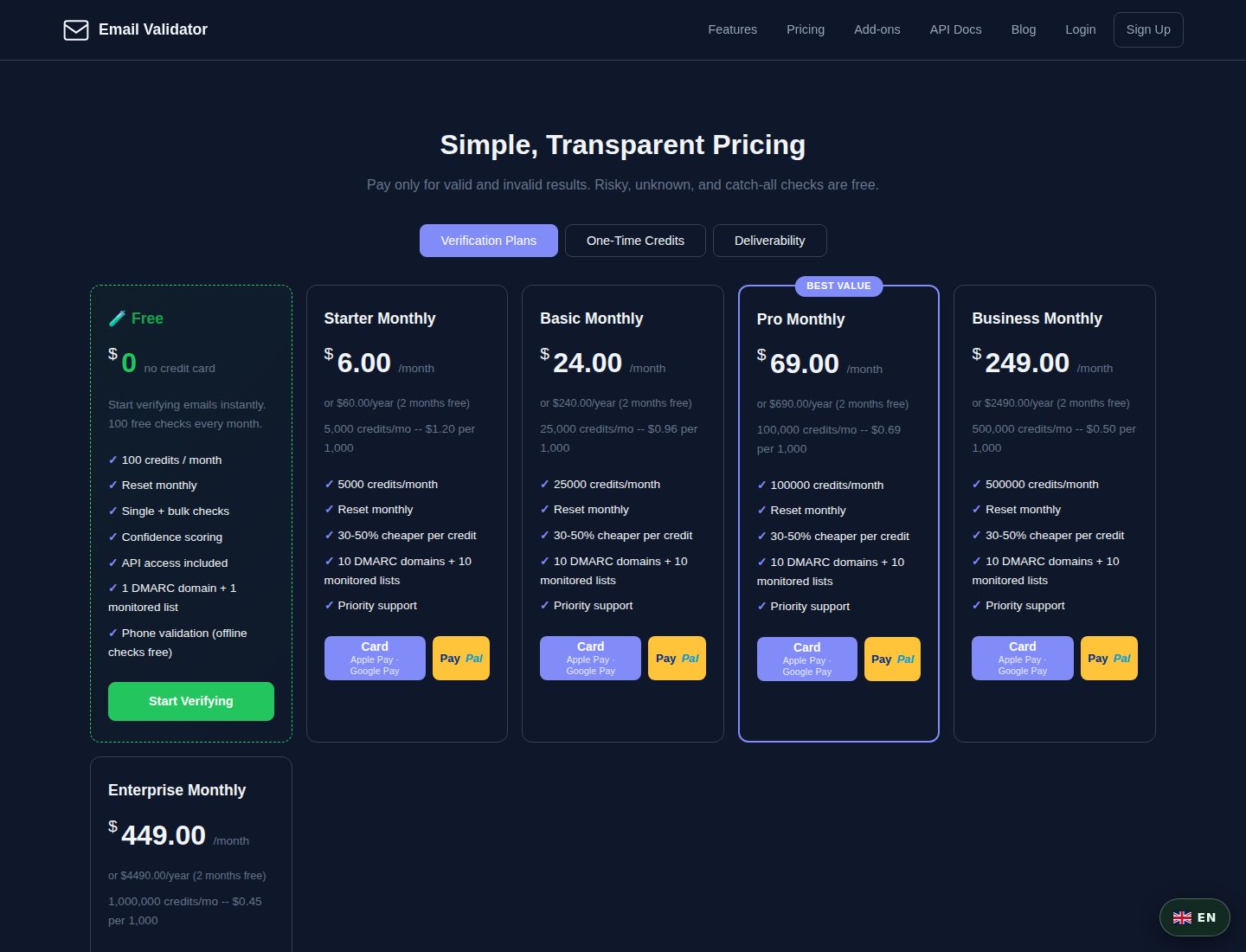
| Plan | Per month | Credits | Per 1,000 | What else changes |
|---|---|---|---|---|
| Free | 0 | 100 | - | 1 DMARC domain, 1 monitored list, API access |
| Starter | 6 USD (60 yearly) | 5,000 | 1.20 | 10 DMARC domains, 10 monitored lists |
| Growth | 24 USD (240 yearly) | 25,000 | 0.96 | 10 DMARC domains, 10 monitored lists |
| Scale | 69 USD (690 yearly) | 100,000 | 0.69 | 10 DMARC domains, 10 monitored lists |
Annual billing is two months free, so the yearly figures are ten monthly payments rather than twelve. The free tier is a hundred checks every month, not a hundred checks once, and it does not ask for a card.
There is a billing rule underneath that table which is the most important sentence on the pricing page, and it is easy to miss: only valid and invalid results are charged. Risky, unknown and catch-all checks are free. On a clean list this changes nothing, because almost every address resolves to valid or invalid. On a dirty list it changes the arithmetic a lot: if 20% of your list sits on catch-all domains, that fifth of the run costs nothing, and the effective price per deliverable address is lower than the sticker price per thousand.
That rule is also a fair way to sell verification, because it aligns the cost with the outcome: the provider is paid when it can say something definite, not when it shrugs.
What the numbers on the homepage mean
The homepage runs a live counter - at the time of writing it reported 53.4k emails verified today - and three claims next to it: 99.9% accuracy, under one second per check, and 2,000+ developers and marketers using it.
These are the operator's own figures, published by the operator, and this page is written by the operator. So read them the way you should read any vendor statistic: as a description of intent and volume, not as an independently audited result. Accuracy in this category is not a single number anyway - it depends on the list. A list of Gmail addresses verifies near-perfectly; a list of small-business addresses on catch-all domains cannot be verified perfectly by anyone, because the receiving server refuses to answer. Any provider quoting one accuracy figure across all lists is quoting an average, and the useful question is what the number is on *your* list.
Where it fits, and where it does not
It fits three jobs. Cleaning before a send - run the list, drop invalid, quarantine catch-all and unknown, and stop paying for bounces. Forms and signups - verify at the point of entry so a fake address never reaches the database. DMARC - monitor who is sending as your domain, which is the part most small senders skip until a spoofing report arrives.
It stops being the right tool in three cases. If your list is small and clean and you send once a quarter, the free hundred a month covers you and paying is unnecessary. If your problem is engagement rather than existence - real addresses that never open - verification will not help, because the address is genuinely valid. And if you need a deliverability consultant's judgement about content, sending volume and warm-up, that is a different service; this one answers a narrow question well.
How it compares in this category
The comparison worth making is not against a named competitor's price, because we have not tested one on the same list and quoting their sticker price would be guesswork. The comparison worth making is against the three things a small sender actually does instead:
| Approach | Cost | What it catches | What it misses |
|---|---|---|---|
| No verification | 0 | nothing | typos, dead domains, disposables, spam traps |
| Manual spot checks | your time | obvious typos | everything a human cannot see: MX, SMTP, catch-all |
| Bounce-driven cleanup | your sender reputation | addresses that already bounced | the first bounce, which is the one that hurts |
| Verification before sending | from 0.69 to 1.20 per 1,000 | the four categories above, before they hit a send | engagement, content, warm-up |
The last row is the only one where the cost is measurable in advance and the damage is prevented rather than repaired. A single bounce on a 5,000-address send is a rounding error; a list that is 12% invalid is a reputation problem that takes months to undo.
Questions we get
Is there a free plan? Yes - 100 checks a month, every month, no card. It includes API access and one DMARC domain.
What counts against a credit? Valid and invalid results. Risky, unknown and catch-all are free, which is why a messy list often costs less than the sticker price suggests.
Can it verify a catch-all address? No provider can, definitively: the server accepts everything, so there is nothing to ask. The honest output is "catch-all", and the decision to send or suppress belongs to you.
Does it replace DMARC setup? It monitors DMARC for domains you add and reports on alignment; you still have to publish the records. The monitoring is the part that tells you whether the records work.
Is the domain spelled correctly? It is spelled validaton, one i short. That is the product's name.
What we have not tested
This email validaton review is about our own product, so the list of what has not been tested is deliberately long:
- No independent benchmark. The 99.9% figure is ours, not an audit. A credible accuracy claim needs a labelled dataset, a stated method and a date; that work has not been done.
- No side-by-side test against another verifier on the same list, which is the only comparison a buyer really cares about.
- No deliverability A/B test - two identical campaigns, one to a verified list and one to an unverified list, measuring inbox placement rather than bounce rate.
- No latency measurement under load. "Under one second" is a typical figure, not a percentile; p95 and p99 on a 100k list is the number that would matter to an API customer.
- No SMTP behaviour study across providers - greylisting, rate limits and tarpitting vary by receiving server, and each one changes how a batch behaves.
- No test of what happens at the credit boundary - a run that exhausts the monthly allowance mid-list is a support question, not a marketing one.
When those tests exist, this page becomes a scored review with a stated method. Until then it stays unscored, and the disclosure at the top is the reason.
Bottom line
The pricing is the strongest part: a hundred free checks a month, 1.20 USD per thousand at entry, 0.69 at the top tier, annual billing that gives two months free, and a rule that only charges when the answer is definite. For a small sender cleaning a list before a campaign, the arithmetic is easy - one avoided bounce costs more than a thousand checks.
The weak part is proof. Every number on the homepage is published by the operator, and the operator writes this page, so the numbers describe ambition rather than an audited result. That is exactly why the page carries no score.
If you use it, start on the free tier with a slice of your real list, compare the catch-all and unknown counts against what your last campaign's bounces looked like, and decide from that rather than from the accuracy claim.
Every vendor link on this site is disclosed in the affiliate disclosure; a commission never changes a score. Our rules are in the editorial policy, and the rest of the reviews are in the review index.
Sources
All pages read on 19 November 2026:
- Email Validaton homepage: email-validaton.com - 99.9% accuracy claim, 53.4k verified today counter, under-one-second claim, 2,000+ users
- Pricing: email-validaton.com - Free 100/month, Starter 6 USD (5,000 credits, 1.20/1,000), Growth 24 USD (25,000, 0.96/1,000), Scale 69 USD (100,000, 0.69/1,000), annual two months free, billing rule for risky/unknown/catch-all
- Features: email-validaton.com - syntax, MX, SMTP handshake, catch-all, disposable, DMARC monitoring, phone validation, API














Reader reviews
Loading reader ratings...