
This Klaviyo review is about the platform that turned email marketing into a data product: 250 profiles free, then 25 USD a month for 500 profiles and 5,000 emails, with the price rising by profile count rather than by feature. It is the strongest e-commerce marketing tool in this comparison and the one where the bill can surprise a growing shop.
Prices are from klaviyo.com/pricing, read 24 November 2026, USD. No account was created, so this is a research-based review with no score - the rule is in how we test.
What Klaviyo is
An email and SMS platform built around a customer data model rather than a list. Every profile carries history - orders, browsing, past campaigns - and every message can be triggered by that history. The product grew out of e-commerce and still assumes a store, but the machinery underneath is what separates it: segmentation that answers "customers who bought twice, opened nothing in 90 days, and live in one region" without a query builder course.
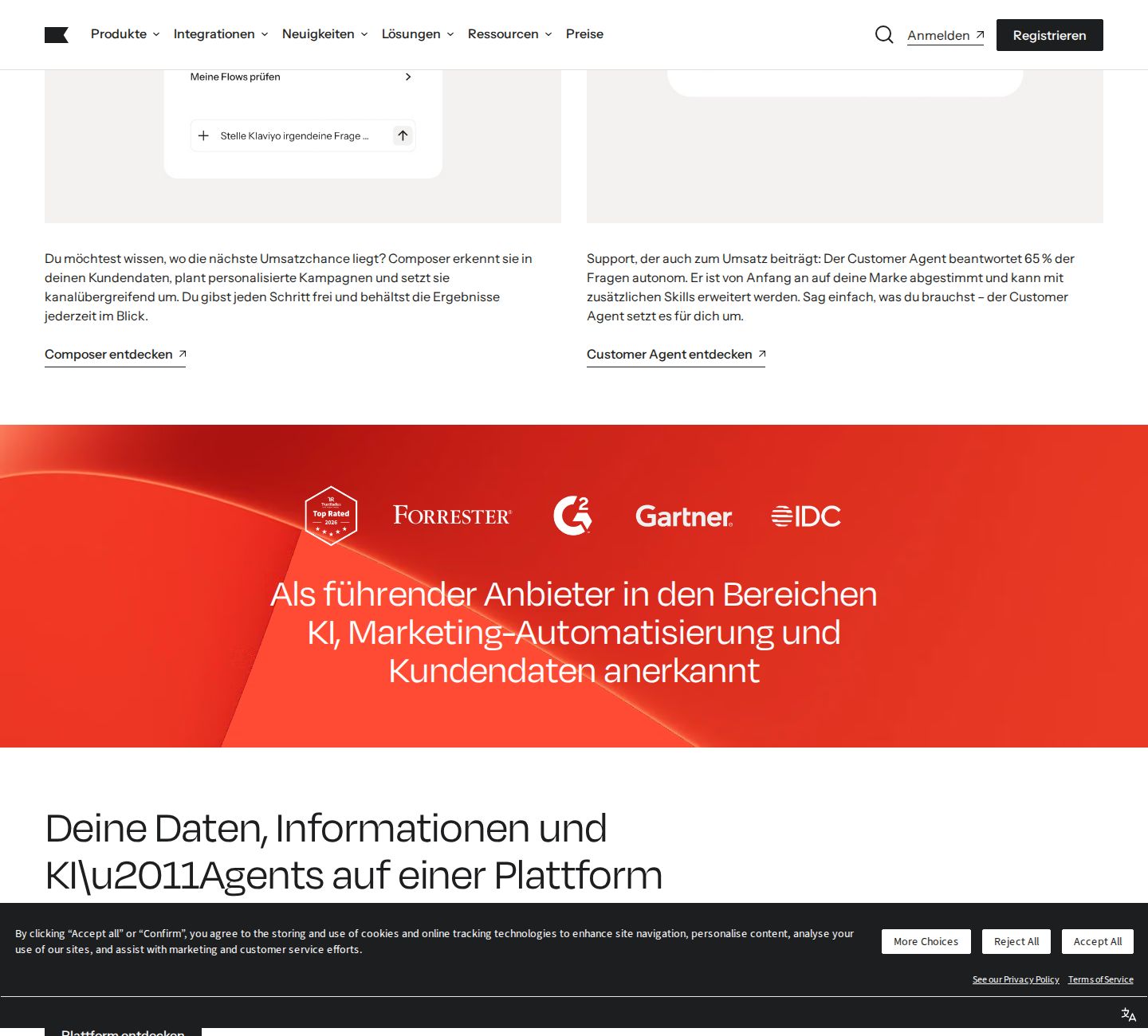
The newer layers are worth naming because they change the pricing discussion: Customer Hub (a customer service surface), Helpdesk, Reviews, Mobile app marketing and Customer Agent with AI resolutions. Klaviyo is no longer only email, and the free plan reflects that.
Pricing, precisely
| Plan | Price | Included |
|---|---|---|
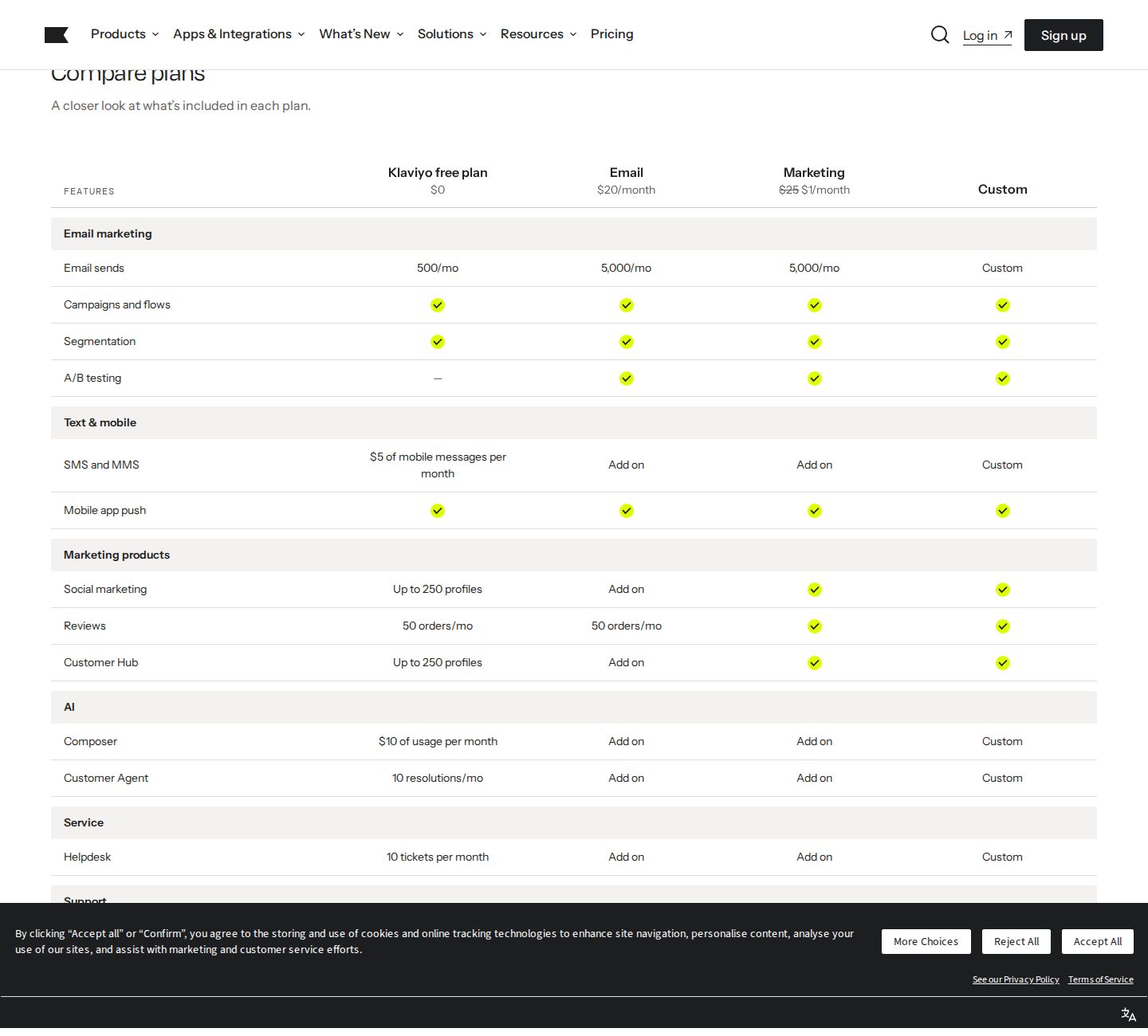
| Free | 0 | 250 active profiles, 500 emails/month, 10 AI resolutions, 50 review orders |
| Marketing | from 25 USD/mo | 500 profiles, 5,000 emails/month, scales with profile count |
| First month offer | 1 USD | for up to 5,000 active profiles, a limited-time promotion |
| SMS | $5 of mobile messages on Free | credits on paid plans |
The structure to understand is that the price is a function of active profiles, not of features: a 2,000-profile shop pays more than a 500-profile shop for the same product, and there is no way to buy the cheaper tier and stay on it while growing. That is fair - you are paying for the data you store and message - and it means the cost must be modelled against list growth, not against last month's invoice.
The free plan is unusually complete for 2026: 250 profiles, 500 emails, and small allowances for reviews, helpdesk and AI resolutions. It is enough to run a real flow on a new store, which is why so many Shopify shops start here.
What you are actually buying
Segmentation and flows built on purchase history. A welcome series, an abandoned cart, a browse abandonment, a win-back for lapsed buyers - each triggered by an event rather than a manual send. The templates are better than most, and the real value is that a segment can reference what someone bought, which a generic email tool cannot do without custom fields.
Reporting that survives a finance question. Revenue per message, per flow, per segment, attributed with a documented model. It is not perfect attribution, and it is consistent enough to argue about numbers with confidence.
The surrounding products. Reviews, helpdesk and AI resolutions sit on the same profile data, so a support ticket can see what the customer bought. For a shop consolidating tools, that is the argument for paying Klaviyo's rate rather than assembling three cheaper products.
What you do not get at these tiers is a human: support is documentation and email, and deliverability help is self-service. For a shop sending 5,000 emails a month that is fine; for one whose revenue depends on inbox placement, the lack of a deliverability consultant is the real gap.
Where it fails
- Profile-based pricing compounds. A shop that grows from 500 to 5,000 profiles pays multiples, and pruning a list is the only lever.
- The first-month dollar offer is a promotion for up to 5,000 profiles, not a price - the second invoice is the real number.
- Complexity. The interface assumes a marketer who will invest a week; smaller shops underuse it badly.
- Email sending limits are separate from contacts - 5,000 emails on the 500-profile plan is comfortable, and a big campaign can hit the ceiling.
- Store-first assumptions make it awkward for a publisher or a service business.
How it compares
| Free tier | Entry paid | Pricing unit | Consolidates | |
|---|---|---|---|---|
| Klaviyo | 250 profiles, 500 emails | 25 USD/mo | active profiles | email, SMS, reviews, helpdesk |
| Omnisend | 250 contacts, 500 emails | about 16 USD/mo after promo | contacts | email, SMS, push |
| Brevo | 300 emails/day | about 9 EUR/mo | emails | email, SMS, CRM |
| MailerLite | 1,000 subscribers | about 10 EUR/mo | subscribers | email only |
The choice between Klaviyo and Omnisend is a size decision dressed as a feature decision. Under a thousand contacts, Omnisend does the same job for less and includes push. Above a few thousand, Klaviyo's segmentation and reporting start returning more than the price difference - and its reviews and helpdesk modules remove subscriptions that would otherwise be paid separately.
Who should buy it
A Shopify or WooCommerce store past its first hundred orders. The data model earns its price once there is purchase history to segment on.
A shop consolidating tools. Email plus reviews plus helpdesk in one profile store is fewer logins and fewer exports.
A marketer who will use the depth. If someone owns email as a channel and will build flows, the product rewards that investment.
Who should not
A new store with 200 contacts - the free plan is enough, and paying 25 USD for segmentation you have no data for is premature. A publisher or a service business without a catalogue. And a shop that will not prune its list, because profile-based pricing punishes accumulation.
Questions people ask
Is the free plan really free? Yes: 250 active profiles, 500 emails a month, plus small allowances for reviews, helpdesk and AI resolutions.
How does the price scale? By active profiles - the 25 USD tier covers 500, and each band above that costs more.
What is the 1 USD first month? A limited-time promotion for up to 5,000 profiles; the following invoice is at the plan rate.
Are SMS included? There is a 5 USD allowance on the free plan and credits on paid plans; SMS is priced separately from email.
Can I send 20,000 emails on the 500-profile plan? No - email volume is capped per tier as well as profiles.
What we have not tested - and will
No account was created for this page. The checks that would produce a score:
- Deliverability into Gmail and Outlook on a warmed domain over a month
- Setup time for a standard four-flow e-commerce stack, measured in hours
- Whether the attribution numbers reconcile with Shopify's own reporting
- The price step from 500 to 2,000 profiles, checked in the checkout rather than the calculator
- Behaviour when the email cap is hit mid-campaign
- How the reviews and helpdesk modules compare with the dedicated tools they replace
- AI resolution quality on real refund and delivery questions
Bottom line
Klaviyo is the best e-commerce marketing platform in this comparison and priced like a data product: 25 USD a month for 500 profiles, scaling with the list, with reviews and helpdesk attached. For a store with real purchase history it pays for itself in segmentation and consolidated tools.
For a shop under a thousand contacts, Omnisend does the same work for less; for a publisher, a newsletter tool is cheaper still. Buy Klaviyo when the list is an asset worth modelling, not when it is a hope.
Every vendor link on this site is disclosed in the affiliate disclosure; a commission never changes a score. Our rules are in the editorial policy, and the rest of the reviews are in the review index.
Sources
All pages read on 24 November 2026:
- Klaviyo homepage: klaviyo.com - email and SMS with review, helpdesk and AI resolution products on the same profile data
- Klaviyo pricing: klaviyo.com - Free with 250 profiles and 500 emails, Marketing from 25 USD per month with 500 profiles and 5,000 emails, 1 USD first-month promotion for up to 5,000 profiles, 5 USD of mobile messages on the free plan














Reader reviews
Loading reader ratings...