

MailerLite is the email tool people recommend when the question is "which one will I actually use". This mailerlite review is about why the editor matters more than the feature list, what the free tier really allows, and the subscriber count where the pricing stops being friendly.
What MailerLite is
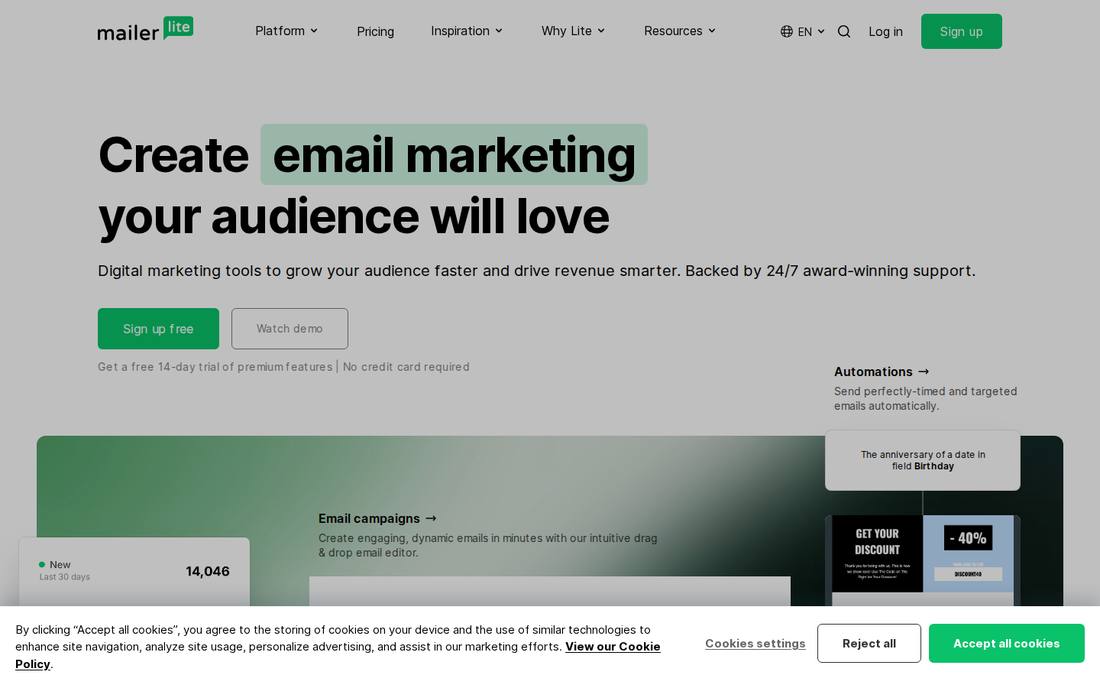
An email marketing platform with a smaller footprint than its competitors. Campaigns, automations, landing pages, popups, forms and a minimal website builder in one account, priced by subscriber count. The design is deliberately plain: fewer settings, fewer menus, and a default path that produces a good-looking email without a designer.
It is aimed at small businesses and creators - the same audience Brevo serves with a different pricing philosophy.
What you see before you sign up
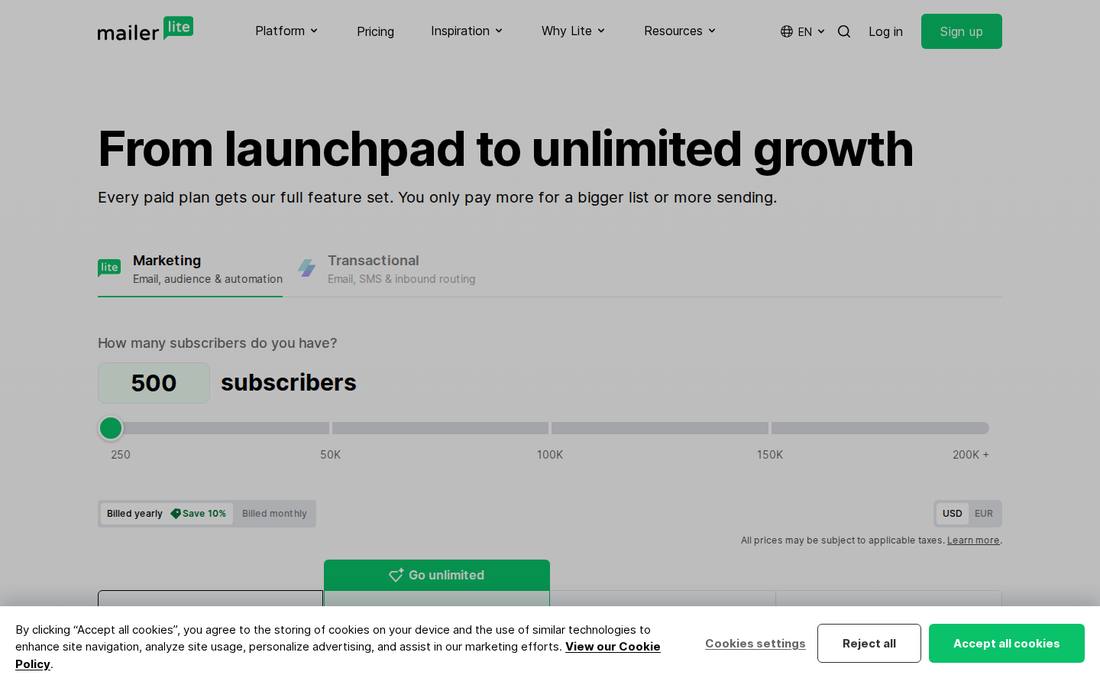
The pricing page is bands by subscriber count, with annual and monthly prices side by side, and a free tier stated plainly at 1,000 subscribers. That is a generous free plan by any measure, and it is capped by emails rather than contacts, which is the right way round for a small list.
We are not enrolled in MailerLite's affiliate programme, so nothing here earns a commission; the affiliate disclosure explains how that is marked if it changes.
What the free tier really allows
A thousand subscribers and 12,000 emails a month covers a weekly newsletter to 1,000 people three times over. The badge stays on the footer, and automation is limited, but nothing about the free plan expires or degrades. For a new site this is the strongest free tier in the category, and it is the reason MailerLite is the default recommendation for a first list.
The honest caveat: free does not include the automation branching that makes email marketing earn its keep. If your plan is "welcome sequence, abandoned cart, win-back", you will be paying by the second month.
The pricing ladder and where it turns
From 1,000 to 2,500 subscribers the price roughly doubles; from 2,500 to 10,000 it doubles again. A list of 5,000 mailed weekly costs more than the same list on Brevo, because Brevo counts sends and MailerLite counts people.
The crossover is the useful thing to know: below about 2,500 subscribers, subscriber pricing is predictable and cheap; above it, volume pricing wins unless you rarely mail.
Why the editor is the argument
Three things make it pleasant. Blocks behave predictably, so a two-column section does not collapse on mobile. The preview renders accurately in Gmail and Outlook, which is not universal. And a plain-text-looking newsletter takes ten minutes, which matters because plain newsletters get opened.
The templates are tasteful rather than distinctive. A brand with a strong identity will export from a design tool; everyone else will use the defaults and look fine.
Automation, honestly assessed
The builder handles the four sequences most small businesses need: welcome, product interest, re-engagement and a simple post-purchase follow-up. It does branching on a condition and delays, and it stops there. No scoring, no predictive sending, no CRM pipeline logic.
That is enough for a newsletter business and not enough for a sales team. If your automation needs to react to what somebody did on your site last Tuesday, this is the wrong product.
Where it fails
- Subscriber pricing at scale. A 10,000-person list costs several times what a volume-priced competitor charges.
- Automation ceiling. Good sequences, limited logic.
- No SMS or WhatsApp. One channel only.
- Landing pages are basic compared with a dedicated builder, though fine for lead capture.
- Reporting is summary-level; attribution beyond opens and clicks is thin.
Who it is for, and who should skip it
It fits creators, small shops and service businesses with a list under a few thousand, and anyone who wants to send the first campaign this afternoon without reading documentation. It fits a site that needs a landing page and a newsletter from one tool.
Skip it if the list is large, if the automation is the product, or if you sell across several channels and want SMS in the same account. And skip it if you need deep e-commerce flows - the cart recovery is there, the logic around it is not.
How it compares with the other three
Against Brevo, the trade is pricing model and polish: MailerLite is friendlier and counts subscribers, Brevo is cheaper per send and includes SMS. Against Mailchimp, MailerLite is cheaper at every band below 10,000 and less aggressive about upselling. Against ActiveCampaign, it is simpler by design and a third of the price; the automation gap is real, not marketing.
The category is compared on /category/email, and the test procedure behind a future score is in how we test.
The migration note
Imports preserve subscribers and tags; automations are rebuilt by hand, and landing pages do not transfer. Plan one send in parallel before switching, and export your old templates as HTML so you can paste them into the new editor rather than rebuilding from scratch.
What we have not tested - and will
Research-based review: public pages plus our own captures, no account. Open questions:
- Inbox placement for 500 recipients on the shared IP
- How many automation branches the free tier allows
- Real editor time for a 600-word newsletter with three images
- Landing-page conversion against a dedicated builder
- Price behaviour at 5,000 and 10,000 subscribers including annual discount
Bottom line
MailerLite is the right first email tool for a small list, and the free tier makes the decision nearly free. Stay until the list outgrows the bands or the automation outgrows the builder, then move to Brevo for volume or ActiveCampaign for logic.
The mistake to avoid is paying for a higher band before the list exists. Start free, send weekly, and let the subscriber count decide when to upgrade.
Sources
- mailerlite.com/pricing - subscriber bands, annual and monthly prices, read 13 November 2026
- mailerlite.com/features - editor, automation, landing pages, read 13 November 2026
- mailerlite.com/pricing - subscriber tiers and email limits, read 23 November 2026
Deliverability and the setup nobody reads
MailerLite asks for domain verification on day one and most people skip it, which is why their first campaign lands in promotions. Three records, twenty minutes, and the difference between the inbox and the tab nobody opens. The platform also enforces a soft double opt-in recommendation that reduces list size and improves engagement - a trade worth taking for a new site.
What the support is like
Live chat with humans on all tiers including free, which is unusual and is part of why the product feels smaller than its competitors. The answers are competent on the platform and honest about its limits; nobody will write your campaign for you.
A realistic first month
Week one: import, verify the domain, build one template, send to yourself and five friends. Week two: publish a signup form, send the first campaign to the real list. Week three: build the welcome automation. Week four: look at which subject lines were opened and write next month accordingly. That sequence costs nothing on the free tier and produces a working newsletter habit - which is the only thing that makes the tool worth paying for later.
The economics of a small list
Five hundred subscribers on the annual plan costs about 130 USD a year. If the newsletter sells a 50 USD product to one percent of the list once a quarter, that is 1,000 USD a year from a 130 USD tool, before counting the traffic the list sends back to the site. That ratio is why email remains the cheapest owned channel - and why the tool decision matters less than the sending habit.
A note on the website builder
It exists, it is included, and it is not the reason to choose MailerLite. For a one-page site tied to a newsletter it is adequate; for anything with structure, a real WordPress install is better. Treat it as a landing-page tool with delusions of a CMS, and use it accordingly.
The short version
Free until 1,000 subscribers, friendly editor, honest automation, and a price that stays reasonable until the list is large. If that describes your next year, buy it and stop comparing.
One last practical note: export your subscriber list once a quarter. Any platform can be migrated from a CSV in an afternoon; the habit costs nothing and removes the fear that keeps people on a tool they have outgrown.














Reader reviews
Loading reader ratings...