
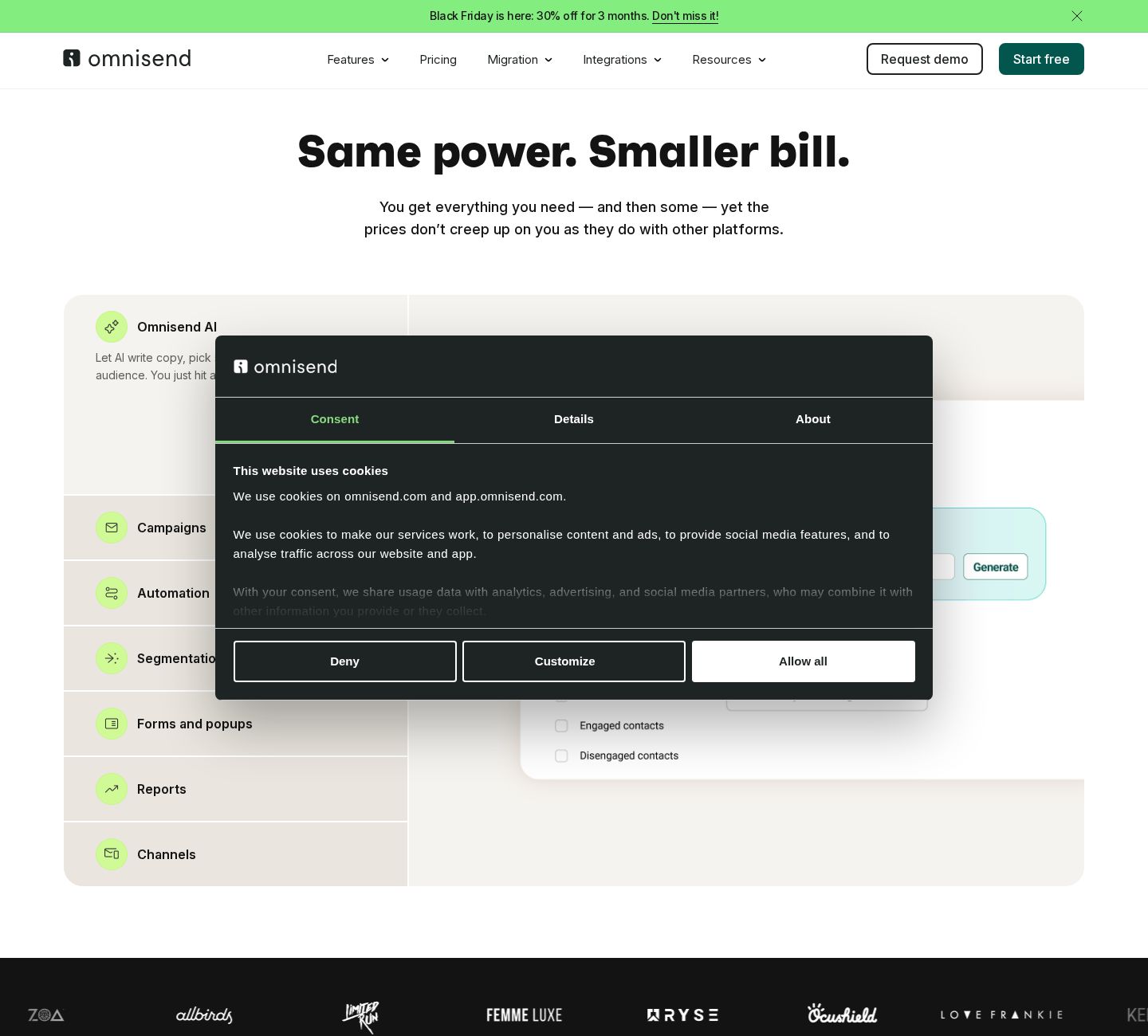
This Omnisend review is about the email platform built for shops: 250 contacts free, then a Standard tier that starts around 11 USD in the promo window and 16 USD after it, with SMS and web push bundled rather than bolted on. For a small store it is the most complete cheap option in this category, and the pricing is the part that needs reading.
Prices are from omnisend.com/pricing, read 24 November 2026, USD. No account was created, so this is a research-based review with no score - the rule is in how we test.
What Omnisend is
An email and SMS marketing platform with e-commerce as its centre of gravity. The product assumes you have a store - Shopify, WooCommerce, BigCommerce, Wix - and that the point of an email list is to sell to it. That assumption shows in the features: product pickers inside the email builder, abandoned cart and browse automations, customer segments based on what was bought rather than what was clicked, and revenue reporting that attributes orders to messages.
If your list is a blog newsletter, half of this is irrelevant. If you sell physical or digital products, it is the difference between a generic email tool and one that knows what is in the cart.
Pricing, precisely
| Plan | Price | Contacts | Emails |
|---|---|---|---|
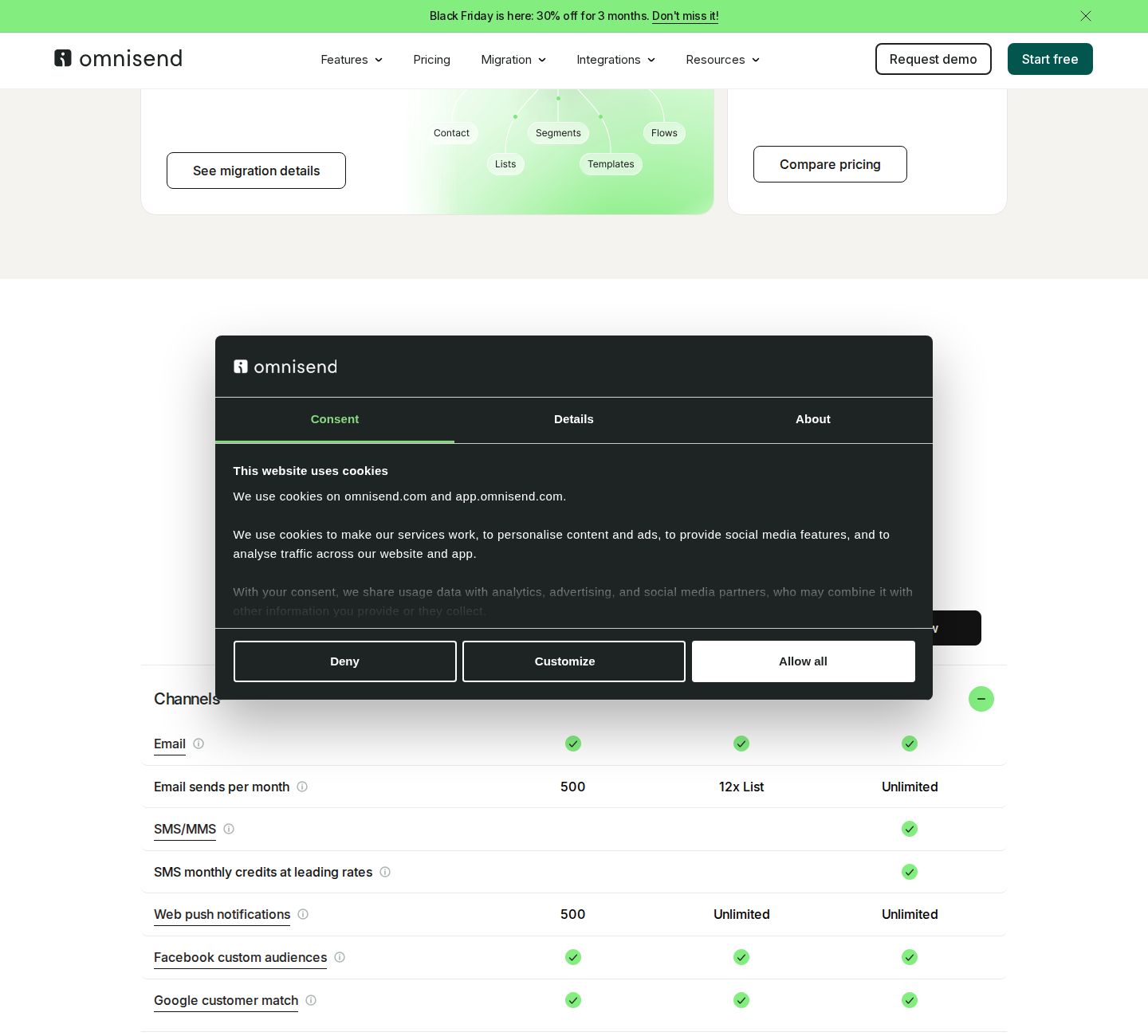
| Free | 0 | 250 | 500 per month, plus 500 web push |
| Standard | 11.20 USD/mo for 3 months, then 16 USD | 500 | 6,000 per month |
| Pro | 41.30 USD/mo | more | unlimited emails |
| SMS | from 0.007 USD per message | - | credits sold in bundles, e.g. 50 USD for about 5,900 |
The promo structure is the first thing to understand: Standard shows a discounted rate for three months, then reverts to the monthly price, and the page prints both numbers if you read the block rather than the headline. That is honest, and it is also exactly the shape of pricing that produces a surprise in month four for anyone who subscribed from a screenshot.
The second thing is the free tier's real ceiling: 250 contacts and 500 emails a month is a shop with a small list, not a demo - it can run a real abandoned-cart flow, which is more than most free plans allow.
What you get beyond sending email
Automations are the product. Welcome series, abandoned cart, browse abandonment, post-purchase follow-up, win-back - pre-built and editable without a workflow canvas that requires a course. For a small shop, the abandoned cart flow alone usually pays for the subscription in the first month, and Omnisend's version is configured from a template in minutes.
Product blocks inside emails pull live prices and images from the store, so a discount email does not go out with last week's price.
Web push is included, which is unusual - most competitors sell it as an add-on. For shops with mobile traffic, a push notification to a returning visitor costs nothing and converts better than another email.
SMS is priced per message from about 0.007 USD, sold in credit bundles. The arithmetic matters: 5,882 messages for 50 USD is under a cent each, which is competitive, and it is still the line that surprises people who assume SMS is included.
Where it fails
- The promo-then-price structure. Three months at 11.20, then 16 - small, and the kind of thing that erodes trust when discovered.
- Contact-based pricing scales fast. 500 contacts on Standard; a growing shop crosses that in a season and the next tier is a step, not a slope.
- Deliverability support is not white-glove at these tiers; you get the platform's reputation and documentation, not a person who will chase an ISP for you.
- The e-commerce focus cuts both ways. A newsletter-first business pays for store integrations it will never connect.
- SMS credits expire in bundles, so buy them against a campaign, not a year.
How it compares
| Free tier | Entry paid | SMS included | E-commerce focus | |
|---|---|---|---|---|
| Omnisend | 250 contacts, 500 emails | about 16 USD/mo after promo | credits from 0.007 USD | yes |
| Klaviyo | 250 profiles, 500 emails | 25 USD/mo | add-on | yes, deeper |
| Brevo | 300 emails/day | from about 9 EUR/mo | credits | partly |
| MailerLite | 1,000 subscribers | about 10 EUR/mo | no | no |
The comparison that decides most small-shop purchases is Omnisend against Klaviyo. Klaviyo is the stronger product for a serious store and costs more from the start; Omnisend is cheaper, simpler and includes push. Below 1,000 contacts, the cheaper one usually wins on value; above 5,000, the deeper one starts to pay for itself in segmentation.
Who should buy it
A small shop with a few hundred contacts. The free tier runs real automations, and Standard at 16 USD is a fair price once the list grows.
A store that wants push notifications without another vendor. The bundled web push is a genuine differentiator at this price.
A shop sending SMS occasionally. Per-message credits avoid a monthly SMS subscription for a Black Friday campaign.
Who should not
A newsletter publisher with no store - you are paying for cart integrations and product blocks you will not use. A larger store with complex segmentation needs, where Klaviyo's data model is worth the extra. And anyone who needs deliverability consulting rather than a platform.
Questions people ask
Is the free plan really usable? Yes: 250 contacts, 500 emails a month and 500 web pushes, with automations available - enough for a small shop to run a cart flow.
What happens after the promo? Standard reverts to the monthly price (16 USD in our reading); the discounted rate covers three months.
Is SMS included in the price? No - credits, from about 0.007 USD per message, bought in bundles.
Do push notifications cost extra? No, they are included on the free and paid tiers.
Is it good for a non-e-commerce list? It works, but the product is shaped for stores; a simpler newsletter tool is cheaper for that job.
What we have not tested - and will
No account was created for this page. The measurements that would produce a score:
- Deliverability into Gmail and Outlook on a warmed domain, measured over a month
- Whether the abandoned-cart template works out of the box on WooCommerce without custom code
- Revenue attributed to automations against a control month
- Contact-tier behaviour at 500 and the price step after it
- Web push opt-in rate on mobile traffic, which decides whether the feature is real
- SMS deliverability and the actual cost per delivered message
- How the segmentation builder handles a list with duplicate emails
Bottom line
Omnisend is the best value email platform for a small shop: 250 contacts free with working automations, about 16 USD a month for 500 contacts and 6,000 emails, push included and SMS priced per message. The promo-then-price structure is the only part that requires attention.
If you sell products and your list is under a thousand people, this is the sensible default. If you are a publisher, or you have outgrown contact tiers, look at a newsletter tool or at Klaviyo - and if you are just starting, the free plan is genuinely enough to find out whether email sells for you.
Every vendor link on this site is disclosed in the affiliate disclosure; a commission never changes a score. Our rules are in the editorial policy, and the rest of the reviews are in the review index.
One note on list hygiene
Both this platform and Klaviyo price by the number of contacts or profiles you store, which means a list is a bill as well as an asset. The habit worth building early is a quarterly prune: remove hard bounces, suppress anyone who has not opened in a year, and stop importing every giveaway signup into the main list. On a 5,000-contact list that discipline is worth more than any negotiation with the vendor, and it is the first thing an experienced operator does after switching.
Sources
All pages read on 24 November 2026:
- Omnisend homepage: omnisend.com - e-commerce email and SMS platform, automations, product blocks, web push
- Omnisend pricing: omnisend.com - Free with 250 contacts and 500 emails, Standard at 11.20 USD for three months then 16 USD with 500 contacts and 6,000 emails, Pro 41.30 USD with unlimited emails, SMS from 0.007 USD per message














Reader reviews
Loading reader ratings...